


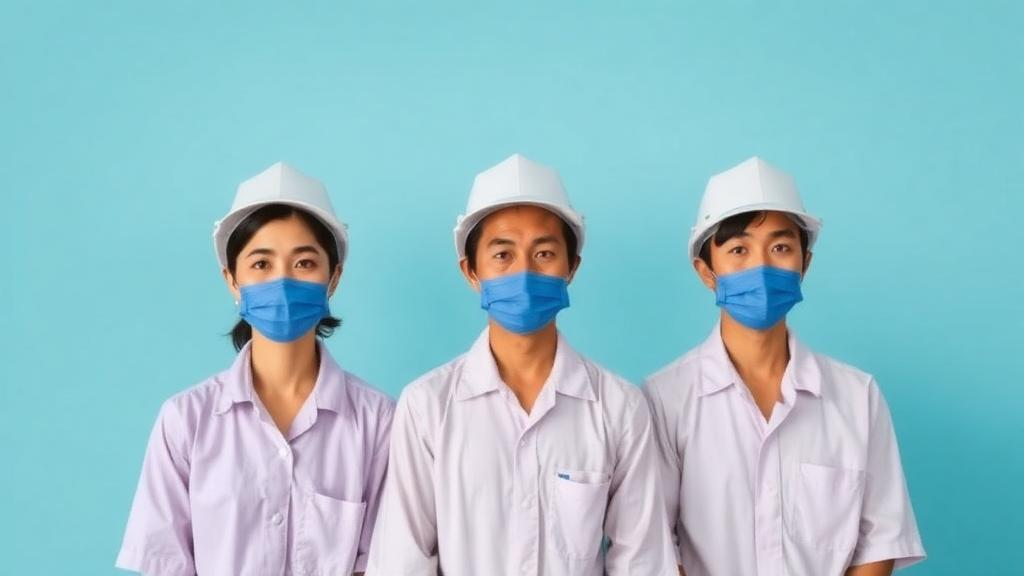
Every year, the world loses an estimated 12 billion working days to mental health problems, a figure that translates into staggering economic losses for employers, health systems, and families alike. While the burden is global, its distribution is far from even. Workers on factory floors, particularly in food manufacturing, contend with a distinctive cluster of psychosocial stressors: relentless production schedules, tight time constraints, repetitive tasks that offer little variation, and limited autonomy over how the work gets done. These conditions can quietly erode psychological wellbeing while simultaneously dragging down productivity, yet the evidence base for what actually helps such workers remains surprisingly thin. A new study protocol published in PLOS One by Wei Sen Yim and colleagues sets out to change that, describing a rigorously designed quasi-experimental trial of a structured Worksite Mental Health Program tailored to manufacturing settings in Malaysia.
The research team, drawn from Malaysian public health and occupational health institutions, argues that most of what we know about workplace mental health interventions comes from high-income countries and from office-based service sectors. Call-center employees, financial professionals, and knowledge workers have been studied extensively; assembly-line and production workers in middle-income economies have not. That gap matters because the interventions validated in one context may not transfer cleanly to another. A mindfulness app designed for remote workers with flexible schedules may be irrelevant to a machine operator locked into a fixed shift pattern. By focusing specifically on food manufacturing factories in Malaysia, the study aims to generate evidence that speaks directly to an industrial environment where psychosocial hazards are woven into the structure of the work itself.
The intervention at the heart of the trial is an eight-week Worksite Mental Health Program, or WMHP, built from four complementary components. Psychoeducation sessions aim to give workers a practical understanding of mental health, stress physiology, and early warning signs, helping to dismantle stigma and encourage help-seeking. Mindfulness practices train attention and present-moment awareness, techniques that have accumulated considerable evidence for reducing rumination and emotional reactivity. Progressive muscle relaxation guides participants through systematically tensing and releasing muscle groups, a method with a long clinical history for lowering somatic tension. Breathing exercises, finally, target the autonomic nervous system directly, offering workers a portable tool they can deploy during a stressful shift. Together, these elements form a low-cost, scalable package that does not require clinical staff to be present on site at all times.
Methodologically, the study adopts a quasi-experimental, two-arm, repeated-measures design. Rather than randomizing individuals, the researchers will compare workers who receive the WMHP with a comparison group that continues routine workplace practices and receives only a general mental health information pamphlet. This design reflects the practical realities of factory research, where randomizing individual workers within the same production line risks contamination, as participants share information and techniques with colleagues in the control condition. Assessments will occur at three time points: baseline before the program begins, one month after the intervention ends, and again at three months of follow-up. This repeated-measures structure allows the team to track not just whether outcomes improve, but whether any improvements persist once the structured program has concluded, a critical question for interventions that depend on sustained practice.
The outcome measures span both psychological and economic territory. The primary outcomes are depression, anxiety, stress, and burnout, the four pillars of occupational mental health research. Burnout deserves particular attention in manufacturing, where emotional exhaustion and reduced professional efficacy can compound the physical fatigue of production work. Secondary outcomes extend the picture into the workplace itself, capturing job satisfaction, absenteeism, and presenteeism, the phenomenon of employees showing up physically but functioning well below capacity. Presenteeism is notoriously difficult to quantify but may represent an even larger hidden cost than absenteeism, since a disengaged or distressed worker on the line can affect both output and quality. Economic outcomes round out the measurement framework, feeding directly into the study’s second major component.
That component is a formal cost-benefit analysis, a relatively rare feature in workplace mental health research, especially in middle-income countries. The economic evaluation will weigh the costs of delivering the program, including trainer time, materials, and the hours workers spend in sessions, against the monetary value of productivity gains, reduced absence, and improved performance. For policymakers and factory managers, this is arguably the most consequential part of the study. Mental health programs compete for resources with safety equipment, quality systems, and wage negotiations, and decision-makers often demand evidence that an investment in psychological wellbeing pays for itself. By quantifying the return on investment in a real industrial setting, the study could give occupational health advocates a powerful financial argument to accompany the humanitarian one.
On the analytical side, the researchers will employ Generalised Estimating Equations, a statistical framework well suited to repeated-measures data collected from the same individuals over time. GEE models account for the correlation between observations within each participant, producing more reliable estimates of how outcomes change across the three assessment waves and whether those changes differ between the intervention and comparison groups. This approach is robust even when outcome distributions deviate from normality, which is common with symptom scales that are often skewed in working populations. The combination of GEE for effectiveness analysis and cost-benefit analysis for economic impact gives the protocol a dual lens that few occupational mental health studies in the region have applied.
The anticipated results, as outlined by the authors, are that the program will improve mental health and work performance while simultaneously reducing absenteeism and presenteeism, and that the economic evaluation will demonstrate positive productivity gains associated with the intervention. Such findings would carry significance well beyond the participating factories. Malaysia, like many middle-income economies, has a large and growing manufacturing sector in which occupational health policy has traditionally emphasized physical safety, chemical exposure, and ergonomics. Psychosocial risk management has lagged behind, partly because local evidence has been scarce. A demonstrated, cost-effective mental health program designed for this exact context could inform national workplace health strategies and provide a template for neighboring economies with similar industrial profiles.
The study has been registered prospectively on the Thai Clinical Trials Registry under identifier TCTR20241217003, a step that strengthens transparency and helps guard against outcome reporting bias. Registration matters particularly for quasi-experimental designs, where the absence of randomization makes pre-specification of outcomes and analyses all the more important for credibility. If the trial delivers on its design, the resulting evidence would fill a conspicuous gap in the global literature, extending the reach of workplace mental health science from the offices of wealthy nations to the production lines of an emerging economy, and offering the roughly tens of millions of manufacturing workers worldwide a clearer answer to a question that affects 12 billion lost workdays a year: does investing in their minds pay off?
Subject of Research: A quasi-experimental trial evaluating the effectiveness and cost-benefit of a worksite mental health program among food manufacturing workers in Malaysia.
Article Title: Evaluating the effectiveness and cost–benefit of a worksite mental health program among manufacturing workers: A study protocol for a quasi-experimental study
Article References: Yim, W. S., Sundram, B. M., Azzeri, A., Lim, Y. C., Supramaniam, R. K., Vallasamy, S. K., & Hassan, S. N. (2026). Evaluating the effectiveness and cost–benefit of a worksite mental health program among manufacturing workers: A study protocol for a quasi-experimental study. PLOS One, 21(10), e0360481. https://doi.org/10.1371/journal.pone.0360481
Image Credits: AI Generated
DOI: 10.1371/journal.pone.0360481
Keywords: workplace mental health, manufacturing workers, Malaysia, quasi-experimental study, burnout, cost-benefit analysis, mindfulness, absenteeism, presenteism, occupational health, psychoeducation, PLOS One
Cite Scienmag News
Glenn Wilkins. (October 14, 2026). Eight-Week Program Puts Factory Workers’ Mental Health to the Test in Malaysia. Scienmag. https://scienmag.com/eight-week-program-puts-factory-workers-mental-health-to-the-test-in-malaysia/
Glenn Wilkins. "Eight-Week Program Puts Factory Workers’ Mental Health to the Test in Malaysia." Scienmag, 14 October 2026, https://scienmag.com/eight-week-program-puts-factory-workers-mental-health-to-the-test-in-malaysia/. Accessed 14 October 2026.
Glenn Wilkins. "Eight-Week Program Puts Factory Workers’ Mental Health to the Test in Malaysia." Scienmag. October 14, 2026. https://scienmag.com/eight-week-program-puts-factory-workers-mental-health-to-the-test-in-malaysia/


