


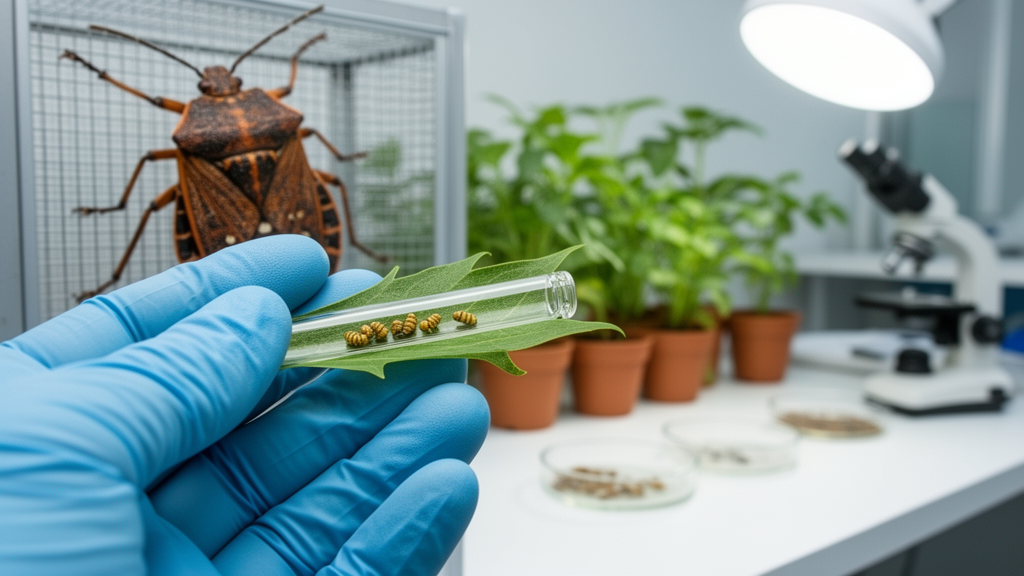
The Yellow Spotted Stink Bug, Erthesina fullo, is one of the most alarming invasive insects now spreading beyond East Asia, and a new comparative study published in NeoBiota has for the first time mapped the wasps that attack its eggs in both its native China and its newly colonized territory in Albania. The findings carry significant implications for the future of European fruit growing, because this polyphagous pest feeds on more than fifty plant species, including apples, cherries, pears and kiwifruit, piercing plant tissue and injecting phytotoxic saliva that produces necrotic lesions, fruit deformation and severe commercial losses. Understanding which natural enemies exploit the bug’s eggs, and how effectively they do so, is a critical first step toward predicting whether biological control can restrain an invasion that ecological niche models identify as highly suitable across large areas of Europe, the Americas and Oceania.
Erthesina fullo is native to East Asia, particularly China, where it has long been recognized as an economically significant pest. Its invasion history is remarkably well documented for a hemipteran. The earliest record outside the native range comes from Japan before 1775, apparently the oldest precisely localized invasion in the entire order. A single adult was intercepted in New Zealand in 2014, but the species failed to establish there. In 2017, however, the bug was found in Tirana, Albania, and subsequent observations confirmed a self-sustaining population. By 2020 it had been detected in Santos, São Paulo State, Brazil, with additional records in 2021 indicating successful establishment. Interceptions followed in the Czech Republic in 2023, in Rio in the Peloponnese near the port of Patras in October 2024, with iNaturalist reports from August 2025 suggesting local establishment in Greece, and in Spain in April 2025, although the Spanish record appears to represent a single interception rather than a breeding population.
The concern among entomologists is amplified by the bug’s ecological affinity with the Brown Marmorated Stink Bug, Halyomorpha halys, a fellow member of the tribe Halyini that shares its native range with E. fullo and has inflicted severe economic damage on fruit crops across North America and Europe. Given their biological and ecological similarities, researchers regard E. fullo as a species of significant concern for Europe, underscoring the urgency of strengthened surveillance and the investigation of potential control measures, particularly biological control using egg parasitoids.
In China, natural enemies of E. fullo include birds, mantids and spiders preying on nymphs and adults, and the fungus Beauveria bassiana infecting adults, but the egg stage is attacked by a complex of hymenopteran parasitoids spanning several families, including Trissolcus, Anastatus, Telenomus and Ootetrastichus species. In Europe, where E. fullo is a recent invader, resident pentatomid egg parasitoids could potentially adopt the new host through ecological fitting, a process documented after the introduction of H. halys, which was rapidly incorporated into the host range of the native Anastatus bifasciatus and adventive Trissolcus species. When the invaded habitat already contains a taxonomically and ecologically similar native host, the chances of native parasitoids adopting the newcomer are high, although adoption does not necessarily guarantee successful parasitoid development or adequate pest suppression. In Europe, the arboreal stink bug Apodiphus amygdali shares the same ecological niche as E. fullo and is its closest European relative, being the only other European member of the tribe Halyini, making it an ideal ecological analogue for comparison.
The research team surveyed field-collected egg masses of E. fullo in its native range in China and its invaded range in Albania, and egg masses of A. amygdali in kiwifruit orchards in Meliki, Imathia, Greece, across the summers of 2021 to 2024. In Beijing, E. fullo and H. halys egg masses were hand-collected between July and August 2025 on different host plants in agricultural landscapes, including apricot, squash and walnut. In Durrës, Albania, sampling took place from May to July 2024, corresponding to the peak oviposition period of E. fullo, with egg masses collected from trees planted along city streets, including large-leaved linden and sweetgum. All egg masses were stored individually in labeled ventilated vials under controlled laboratory conditions at 23 ± 5 °C, 70 ± 10% relative humidity and a 14L:10D photoperiod until all nymphs and parasitoids had emerged, after which the wasps were preserved in 70% ethanol and identified morphologically under a stereomicroscope.
Species identification combined classical morphology with DNA barcoding. Photographs of specimens were captured using a Canon 90D camera equipped with extension tubes and 5× and 10× Mitutoyo objective lenses, with image stacks processed and rendered with Zerene Stacker software. Identification of Trissolcus species followed established diagnostic treatments, while Anastatus species were identified using published keys. For molecular confirmation, DNA was extracted non-destructively from individual wasps and amplified and sequenced using standard DNA barcode primers LCO1490 and HCO2198. In a forensic approach, empty egg masses from which parasitoids had already emerged in the field were also analyzed to detect trace amounts of DNA belonging to both parasitoids and host species, using modified barcode primers that uniquely amplify members of the Pentatomidae and Scelionidae from the same egg, together with a set of PCR primers that uniquely amplify members of the genus Anastatus. All resulting sequences were deposited in the Barcode of Life Datasystems in the project EFUL, and screened through the BOLD ID engine to assign taxonomic classification.
The results reveal a striking contrast between native and invaded ranges. In China, 17 egg masses of E. fullo were collected, and parasitoids emerged from 10 of them, with 53% of all eggs parasitized. The parasitoid complex consisted of Trissolcus japonicus, recorded from five egg masses with an exploitation efficiency of 63.5 ± 33.4%, and Anastatus japonicus, obtained from four egg masses with an exploitation efficiency of 46.8 ± 41.7%. One case of multiple parasitoids associated with the same egg mass was observed, with one female of A. japonicus and 11 individuals of T. japonicus emerging together. Both species represent the first field evidence of these parasitoids attacking E. fullo eggs, since the suitability of the host for T. japonicus development had previously been demonstrated only under laboratory conditions. In the same region, three egg masses of H. halys yielded 25 T. japonicus individuals, corresponding to 39.7% of the eggs.
In Albania, 42 egg masses of E. fullo were collected, and parasitism was recorded in seven of them, representing 13.1% of all eggs, involving two native European species: Trissolcus saakowi, recovered from three egg masses, and Anastatus bifasciatus, from four. A total of eight emerged parasitoids were DNA barcoded, and molecular identifications were consistent with morphological identifications. Molecular screening of seven egg masses detected T. saakowi DNA in four, A. bifasciatus DNA in one, and two egg masses positive for both parasitoid species in the same egg and egg mass, providing evidence of multiparasitism at both the egg mass and individual egg level. Host DNA was detected in five of the seven egg masses and confirmed as E. fullo. These records represent the first natural enemies attacking E. fullo eggs anywhere in its invaded range. In Greece, egg masses of A. amygdali were exclusively parasitized by T. saakowi, with a parasitoid impact of 6.3% and an exploitation efficiency of 57.1 ± 30.3%.
Body size comparisons produced particularly interesting results. Females of T. japonicus emerging from E. fullo eggs were significantly larger than conspecifics emerging from H. halys eggs, with body length ranging from 1.52 to 1.80 mm in females from E. fullo, mean 1.67 ± 0.10 mm, compared with 1.10 to 1.20 mm from H. halys, mean 1.14 ± 0.03 mm, a difference confirmed by Welch’s two-sample t-test with t = 16.67 and P < 0.001. This pattern is consistent with previous evidence that host egg size influences adult body size in solitary scelionid egg parasitoids, and the values recorded here were considerably greater than previously reported for T. japonicus, suggesting that E. fullo eggs may allow the expression of exceptionally large phenotypes. In contrast, females of T. saakowi emerging from E. fullo and A. amygdali showed similar body sizes, with no significant difference between host species, and no consistent differences in external morphology were observed between specimens from the two hosts.
The findings support the hypothesis that ecological similarity between native and invasive hosts may facilitate the adoption of non-native hosts by native parasitoids. Trissolcus saakowi, widely distributed in the eastern Mediterranean and previously recorded from A. amygdali and Apodiphus integriceps, was found together with E. fullo feeding on Tilia and Platanus trees during surveys in Albania, and the overlapping habitat and close phylogenetic relationship of the two bug species are likely reasons why T. saakowi can adopt and develop on E. fullo, which was unexpected because many native European Trissolcus species cannot develop on H. halys eggs. The large females of A. bifasciatus obtained from E. fullo indicate that this host provides a resource level comparable to the largest hosts tested under controlled laboratory conditions, and since host egg size is a major determinant of adult body size, longevity and fecundity in this species, the results suggest that E. fullo eggs would enable A. bifasciatus to fully express its morphological and reproductive potential. Both the adventive T. japonicus, now established in several European countries including Switzerland, Italy, Germany, France, Serbia and Hungary, and the native A. bifasciatus and T. saakowi may contribute to the biological control of E. fullo in Europe, although their current impact appears limited. Continued monitoring of parasitoid communities associated with E. fullo in southeastern Europe will be essential to track these dynamics, assess the prospects and efficacy of resident natural enemies, and detect the potential unassisted arrival of adventive Asian parasitoids.
Subject of Research: Comparative study on the egg parasitoids of Erthesina fullo (Thunberg, 1783) ( Hemiptera , Pentatomidae ) in its native and invaded ranges
Article Title: Comparative study on the egg parasitoids of Erthesina fullo (Thunberg, 1783) ( Hemiptera , Pentatomidae ) in its native and invaded ranges
Article References: Tortorici, F., Flore, S., Gariepy, T. D., Andreadis, S. S., Maxwell, A., Zhang, J., Li, P., Ruiu, L., Tavella, L., Loru, L., & Haye, T. (2026). Comparative study on the egg parasitoids of Erthesina fullo (Thunberg, 1783) (Hemiptera, Pentatomidae) in its native and invaded ranges. NeoBiota, 108, 213-230. https://doi.org/10.3897/neobiota.108.193683
Image Credits: AI Generated
DOI: 10.3897/neobiota.108.193683
Keywords: Comparative, parasitoids, Erthesina, fullo, Thunberg, Hemiptera, Pentatomidae, native, invaded, ranges, scientific research
Cite Scienmag News
Alan Morgan. (October 17, 2026). Egg Parasitoids of Invasive Stink Bug Erthesina fullo Compared Across Native and Invaded Ranges. Scienmag. https://scienmag.com/egg-parasitoids-of-invasive-stink-bug-erthesina-fullo-compared-across-native-and-invaded-ranges/
Alan Morgan. "Egg Parasitoids of Invasive Stink Bug Erthesina fullo Compared Across Native and Invaded Ranges." Scienmag, 17 October 2026, https://scienmag.com/egg-parasitoids-of-invasive-stink-bug-erthesina-fullo-compared-across-native-and-invaded-ranges/. Accessed 17 October 2026.
Alan Morgan. "Egg Parasitoids of Invasive Stink Bug Erthesina fullo Compared Across Native and Invaded Ranges." Scienmag. October 17, 2026. https://scienmag.com/egg-parasitoids-of-invasive-stink-bug-erthesina-fullo-compared-across-native-and-invaded-ranges/


