

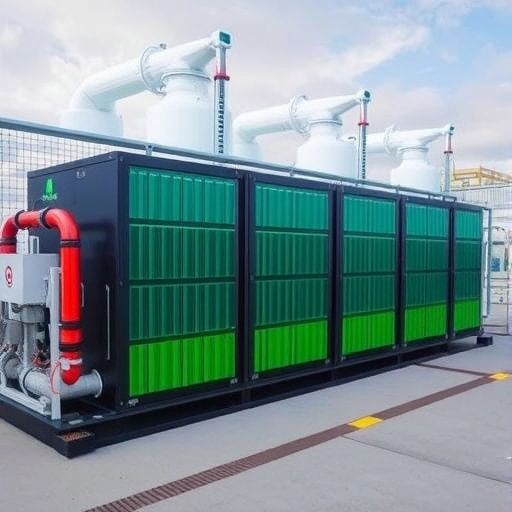
In a remarkable breakthrough for greenhouse gas mitigation, researchers have unveiled a revolutionary membrane contactor designed for carbon dioxide capture. This innovative approach promises to significantly enhance the efficiency and robustness of CO2 separation technologies, addressing one of the most pressing environmental challenges of our time. The focus of this cutting-edge research revolves around the development of a thin-film composite Janus membrane, which has been shown to possess unique properties that optimize the capture process.
The Janus membrane, characterized by its dual-functionalized surfaces, is at the heart of this study. Its asymmetric design allows for selective permeability, enabling it to facilitate the diffusion of carbon dioxide while effectively blocking other gases. This property is crucial as it amplifies the efficiency of CO2 capture, ensuring that the process is not only effective but also energy-efficient. The design of the membrane is a significant advancement over traditional membranes, which often struggle with selectivity and permeability trade-offs.
Through rigorous experimentation, the researchers demonstrated that this novel membrane contactor could operate under various conditions while maintaining its integrity and performance. This is particularly important in practical applications where varying environmental conditions can significantly affect the efficiency of CO2 capture technologies. The robustness of the Janus membrane ensures that it can function optimally across a range of temperatures and pressures, making it an ideal candidate for large-scale applications.
The scientific community has long recognized the necessity of advancing CO2 capture technologies to combat global warming. The thin-film composite Janus membrane offers a promising solution by not only improving capture rates but also lowering the overall energy consumption of the separation process. By utilizing this new membrane technology, industries that are major sources of CO2 emissions could potentially reduce their carbon footprint significantly, aligning with global sustainability goals.
One of the most compelling aspects of this research is the membrane’s ability to be integrated into existing infrastructure. This versatility means that various industries, including power generation and manufacturing, can adopt this technology without the need for extensive modifications to their current systems. As the world strives to meet ambitious carbon reduction targets, such innovations are vital in accelerating the transition to a low-carbon economy.
The performance metrics outlined in this study are exceptionally promising. Under controlled conditions, the Janus membrane exhibited remarkable efficiencies in CO2 capture that surpassed many conventional technologies. This groundbreaking achievement is expected to stimulate further research and development in membrane technologies aimed at enhancing carbon capture and storage systems globally.
Moreover, the research team emphasized the importance of scalability in commercial applications of the Janus membrane. Ensuring that this technology can be produced and deployed at scale will be crucial in the fight against climate change. The team has begun preliminary discussions with industrial partners to explore commercialization opportunities that could harness the full potential of this innovative membrane technology.
Public awareness of the environmental impacts of carbon emissions is on the rise, and this development could not have come at a better time. The pressing need for effective carbon capture solutions is becoming increasingly apparent, and the Janus membrane appears poised to play a pivotal role in addressing these challenges head-on. The implications of this research extend beyond the laboratory; they resonate with policymakers, environmentalists, and the general public alike.
The researchers, led by Zhou and colleagues, highlighted the collaborative nature of this project, which brought together expertise from various disciplines including materials science, chemical engineering, and environmental science. Such interdisciplinary efforts are vital in pushing the boundaries of current knowledge and developing practical solutions to complex global issues.
Moving forward, additional studies will be required to assess the long-term stability and performance of the Janus membrane under real-world conditions. Researchers are committed to investigating the durability of the membrane, which is critical to ensuring its effectiveness over time in industrial applications. Understanding how the membrane interacts with different gases and its behavior over extended periods will be essential to its success.
In summary, the introduction of the thin-film composite Janus membrane marks a significant step forward in carbon capture technology. Its unique design, combined with its robust performance characteristics, positions it as a game-changer in the ongoing battle against climate change. As industries seek new methods to reduce their carbon emissions, solutions like the Janus membrane could prove indispensable in achieving a sustainable future.
As the public and private sectors continue to prioritize sustainable practices, innovations like the Janus membrane will remain at the forefront of discussions about environmental responsibility. The future of energy production and consumption hinges on the successful implementation of effective carbon capture technologies, and the Janus membrane stands out as a beacon of hope in this critical endeavor.
The work of Zhou and colleagues serves as an impetus for further research, prompting scientists to explore even more advanced materials and designs for carbon capture. The team’s dedication to addressing one of humanity’s most significant challenges exemplifies the spirit of innovation that is needed as we forge ahead in the quest for a greener planet.
With renewed momentum in carbon capture technologies, the world may be on the brink of a transformative shift, fueled by scientific ingenuity and collaboration. The potential impact of these advancements could redefine our approaches to energy use and environmental sustainability, paving the way for a cleaner future.
In conclusion, the development of the robust and efficient membrane contactor showcases the power of scientific research to catalyze change. As we reflect on our responsibility to protect the planet, such innovations remind us of the possibilities that lie ahead when we harness technology for the greater good.
Subject of Research: Development of a thin-film composite Janus membrane for efficient carbon dioxide capture.
Article Title: Robust and efficient membrane contactor for carbon dioxide capture enabled by thin-film composite Janus membrane.
Article References:
Zhou, W., Su, C., Feng, D. et al. Robust and efficient membrane contactor for carbon dioxide capture enabled by thin-film composite Janus membrane. ENG. Environ. 20, 36 (2026). https://doi.org/10.1007/s11783-026-2136-6
Image Credits: AI Generated
DOI:
Keywords: Carbon capture, Janus membrane, thin-film technology, greenhouse gases, sustainability, environmental innovation.


