


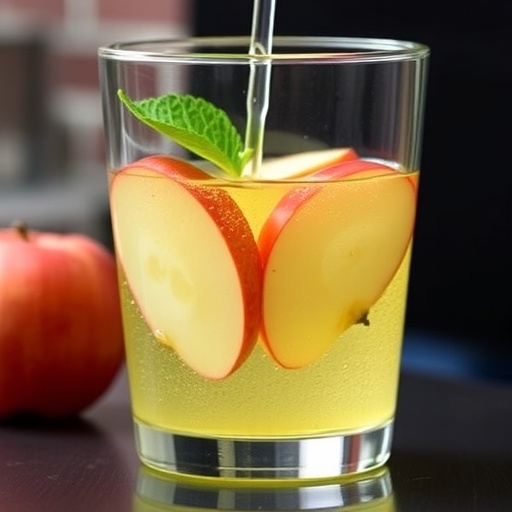
In the evolving realm of food technology, efficient and sustainable methods for juice clarification represent a focal point attracting significant scientific interest. A groundbreaking study by Mahmood-Fashandi, Khodaiyan, and Hosseini, published in Scientific Reports in 2026, introduces an innovative biotechnological advancement that promises to revolutionize the apple juice manufacturing industry. This research expertly integrates enzyme immobilization with novel reactor design, harnessing immobilized pectinase enzymes on glass surfaces within a uniquely devised support-free plate bioreactor. The result is a markedly enhanced apple juice clarification process, notable for both its technical sophistication and industrial relevance.
Fruit juice clarification is critical for improving both the aesthetic appeal and shelf stability of beverages, directly impacting consumer acceptance and marketability. Traditionally, clarification relies on enzymatic treatment to degrade pectin substances responsible for turbidity. Pectinase enzymes hydrolyze the pectic polysaccharides, thereby facilitating sedimentation and filtration of suspended particles. However, conventional enzyme application often suffers from limitations such as enzyme denaturation, difficulty in enzyme recovery, and operational inefficiency. The approach detailed by Mahmood-Fashandi et al. circumvents these issues through immobilization, a technique that binds enzymes to solid supports, enhancing enzyme stability and reusability.
Immobilization of enzymes on solid surfaces presents multiple advantages, including improved operational stability, ease of separation from the product, and potential for continuous processing. In this study, glass surfaces serve as an innovative support matrix due to their inert nature, mechanical strength, and chemical stability. The authors meticulously optimized the immobilization process, ensuring maximal enzyme activity retention while maintaining structural integrity of the glass interface. This immobilization strategy is pivotal, allowing the enzyme to retain catalytic proficiency during prolonged operation, thereby significantly extending the usability of the biocatalyst.
The hallmark of this research lies in the novel support-free plate bioreactor design. Unlike conventional packed-bed or stirred-tank reactors, this bioreactor advances a flat-plate configuration where immobilized enzymes adhere directly to glass plates without auxiliary support materials. Such a setup minimizes mass transfer limitations and optimizes enzyme-substrate interaction by maintaining a maximal surface-area-to-volume ratio. The innovative bioreactor design thus facilitates efficient contact between apple juice containing pectic substances and immobilized pectinase enzymes, leading to rapid and efficient clarification.
Technically, the operation of this bioreactor involves the continuous flow of raw apple juice over enzyme-laden plates, allowing the immobilized pectinase to catalyze the degradation of pectin molecules progressively. The substrate turnover is markedly improved due to minimized diffusion barriers. Additionally, reaction parameters such as pH, temperature, and flow rate were systematically examined and optimized to achieve peak enzymatic performance. This scientific diligence ensures that the process remains robust across typical industrial conditions, which often vary widely.
One of the most compelling outcomes highlighted in the study is the operational reusability of the immobilized enzyme system. The authors report minimal loss of catalytic activity across multiple continuous operation cycles. This sustainability feature translates directly into reduced enzyme consumption and lower operational costs while maintaining product quality. From an industrial perspective, such reusability paves the way for greener, more economically viable juice processing technologies, aligning with the global push for sustainable food production methods.
Furthermore, the clarity achieved in the apple juice processed with this system surpassed that of conventional enzymatic treatments. Turbidity measurements revealed significantly lower haze values, contributing to a brighter and more visually attractive final product. This improvement is not merely cosmetic; it reflects a higher degree of pectin degradation and particulate removal, ensuring a cleaner juice matrix with extended shelf life. The superior clarification capability achieved enhances consumer confidence and could motivate widespread adoption within the beverage industry.
The study also delves into the biochemical stability of immobilized pectinase during the clarification process. Unlike free enzymes which are prone to rapid inactivation under operational stresses, the immobilized form exhibited heightened resistance to denaturing agents and thermal fluctuations encountered during juice processing. This stability is attributed to the restrictive microenvironment afforded by the glass surface and the absence of support matrices that may provoke unfavorable enzyme conformational changes. This discovery underscores the potential of immobilized enzymes to overcome traditional limitations encountered in bioprocess applications.
Scaling this technology from laboratory to industrial scale is another significant aspect addressed by Mahmood-Fashandi and colleagues. The modular nature of the support-free plate bioreactor design facilitates scalability, accommodating varying juice processing capacities without compromising enzymatic efficiency. The simplicity of the reactor geometry enables easy maintenance, cleaning, and integration into existing production lines, traits highly valued by manufacturers. This adaptability enhances the commercial feasibility of the technology, providing a concrete pathway from innovation to market.
Environmental implications are profoundly positive when comparing this immobilized enzyme reactor to traditional juice clarification approaches relying on chemical fining agents or extensive filtration. By minimizing the need for consumable inputs and reducing waste generation, the bioreactor aligns well with sustainability goals. Additionally, the enzymatic degradation route is inherently biodegradable and avoids synthetic additives, catering to an increasingly health- and environment-conscious consumer base. This research, therefore, not only advances industrial biotechnology but also contributes to ecological stewardship.
Scientific enthusiasm around enzyme immobilization stems from the broader implications this study presents. Beyond juice clarification, the underlying principles can be extrapolated to other fruit juices, beverages, and even non-food related bioprocesses involving polysaccharide degradation. The effective immobilization on inert glass surfaces coupled with an innovative bioreactor design opens avenues for customizing enzyme reactors tailored for diverse substrates and applications, potentially transforming the biocatalytic landscape.
The researchers employed advanced characterization techniques to monitor enzyme attachment and activity post-immobilization. Surface analysis via microscopy and spectroscopic methods confirmed the uniform enzyme distribution and adherence on glass plates. Enzymatic assays quantified activity retention, revealing remarkable catalysis conservation. These analytical evaluations underscore the rigorous experimental framework underpinning the study, providing confidence in the reported results and facilitating replication or further development by researchers and engineers.
In conclusion, this salient work by Mahmood-Fashandi, Khodaiyan, and Hosseini marks a significant stride towards enhancing juice processing technology through ingenuity in enzyme immobilization and reactor design. The support-free plate bioreactor epitomizes a harmonious fusion of bioengineering and process innovation, delivering superior apple juice clarification with robust industrial applicability. The research combines scientific rigor, environmental consciousness, and economic sensibility, positioning it as a flagship development poised to impact beverage manufacturing profoundly.
As the global food industry grapples with consumer demand for higher quality and sustainability, such biotechnological innovations are pivotal. This research serves as a blueprint for future endeavors aiming to exploit immobilized enzymes more broadly, not only improving product quality but also fostering greener industrial practices. With ongoing advancements, the ideal of cost-effective, sustainable, and efficient juice clarification is progressively becoming a commercial and ecological reality.
Cite Scienmag News
Denise Maddox. (May 27, 2026). Efficient Apple Juice Clarification via Glass-Immobilized Pectinase. Scienmag. https://scienmag.com/efficient-apple-juice-clarification-via-glass-immobilized-pectinase/
Denise Maddox. "Efficient Apple Juice Clarification via Glass-Immobilized Pectinase." Scienmag, 27 May 2026, https://scienmag.com/efficient-apple-juice-clarification-via-glass-immobilized-pectinase/. Accessed 3 September 2026.
Denise Maddox. "Efficient Apple Juice Clarification via Glass-Immobilized Pectinase." Scienmag. May 27, 2026. https://scienmag.com/efficient-apple-juice-clarification-via-glass-immobilized-pectinase/


