

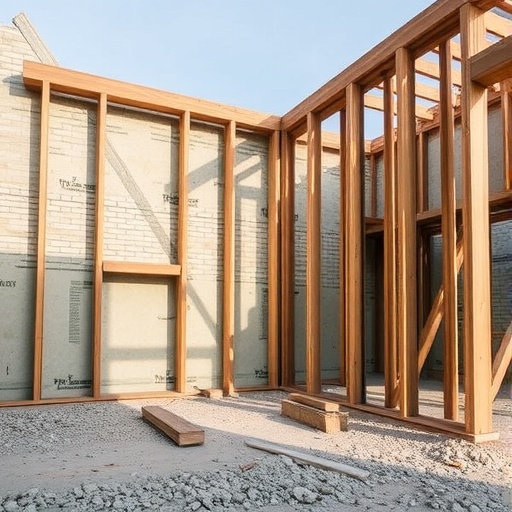
In the realm of civil engineering and earthquake resilience, a pivotal study has emerged that promises to reshape our understanding of structural performance during seismic events. Ö.F. Nemutlu’s research, anchored in the analysis of infill walls and their effect on reinforced concrete (RC) frame buildings, explores the intricacies of building behavior under the extreme conditions of near-fault earthquakes. This investigation draws on data from the significant Kahramanmaras earthquake, providing a robust empirical framework for evaluating structural integrity during potential seismic crises.
The impact of infill walls on RC frame buildings has been a topic of ongoing research, especially since these walls are often utilized for their cost-effectiveness and ease of construction. However, their role during seismic activities has created a divide among engineers and researchers. Some advocate for their use, while others warn of their potential to adversely affect the overall dynamics of buildings during tremors. Nemutlu’s work takes a closer look at this dichotomy, intending to bridge gaps in current knowledge and provide actionable insights for engineers.
Near-fault earthquakes, characterized by their proximity to the fault line at which they occur, present unique challenges not commonly experienced in distant seismic events. These earthquakes can generate ground motions that possess both high frequency and significant amplitude, often leading to increased pressure on structures. During such events, conventional engineering approaches may falter, making the study of structural responses critical. Nemutlu’s research thus becomes a fundamental reference point, addressing the complexities inherent in building design under these hazardous conditions.
The study meticulously details the methodologies employed in analyzing the responses of various RC frame structures with differing configurations of infill walls. By utilizing data from the Kahramanmaras earthquake—a notably impactful seismic event—Nemutlu provides a real-world context that enhances the significance of the findings. Advanced computational modeling techniques were utilized to simulate the seismic behavior of the structures, allowing for a comprehensive assessment of their responses under varying conditions of stress and strain.
One of the noteworthy outcomes of the study is the identification of specific configurations of infill walls that can considerably enhance the seismic performance of RC frame buildings. Rather than being a mere adjunct to the structural frame, these walls can act to stabilize the building under impending seismic loads. The research identifies optimal placements and materials that maximize energy dissipation during an earthquake, promoting better overall building performance.
Furthermore, the study highlights that while infill walls can provide significant benefits, their performance is largely contingent on the quality of materials and construction practices employed. Structural engineers are urged to prioritize robust construction standards when integrating infill walls into their designs, as subpar materials can negate the advantages these walls may offer. The detailed recommendations provided in the research guide engineers in making informed decisions regarding material selection and structural configuration.
In exploring the dynamics between infill walls and structural performance, Nemutlu’s work also calls attention to the importance of continuous monitoring and assessment of building integrity post-earthquake. Establishing post-event protocols for assessing damage ensures that buildings maintain their safety for occupants. Researchers and engineers alike are encouraged to develop and refine techniques for rapid evaluation of structural conditions following seismic events to maximize safety.
As the field of earthquake engineering continues to evolve, Nemutlu’s findings contribute to the development of new guidelines and standards aimed at enhancing building resilience. Policymakers and building codes may soon reflect the insights garnered from this significant study, with the potential for improved construction practices that ensure safer communities in earthquake-prone regions.
Additionally, the implications of the study extend beyond mere structural performance. The discussion around infill walls touches on life safety, economic recovery, and the resilience of urban environments, emphasizing that sound engineering decisions can substantially mitigate the impacts of earthquakes on societies as a whole. By fostering a deeper understanding of infill wall dynamics, engineers can better contribute to designing structures that protect lives and minimize loss.
As communities around the globe remain vigilant in preparing for the next seismic event, the findings of Nemutlu’s study resonate with urgency and importance. With every new advancement in understanding earthquake dynamics, there comes an opportunity for innovation in civil engineering. Emphasizing research-driven approaches will ensure that future structures are not just built to code but are genuinely resilient against the uncertainties posed by nature.
In conclusion, Ö.F. Nemutlu’s study is not just an academic pursuit; it is a clarion call for the engineering profession to reassess and refine its approaches to building design in seismically active regions. With its rich data and comprehensive analysis, the research stands as a significant milestone, reinforcing the need for continuous exploration in the face of nature’s unpredictable forces. It pushes the envelope of engineering practice, paving the way for advancements that could one day save countless lives during seismic activities.
Subject of Research: Impact of infill walls on RC frame buildings under near-fault earthquake conditions
Article Title: Analyzing the impact of infill walls on RC frame building behavior under near-fault earthquake conditions: A study using Kahramanmaras earthquake data.
Article References:
Nemutlu, Ö.F. Analyzing the impact of infill walls on RC frame building behavior under near-fault earthquake conditions: A study using Kahramanmaras earthquake data.
Earthq. Eng. Eng. Vib. 24, 993–1014 (2025). https://doi.org/10.1007/s11803-025-2346-0
Image Credits: AI Generated
DOI:
Keywords: Earthquake engineering, reinforced concrete, infill walls, seismic performance, building resilience, Near-fault earthquake analysis, Kahramanmaras earthquake, structural performance.


