


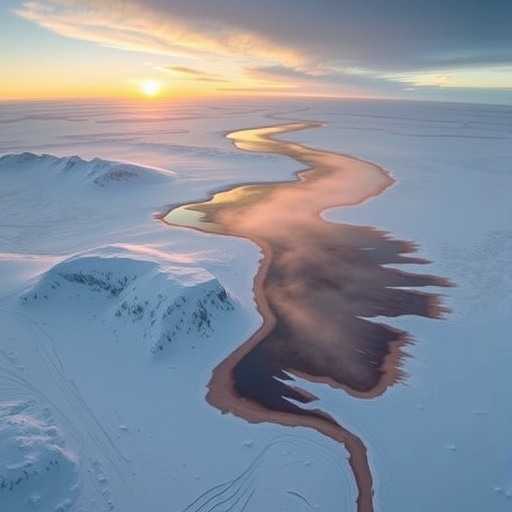
In a groundbreaking study published in Nature Communications, researchers have unveiled new insights into the climatic dynamics of the Late Pleistocene by analyzing ice wedges from East Siberia. The study provides a detailed record of dust transport variability, shedding light on atmospheric circulation patterns and environmental changes that occurred tens of thousands of years ago. The scientists employed state-of-the-art isotopic and geochemical analyses on ice wedge samples, offering an unprecedented view into the past conditions of the Arctic and their broader implications for global climate history.
Ice wedges, large wedges of ice formed in permafrost regions during cold periods, act as natural archives of past atmospheric conditions. The study by Kim, Lee, Kim, and colleagues focused on these ice wedges as a means to reconstruct dust fluxes and sources throughout the Late Pleistocene. Their meticulous sampling across East Siberia harnessed stratified ice layers that have preserved particulate matter and gases entrapped over millennia. The fine dust particles found within these ice formations serve as proxies for understanding regional wind regimes and the intensity of aeolian processes during glacial-interglacial cycles.
The Late Pleistocene epoch, which spans from around 126,000 to 11,700 years ago, was marked by dramatic climatic fluctuations, including the last glacial maximum. Researchers have long sought to decode how dust transport pathways and deposition rates responded to these climatic shifts, yet direct evidence from high-latitude permafrost zones has been scarce. This investigation fills a critical gap by offering a continuous and robust record from Siberia’s coldest regions. The dust particle composition and concentration within ice wedges demonstrate significant variability tied to climatic events, such as stadials and interstadials, that characterize this epoch.
Key findings reveal that during colder intervals, increased dust deposition corresponds with intensified katabatic winds descending from the frigid continental interiors. These winds transported mineral dust over vast distances, altering the Arctic’s radiative balance by increasing surface albedo and influencing atmospheric chemistry. Conversely, warmer phases saw reduced dust fluxes, indicating weakened wind systems and shifts in source regions that reflected changes in atmospheric circulation patterns, including the position of the westerly jet stream and Siberian High.
By coupling isotopic signatures of oxygen and hydrogen in the ice with geochemical fingerprinting of dust particles, the team could discern subtle variations in moisture sources and dust provenance. For example, elevated ratios of heavier oxygen isotopes suggest warmer atmospheric temperatures at certain intervals, correlating with dust influx minima. Elemental analyses pinpointed dominant dust sources originating from central Asian deserts and adjacent periglacial zones, which acted as dust reservoirs under glacial conditions. Such multi-proxy approaches highlight the complex interactions between terrestrial dust supply, atmospheric transport pathways, and climatic oscillations.
Implications of this research extend beyond paleoclimate reconstruction. Understanding dust dynamics during the Late Pleistocene informs models of particulate matter’s role in Earth’s energy balance. Dust affects cloud nucleation, solar radiation scattering, and nutrient supply to oceanic ecosystems, all vital components of the climate system. The Siberian ice wedge record thus provides a calibration point for climate simulations that seek to project future changes in polar environments amid ongoing anthropogenic warming.
The meticulous methodology involved precise core drilling into ice wedges followed by contamination-free sampling under ultra-clean laboratory conditions. Advanced mass spectrometry techniques enabled measurement of isotope ratios and elemental concentrations at high resolution. The integration of remote sensing data and climate model outputs contextualized these empirical findings within broader atmospheric circulation frameworks. The interdisciplinary nature of the work underscores how combining fieldwork, laboratory science, and computational modeling fosters new discoveries in Earth system science.
Moreover, the study underscores the vulnerability of permafrost landscapes to ongoing climate change. Ice wedge degradation due to warming threatens to erase these invaluable paleoenvironmental archives, emphasizing the urgency of acquiring and preserving such data. The authors advocate for expanded monitoring networks across Arctic permafrost regions to capture rapid environmental shifts and better understand the feedback loops linking ice, dust, and climate interactions.
In conclusion, the analysis of East Siberian ice wedges offers a transformative window into Late Pleistocene dust transport variability. This work not only enriches our understanding of ancient atmospheric dynamics but also enhances predictive capabilities for future climate scenarios. As the Arctic continues to warm at unprecedented rates, insights gleaned from past dust cycles serve as crucial analogs for anticipating ecological and climatic responses in polar regions.
This landmark research stands as a testament to the power of combining cryospheric studies with geochemical detective work, advancing the frontier of climate science. As dust remains a key component of Earth’s climate engine, unraveling its past behavior is pivotal for navigating the challenges of a changing planet.
Cite Scienmag News
Violet Maxwell. (November 10, 2025). East Siberian Ice Wedges Reveal Dust Transport Changes. Scienmag. https://scienmag.com/east-siberian-ice-wedges-reveal-dust-transport-changes/
Violet Maxwell. "East Siberian Ice Wedges Reveal Dust Transport Changes." Scienmag, 10 November 2025, https://scienmag.com/east-siberian-ice-wedges-reveal-dust-transport-changes/. Accessed 4 September 2026.
Violet Maxwell. "East Siberian Ice Wedges Reveal Dust Transport Changes." Scienmag. November 10, 2025. https://scienmag.com/east-siberian-ice-wedges-reveal-dust-transport-changes/


