


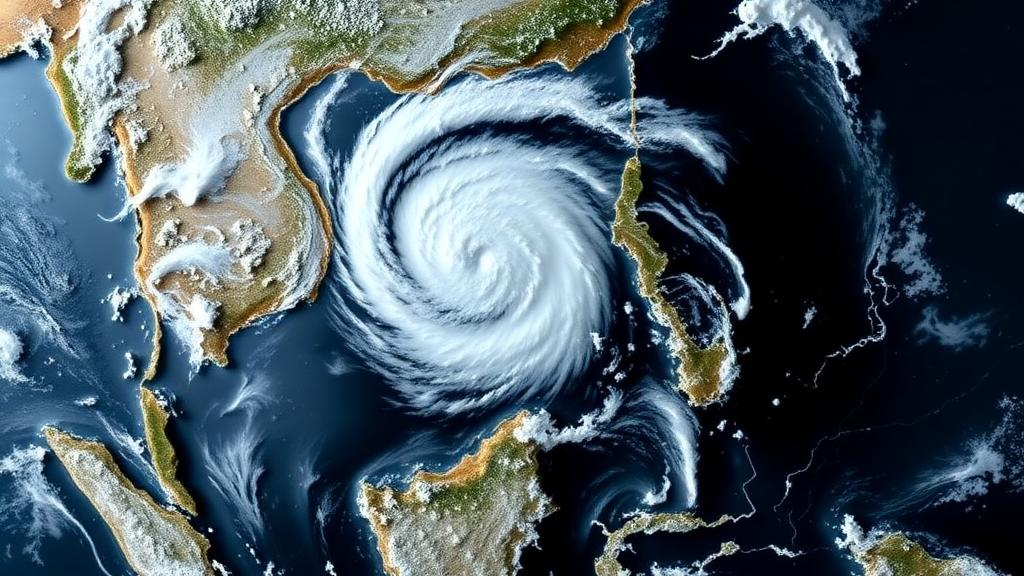
Tropical cyclones are born in the warm waters of the tropics, but they do not always stay there. A new analysis of more than four decades of storm records suggests that, along the coastlines of East Asia, the geography of typhoon danger is quietly but steadily migrating toward the north. The finding, published in the peer-reviewed journal Advances in Atmospheric Science, is less a story about more storms and more a story about where those storms are increasingly likely to strike, and how little warning they may give when they do.
The research team, led by Jia Sun of the First Institute of Oceanography under China’s Ministry of Natural Resources, examined tropical cyclone activity across the western North Pacific from 1980 to 2025. This basin is the most active tropical cyclone region on Earth, generating more named storms in an average year than any other ocean basin, and it is the source of nearly every typhoon that threatens eastern China, the Korean Peninsula, and the Japanese archipelago. By tracking where storms formed, the paths they followed, and the points where they made landfall, the researchers assembled one of the most detailed pictures yet of how the region’s coastal hazard landscape is changing.
The central result is a redistribution rather than a simple intensification. South of 20 degrees north latitude, the likelihood that a tropical cyclone would make landfall declined over the study period. North of 30 degrees north, the likelihood increased. That northern band broadly encompasses parts of eastern China, the Korean Peninsula, and Japan, meaning that communities which historically sat at the margins of the typhoon belt are now finding themselves closer to its center of gravity. At the same time, storms have tended to form farther to the northwest, to follow tracks that are both more landward and more poleward, and to move modestly faster along their journeys toward the coast.
One of the most consequential numbers in the study concerns time. The average duration that landfalling cyclones spent over the ocean fell from roughly 5.6 days in the 1980 to 2015 period to about 4.7 days in 2016 to 2025. That difference of nearly a full day may sound abstract, but it has direct operational meaning. A storm that forms closer to shore and races toward the coast more quickly compresses the window available for forecasters to issue warnings, for emergency managers to position resources, and for residents to evacuate or shelter. In densely populated coastal megacities, where evacuation logistics are measured in hours and days, a shortened lead time can translate directly into greater human risk even if the storm itself is no stronger than its predecessors.
Co-corresponding author Guihua Wang of Fudan University emphasized that this changing tempo demands a change in mindset. Preparedness plans, she noted, often lean heavily on past experience, on the assumption that future storms will behave like the ones recorded in historical archives. The new findings show why that assumption is increasingly fragile. Coastal risk assessments and early warning systems, particularly in northern East Asia, must now account for shifting cyclone routes and shrinking travel times, not merely for changes in storm frequency or intensity.
Notably, the study did not detect a significant long-term increase in the maximum intensity that these cyclones achieved. In other words, the strongest storms are not steadily getting stronger in this dataset. That distinction matters for how the risk should be understood and communicated. The evolving threat appears to be driven mainly by where tropical cyclones travel and where they come ashore, rather than by a uniform ramping up of their peak winds. For a coastal planner, this reframes the problem: the question is not only how powerful the next typhoon might be, but where it is increasingly likely to arrive.
What physical mechanisms could be steering storms toward higher latitudes? The researchers point to changes in the large-scale winds over the Pacific, which act as a steering current for tropical cyclones. These environmental flow patterns appear to be guiding more storms on westward and poleward trajectories and toward land. Shifts in the subtropical ridge, the monsoon trough, and the background circulation of the western North Pacific can all alter the preferred corridors along which cyclones move, and the observed trends are consistent with such a steering-driven explanation. The storms are, in effect, being redirected by the atmospheric highways they travel.
The authors are careful, however, not to attribute the entire pattern to long-term climate change. The observed redistribution reflects a combination of forced climate trends and natural climate variability, including multidecadal oscillations in the Pacific system that can redistribute storm activity for years or even decades at a time. Separating the anthropogenic signal from natural swings will require longer observational records and targeted climate model experiments designed to isolate the influence of rising greenhouse gases on steering flows and storm tracks. Until that attribution work matures, the safest interpretation is that the northward shift is real and consequential, even if its ultimate causes remain partly open.
The practical implications for coastal communities are immediate. Populations and infrastructure in southern regions that have long been the traditional focus of typhoon preparedness may face somewhat reduced exposure, while cities and provinces farther north, some of which have comparatively less hardened defenses and less deeply ingrained cyclone cultures, may need to plan for a hazard that was once rare on their doorstep. Building codes, drainage systems, evacuation routes, and insurance models calibrated to historical landfall statistics may all understate the risk now emerging in places like the Korean Peninsula and northern Japan. Yesterday’s tropical cyclone map, as the study’s authors put it, may simply not describe tomorrow’s risk.
As the planet continues to warm, understanding how the geography of tropical cyclone hazard evolves will be essential for protecting hundreds of millions of people along the world’s most storm-exposed coastlines. This study adds a crucial nuance to that picture: the danger is not uniformly growing, but it is moving. For the communities of northern East Asia, the message is to watch not only how strong the next storm may become, but where it is increasingly likely to go, and how much warning time it may leave behind as the risk shifts steadily northward.
Subject of Research: Poleward redistribution of tropical cyclone landfall hazards along East Asian coasts
Article Title: East Asia's tropical cyclone risk is moving steadily north
Article References: East Asia's tropical cyclone risk is moving steadily north. (n.d.). Original publication
Image Credits: AI Generated
DOI: Not provided
Keywords: tropical cyclones, typhoons, East Asia, western North Pacific, landfall, poleward shift, climate change, storm tracks, early warning systems, coastal risk, steering winds, natural variability
Cite Scienmag News
Russell Cooper. (September 30, 2026). East Asia’s Typhoon Danger Is Shifting Northward, New Study Finds. Scienmag. https://scienmag.com/east-asias-typhoon-danger-is-shifting-northward-new-study-finds/
Russell Cooper. "East Asia’s Typhoon Danger Is Shifting Northward, New Study Finds." Scienmag, 30 September 2026, https://scienmag.com/east-asias-typhoon-danger-is-shifting-northward-new-study-finds/. Accessed 4 October 2026.
Russell Cooper. "East Asia’s Typhoon Danger Is Shifting Northward, New Study Finds." Scienmag. September 30, 2026. https://scienmag.com/east-asias-typhoon-danger-is-shifting-northward-new-study-finds/


