


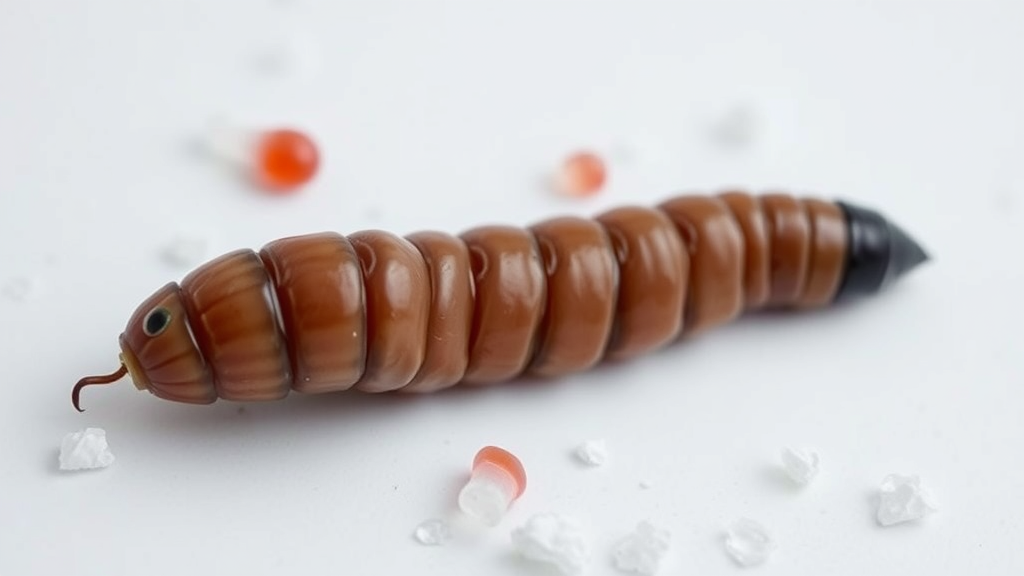
Beneath every healthy soil ecosystem lies an army of unassuming engineers. Earthworms churn, aerate and enrich the ground we depend on for food, and their well-being has long served as a bellwether for soil health. Now a team of researchers at the University of Bayreuth has delivered one of the most detailed looks yet at what microplastic particles do to the inner defenses of these vital invertebrates, and the results suggest that the smallest pollutants in our soils may be quietly undermining the immune systems of the creatures that keep those soils alive.
The new study, published in the open-access journal Microplastics and Nanoplastics, focused on Eisenia fetida, the composting earthworm that has become the standard model organism for terrestrial ecotoxicology. Rather than examining gross measures of animal health such as weight change, reproduction or survival, the researchers zoomed in on the cellular level, specifically on coelomocytes, the immune cells that circulate in the coelomic fluid of earthworms and perform functions analogous to those of white blood cells in humans. These cells come in two principal flavors: amoebocytes, which patrol tissues and engulf foreign material, and eleocytes, which are derived from chloragocytes and contribute to immunity and nutrient transport.
To test how plastic ingestion reshapes this immune cell population, the team exposed earthworms outside of soil for six days to food pellets under three conditions. One group received pellets with no microplastic particles at all, serving as the mock-treated control. A second group received food containing 10 percent by weight of pure polystyrene microplastic particles ranging from 25 to 75 micrometers in size. A third group received the same polystyrene diet but supplemented with 0.5 percent by weight of Irgafos 168, a phosphite antioxidant widely used in plastic manufacturing to prevent polymer degradation during processing. This additive-design decision is what gives the study its sharpest edge, because most laboratory toxicity tests rely on pristine, additive-free plastic spheres that bear little resemblance to the weathered, chemically loaded particles found in real environments.
One of the study’s most notable methodological achievements was the use of a non-invasive technique to harvest the earthworms’ immune cells. Instead of sacrificing the animals, the researchers induced them to expel coelomic fluid containing coelomocytes, allowing repeated sampling from the same individuals and reducing experimental variability. The recovered cells were then analyzed by flow cytometry, a laser-based technique that can distinguish and count thousands of individual cells per second based on their size, internal complexity and fluorescent labeling. This allowed the team to quantify not just the total number of immune cells, but their viability and the relative proportions of amoebocytes and eleocytes within each sample.
The first key finding was deceptively reassuring: the total number of cells isolated from the worms was not significantly affected by microplastic ingestion. In other words, earthworms eating polystyrene did not simply produce fewer coelomocytes overall. But when the researchers looked at cell viability, a different picture emerged. Earthworms that had ingested pure polystyrene particles showed significantly reduced coelomocyte viability compared with the mock-treated controls. The cells were still there, but a larger fraction of them were dead or dying, a sign that something in the plastic-exposed animals was harming the immune cells themselves.
The damage grew worse when the plastic carried its industrial additive. In worms fed the Irgafos 168-containing polystyrene, the number of living cells per milligram of body fresh weight dropped even further than in the pure-polystyrene group, indicating that the additive amplified the toxicity of the particles. The researchers backed up this in-vivo result with ex vivo assays, exposing isolated coelomocytes directly to the two particle types in the laboratory. Those experiments independently confirmed that particles supplemented with Irgafos 168 were more toxic to the cells than the pure polystyrene particles, strengthening the argument that the chemical additive, not merely the plastic polymer, drives part of the harm.
Why would an antioxidant designed to protect plastics from degradation be harmful to living cells? Irgafos 168 belongs to a class of phosphite compounds that can oxidize over time into phosphate derivatives, and laboratory studies have suggested that both the parent compound and its degradation products can interact with cell membranes and intracellular signaling. Because additives are not covalently bound to the polymer matrix, they can leach out of plastic particles once the material enters the environment and encounters warmth, digestive fluids or microbial action. When an earthworm swallows a contaminated particle, its gut becomes a reaction vessel in which these compounds can be released at close range to the very tissues responsible for defense and nutrient absorption.
Beyond the viability data, the study documented that ingestion of microplastic particles and their additives caused measurable shifts in the distribution of immune cell subpopulations compared with mock-treated worms. Changes in the balance between amoebocytes and eleocytes are more than a bookkeeping detail; they point to a reprogramming of the immune system itself. Amoebocytes are the earthworm’s first line of cellular defense against pathogens, phagocytosing bacteria and encapsulating foreign bodies, while eleocytes participate in immune regulation and reflect the metabolic state of the coelomic cavity. A skewed ratio between these populations could impair an earthworm’s ability to fight off infections, respond to other pollutants, or maintain normal physiological function, even in the absence of visible illness.
The ecological implications extend well beyond a single species in a laboratory feeding trial. Eisenia fetida serves as a surrogate for the broader community of soil-dwelling organisms that face chronic exposure to plastic contamination. Microplastic particles are now documented in agricultural soils across the globe, introduced through sewage sludge, plastic mulch films, irrigation water and the atmospheric deposition of fragmenting debris. Earthworms ingest soil particles indiscriminately as they feed, which means that plastic fragments in the 25 to 75 micrometer range fall squarely within the size class these animals routinely consume. If chronic exposure erodes immune competence in wild populations, soils could become more vulnerable to pathogen outbreaks, and the decomposition processes that underpin nutrient cycling could slow.
The study also carries a broader warning for how microplastic toxicity research is conducted. A growing body of literature has argued that testing pristine, spherical, additive-free particles systematically understates the risks posed by environmental plastics, which arrive pre-loaded with stabilizers, plasticizers, pigments and flame retardants. By deliberately including Irgafos 168 in their experimental design and demonstrating enhanced toxicity, the Bayreuth team has provided concrete experimental support for that argument. The findings suggest that regulatory assessments of microplastic risk, which often focus on the polymer alone, may need to account for the full chemical package that real-world particles carry. For now, the image that emerges from this research is a sobering one: the earthworms that quietly sustain the world’s soils are swallowing our plastic waste, and the chemical hitchhikers riding on that waste appear to reach deep into their cellular defenses, killing the very immune cells that would normally keep them safe.
Subject of Research: Effects of microplastic particle ingestion and plastic additives on earthworm immune cells
Article Title: Microplastic ingestion induces changes in coelomocyte composition of Eisenia fetida
Article References: Fritsche, J. K., Döring, M. V. R., Mauel, A., Senker, J., Feldhaar, H., Freitag, R., & Jérôme, V. (2026). Microplastic ingestion induces changes in coelomocyte composition of Eisenia fetida. Microplastics and Nanoplastics. https://doi.org/10.1186/s43591-026-00224-2
Image Credits: AI Generated
DOI: 10.1186/s43591-026-00224-2
Keywords: microplastics, polystyrene, Irgafos 168, Eisenia fetida, coelomocytes, immune cells, flow cytometry, ecotoxicology, soil health, plastic additives, earthworms, environmental toxicity
Cite Scienmag News
Denise Maddox. (September 12, 2026). Earthworm Immune Cells Falter When They Eat Plastic Laced with Additives. Scienmag. https://scienmag.com/earthworm-immune-cells-falter-when-they-eat-plastic-laced-with-additives/
Denise Maddox. "Earthworm Immune Cells Falter When They Eat Plastic Laced with Additives." Scienmag, 12 September 2026, https://scienmag.com/earthworm-immune-cells-falter-when-they-eat-plastic-laced-with-additives/. Accessed 5 October 2026.
Denise Maddox. "Earthworm Immune Cells Falter When They Eat Plastic Laced with Additives." Scienmag. September 12, 2026. https://scienmag.com/earthworm-immune-cells-falter-when-they-eat-plastic-laced-with-additives/


