


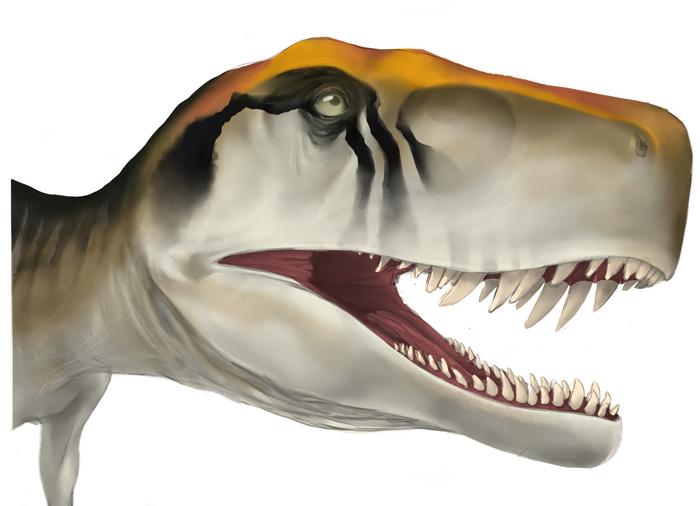
The earliest dinosaurs had rapid growth rates, but so did many of the other animals living alongside them, according to a study published April 3, 2024 in the open-access journal PLOS ONE by Kristina Curry Rogers of Macalester College, Minnesota and colleagues.

Credit: Kristina Curry Rogers (illustration by Jordan Harris, CC-BY 4.0 (
The earliest dinosaurs had rapid growth rates, but so did many of the other animals living alongside them, according to a study published April 3, 2024 in the open-access journal PLOS ONE by Kristina Curry Rogers of Macalester College, Minnesota and colleagues.
Dinosaurs grew up fast, a feature that likely set them apart from many other animals in their Mesozoic (252 to 66 million years ago) ecosystems. Some researchers have proposed that these elevated growth rates were key to the global success of dinosaurs, but little is known about the growth strategies of the earliest dinosaurs. In this study, Rogers and colleagues performed histological analysis, examining patterns of bone tissue growth in the fossilized leg bones of an array of animals in one of the earliest known Mesozoic ecosystems.
The studied fossils come from the Ischigualasto Formation of Argentina and date between 231-229 million years old. Sampled fossils include several of the earliest known dinosaurs as well as several non-dinosaur reptiles and one early relative of mammals.
The analysis found that most of the examined species had elevated growth rates, more similar to some modern-day mammals and birds than to living reptiles. The early dinosaurs all exhibited particularly fast growth, but they weren’t alone in this, as similar growth rates were seen in several of the non-dinosaur reptiles as well.
These results show that the earliest dinosaurs were already fast growers, supporting the idea that this feature was important to their later success. But apparently dinosaurs were only one of multiple lineages evolving with elevated growth rates during the Triassic (252-201 million years ago), suggesting that this feature is only part of the story of dinosaurs’ eventual global prosperity. The authors note that future studies could expand on these preliminary results by sampling a wider variety of ancient animals from additional early Mesozoic fossil sites.
The authors add: “Our sample comes from a time in which dinosaurs were the new kids on the block, restricted to relatively small, basic body plans, and evolving within a world rich with a diverse array of more specialized, non-dinosaur reptiles. We tackled the question of how all of these animals grew, and found that the earliest dinosaurs grew quickly, and that these rapid growth rates probably played a significant role in dinosaurs’ subsequent ascent within Mesozoic ecosystems; but dinosaurs weren’t unique – many of their non-dino sidekicks shared rapid growth 230 million years ago.”
#####
In your coverage please use this URL to provide access to the freely available article in PLOS ONE:
Citation: Curry Rogers K, Martínez RN, Colombi C, Rogers RR, Alcober O (2024) Osteohistological insight into the growth dynamics of early dinosaurs and their contemporaries. PLoS ONE 19(4): e0298242.
Author Countries: USA, Argentina
Funding: This work was supported the National Science Foundation CAREER Grant – EAR-0955716 to KCR and by the Wallace Faculty Travel Grant from Macalester College to KCR. The funders had no role in study design, data collection and analysis, decision to publish, or preparation of the manuscript.
Journal
PLoS ONE
Method of Research
Observational study
Subject of Research
Not applicable
Article Title
Osteohistological insight into the growth dynamics of early dinosaurs and their contemporaries
Article Publication Date
3-Apr-2024
COI Statement
The authors have declared that no competing interests exist.
Cite Scienmag News
Courtney Benton. (April 4, 2024). Early dinosaurs grew up fast, but they weren’t the only ones. Scienmag. https://scienmag.com/early-dinosaurs-grew-up-fast-but-they-werent-the-only-ones/
Courtney Benton. "Early dinosaurs grew up fast, but they weren’t the only ones." Scienmag, 4 April 2024, https://scienmag.com/early-dinosaurs-grew-up-fast-but-they-werent-the-only-ones/. Accessed 3 September 2026.
Courtney Benton. "Early dinosaurs grew up fast, but they weren’t the only ones." Scienmag. April 4, 2024. https://scienmag.com/early-dinosaurs-grew-up-fast-but-they-werent-the-only-ones/

