


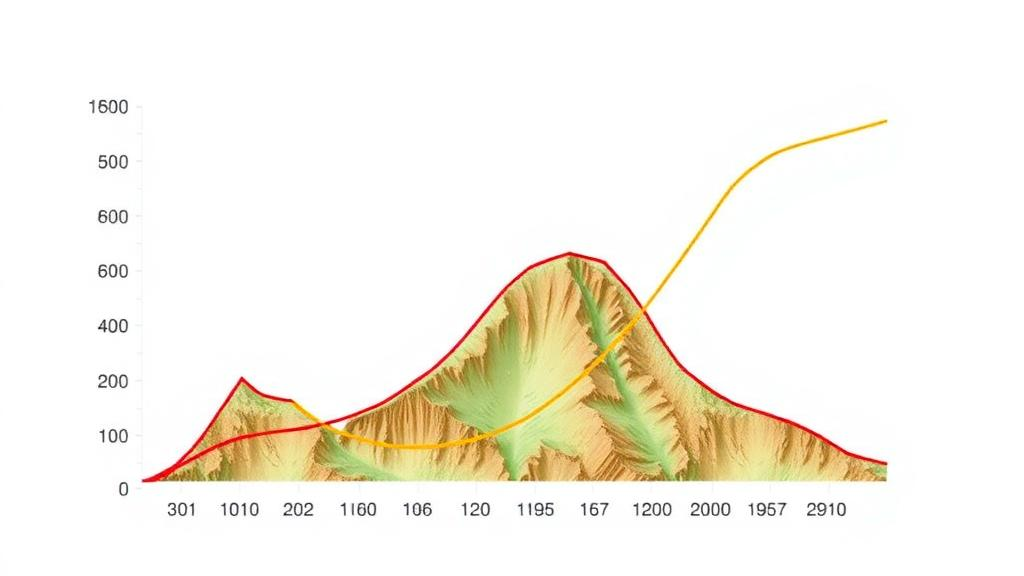
Every estimate of how many species humanity will lose to deforestation, urbanization, and agricultural expansion rests on a quiet mathematical assumption: that habitat disappears in a simple, predictable way. A new modeling study published in Ecology and Evolution argues that this assumption is precisely where many extinction projections go wrong. By coupling a classic equation of population growth with a macroecological framework for species ranges, researchers have shown that when land conversion happens the way it actually happens on Earth—starting in many places at once, spreading outward, and merging as patches collide—the shape of the extinction curve changes fundamentally. Species loss appears to be delayed, then arrives all at once, like a dam that holds until it suddenly does not.
The study, led by Nao Takashina with Buntarou Kusumoto, tackles a long-standing tension in conservation science. The workhorses of extinction forecasting are the species-area relationship (SAR) and its mirror image, the endemics-area relationship (EAR). The SAR tallies how many species occupy a given area of habitat; the EAR counts how many species are found nowhere else, and therefore vanish the moment their entire range is destroyed. Both have been applied at scales from single forest plots to the entire planet, and both are embedded in the machinery of international biodiversity targets. But both were built on simplified pictures of habitat loss: a single block of conversion expanding in one direction, or a static level of fragmentation frozen in time.
Real landscapes are messier. A new field is cleared here, a road pushed through there, a suburb swells at the edge of a city. Converted patches emerge simultaneously across a region, expand at different speeds, and coalesce when they meet, so the degree of fragmentation is not fixed but evolves continuously. To capture this, the team turned to the Fisher–KPP equation, a reaction–diffusion model originally devised to describe the spread of advantageous genes. In their formulation, land-use intensity grows logistically at each location and diffuses across space, with separate diffusion coefficients allowing expansion to run faster east–west than north–south. Crucially, the model includes the conventional single-origin scenario as a limiting case: when no new conversion events occur, it collapses back to the standard sampling-area setting that underlies traditional estimates.
On the ecological side, the researchers generated virtual species assemblages grounded in well-established macroecological patterns. Species ranges were placed randomly or arranged along a latitudinal gradient in richness, and range sizes were drawn from a beta distribution tuned to reproduce the left-skewed range-size frequency distributions observed empirically across taxa from primates to beetles. The team then ran hundreds of simulations, overlaying dynamic land conversion onto these species maps and recording, at every time step, how many species had lost their entire geographic range. Alternative extinction criteria—loss of 90 or 95 percent of a range, and the SAR-based rule that any overlap with conversion spells extinction—were tested for comparison.
The central result is counterintuitive and, in its implications, sobering. When land conversion emerged frequently and in many places at once, species loss per unit of converted area was lower in the early stages than under a single expanding conversion front. Dispersed patches are simply less likely to swallow a species’ entire range early on. But as conversion progressed, the endemics-area relationship steepened sharply, producing a much sharper rise in extinctions at later stages than the single-origin scenario ever predicts. In other words, fragmented, multi-site land use does not soften the extinction blow—it postpones it and then concentrates it.
There is a second, more insidious twist. Area-based extinction curves have no clock in them; they relate species loss to the proportion of land converted, not to time. Yet the simulations showed that when new conversion events emerge frequently, a given proportion of converted area is reached far faster than when conversion spreads from a single origin. An apparent delay in area-based species loss therefore does not imply a temporal delay in biodiversity loss. The authors point to the finding that only about 23 percent of terrestrial areas remain relatively wild, suggesting many landscapes may already be entering the late conversion stages where species loss accelerates most abruptly.
Against this backdrop, the study delivers a message of cautious hope about protected areas. When the researchers designated protected cells covering 5 percent of the simulated region—selected from the highest-richness, still-unconverted grids after 20 or 40 percent of the land had been converted—the extinction curve bent visibly downward and its slope declined. Protected cells acted as internal barriers that land-use intensity could not cross, buffering the accumulation of habitat loss. And timing mattered: introducing protected areas earlier, when less land had been converted, saved more species than the same total extent designated later, particularly in the single-origin scenario where early losses accumulate fastest.
The analysis of protected-area geometry added a further layer. Using the pair correlation function, a tool from spatial statistics that measures how frequently protected cells sit at given distances from one another, the team showed that the realized configuration of protected areas was strongly shaped by the underlying land-use regime. Under frequent, dispersed conversion, earlier designation produced more strongly clustered reserves; under contiguous expansion, the clustering differences between early and late designation shifted with distance. When the model was extended to density-dependent land use—where expanding patches interact and total converted area can even shrink—the broad conclusions held, though the extinction curves became noisier because the same converted-area value can recur at multiple time points.
The authors are careful about the limits of their claims. The endemics-area framework assumes immediate extinction upon complete range loss, but alternative criteria introduce the well-known problem of extinction debt: species can persist for decades or even centuries after their habitat is largely destroyed, with documented debts spanning from a few years to 570 years. Under such delayed criteria, a small network of protected areas may prevent immediate extinctions in the short term without suppressing the long-run debt. Sufficiently large protected areas, the study suggests, are needed to bend the extinction curve permanently, not merely postpone it. The work also stops short of the richer reality of socio-ecological landscapes, where traditional agriculture sustains biodiversity and other effective area-based conservation measures complement formal reserves.
Even with those caveats, the study lands at a politically charged moment. The Kunming-Montreal Global Biodiversity Framework commits nations to rapid expansion of area-based conservation, and previous research has warned that delays in establishing protected areas—sometimes justified by the hope of better information—create missed conservation opportunities that can never be recovered. This new modeling effort provides theoretical backing for that warning: because dynamic land use can accelerate the pace of conversion in real time even while appearing to delay species loss on paper, every year of postponement compounds the risk. The extinction curve, the study suggests, is not a gentle slope we can read far ahead. It is a curve that flattens, lulls, and then turns sharply upward—and the window in which protected areas can bend it is open now, and closing.
Subject of Research: Modeling species extinction risk under dynamic spatiotemporal land-use processes and the conservation role of protected areas
Article Title: Species Extinction Curves Under Emergent Spatiotemporal Land‐Use Processes and the Role of Protected Areas
Article References: Takashina, N., & Kusumoto, B. (2026). Species Extinction Curves Under Emergent Spatiotemporal Land‐Use Processes and the Role of Protected Areas. Ecology and Evolution, 16(10), Article e74433. https://doi.org/10.1002/ece3.74433
Image Credits: AI Generated
DOI: 10.1002/ece3.74433
Keywords: biodiversity, extinction risk, land-use change, species-area relationship, endemics-area relationship, protected areas, habitat fragmentation, Fisher-KPP model, macroecology, conservation, extinction debt, spatial modeling
Cite Scienmag News
Margaret Porter. (October 3, 2026). Dynamic Land-Use Model Reveals Extinction Risk May Spike Abruptly, and Protected Areas Can Bend the Curve. Scienmag. https://scienmag.com/dynamic-land-use-model-reveals-extinction-risk-may-spike-abruptly-and-protected-areas-can-bend-the-curve/
Margaret Porter. "Dynamic Land-Use Model Reveals Extinction Risk May Spike Abruptly, and Protected Areas Can Bend the Curve." Scienmag, 3 October 2026, https://scienmag.com/dynamic-land-use-model-reveals-extinction-risk-may-spike-abruptly-and-protected-areas-can-bend-the-curve/. Accessed 4 October 2026.
Margaret Porter. "Dynamic Land-Use Model Reveals Extinction Risk May Spike Abruptly, and Protected Areas Can Bend the Curve." Scienmag. October 3, 2026. https://scienmag.com/dynamic-land-use-model-reveals-extinction-risk-may-spike-abruptly-and-protected-areas-can-bend-the-curve/


