

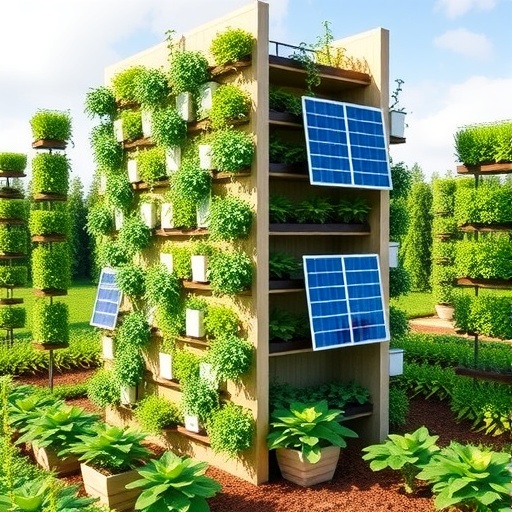
Imagine a future where solar energy generation and agriculture not only coexist but thrive together without compromise. Researchers at Aarhus University in Denmark are pioneering this vision through a groundbreaking agrivoltaic pilot project set in the Danish countryside. This full-scale study offers rigorous data to challenge the conventional notion that solar installations and crop production compete for valuable land resources. By integrating vertical solar panels alongside crops, the team demonstrates a harmonious, symbiotic system that advances both food security and renewable energy generation.
At the heart of their experiment lies an innovative solar panel configuration: vertical, bifacial modules oriented east-west. This design diverges from typical south-facing tilted arrays common in photovoltaic installations. Although vertical panels inherently produce slightly less electricity annually compared to conventional setups, their energy generation peaks in the morning and late afternoon. This pattern better aligns with grid demand cycles, enhancing the economic value and utility of the electricity produced. Thus, energy output quality complements quantity, marking a significant evolution in photovoltaic system design.
From an agricultural perspective, the researchers report promising findings. Tests conducted on wheat and grass-clover mixtures growing among the vertical panels found comparable crop yields to those in open, unshaded fields. Meanwhile, the solar modules occupied only about 10% of the total field area—much less land than would be needed if solar arrays and crops were installed separately. The wind-breaking effect of the panels may also have helped protect plants from harsh weather, a benefit that could translate into more resilient agricultural systems amid climate variability.
Importantly, the vertical bifacial glass-on-glass solar panels offer environmental and structural benefits beyond their land efficiency. Their glass composition results in lower material consumption and consequentially reduced CO₂ emissions throughout the manufacturing process. Additionally, vertical mounting minimizes wind loads on the panels, enhancing stability and longevity while maintaining compatibility with conventional farming machinery. This synergy means the panels do not disrupt routine fieldwork, allowing farmers to maintain their operations with minimal adaptation.
One distinctive aspect of this study is the social dimension—how people perceive and accept agrivoltaic installations in the landscape. The Aarhus team engaged over 100 participants in an immersive virtual reality experiment to gauge public attitudes toward vertical agrivoltaics versus traditional solar parks. The response was clear: vertical panels were rated more positively, perceived as more innovative and environmentally friendly. Participants appreciated that these installations preserved agricultural activity and resembled modern hedgerows rather than industrial solar fields, fostering aesthetic acceptance crucial for large-scale deployment.
Facilitating the development of land-efficient solar power systems is paramount as Europe grapples with rising energy demands, climate commitments, and limited land resources. Agrivoltaics, especially with innovative vertical arrays, uniquely address these intersecting challenges. By maximizing dual land-use efficiency—harvesting watts and crops simultaneously—this approach provides a roadmap toward sustainable, multifunctional landscapes that benefit energy, food production, and biodiversity in tandem.
The project at Foulum serves as both a technological and ecological testbed. Researchers installed two bifacial system variants: traditional tilted south-facing panels and vertical east-west-facing panels. This direct comparison allowed detailed insights into how orientation and configuration impact energy yield, temporal production profiles, and agricultural outcomes under temperate climatic conditions—a research area gaining global importance given the demand for adaptable renewable solutions.
Long-term monitoring remains a vital next step for thoroughly understanding how crop cycles interact with shading patterns, microclimates, and panel performance over multiple seasons. Such longitudinal data will clarify agronomic impacts, panel durability, and potential ecosystem benefits. However, early results confidently debunk the myth that solar infrastructure implies inevitable yield penalties, instead pointing to a future where photovoltaic and agricultural sectors co-evolve sustainably.
Underlying this research is the EU-funded Hyperfarm project (Hydrogen and Photovoltaic Electrification on Farm), which supports multidisciplinary collaborations between departments in mechanical engineering, agroecology, food science, management, and climate research. This holistic approach recognizes that agrivoltaics embody technical, environmental, and social dimensions requiring integrated expertise to optimize design, deployment, and acceptance.
Moreover, vertical agrivoltaic configurations reduce the overall carbon footprint of solar panel production and installation. Less material use, lower CO₂ emissions, and fewer structural supports translate into cleaner manufacturing and logistics. This technical innovation aligns strongly with climate mitigation goals and circular economy principles, positioning agrivoltaics as models for sustainable energy infrastructure.
In conclusion, Aarhus University’s pioneering work reveals that vertical agrivoltaics in temperate climates can revolutionize the landscape of renewable energy and agriculture alike. By enabling energy production that complements crop growth with minimal land use conflict, these systems offer a compelling alternative to conventional, land-intensive solar farms. Coupled with positive social perceptions and environmental benefits, vertical agrivoltaics represent a scalable solution poised to contribute meaningfully to Europe’s green transition and global sustainability efforts. The message is resoundingly clear: it is possible to have wheat and watts, side by side.
Subject of Research: Vertical agrivoltaics in temperate climates including technical, agricultural, meteorological, and social dimensions.
Article Title: Vertical agrivoltaics in a temperate climate: Exploring technical, agricultural, meteorological, and social dimensions
Web References:
- Hyperfarm project: https://hyperfarm.eu/
- DOI: http://dx.doi.org/10.1016/j.nexus.2025.100526
Image Credits: Aarhus University
Keywords: agrivoltaics, vertical solar panels, bifacial photovoltaics, renewable energy, crop yield, land-use efficiency, climate mitigation, social acceptance, sustainable agriculture, energy demand matching, bifacial glass-on-glass panels, EU Horizon 2020


