


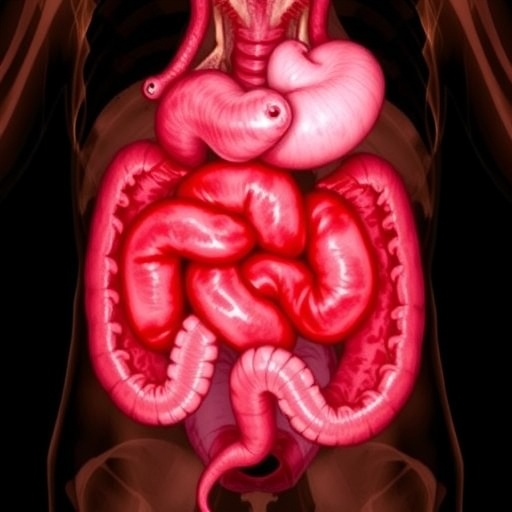
In the ever-evolving field of pediatric medicine, necrotizing enterocolitis (NEC) represents one of the most formidable challenges clinicians face in neonatal intensive care units. This devastating intestinal disease primarily affects premature infants, often leading to severe complications or even mortality if not diagnosed and treated promptly. Despite advances in neonatal care, the diagnosis and prediction of the need for surgical intervention in NEC remain mired in uncertainty due to the subtle, variable nature of early signs and limited current diagnostic tools. Scientists and clinicians alike have long sought innovative ways to improve early identification and prognosis to optimize outcomes for these vulnerable patients.
In a groundbreaking development announced this June, a team of researchers led by Wang, Jin, Cai, and colleagues have unveiled a cutting-edge artificial intelligence model that harnesses the power of multimodal data to improve NEC diagnostic accuracy and surgical risk prediction. Published in Pediatric Research, this new approach leverages a dual swin transformer architecture—the first of its kind applied to this specific clinical problem—blending diverse patient data inputs to provide a transparent, interpretable decision-support system. This innovation not only promises to revolutionize how NEC is understood and managed but also sets a new standard for AI’s role in complex clinical decision-making.
Necrotizing enterocolitis is characterized by inflammation and necrosis of the infant’s intestine, the pathogenesis of which remains incompletely understood but is believed to involve a complex interplay of intestinal immaturity, microbial imbalance, and systemic inflammatory responses. Early symptoms such as feeding intolerance, abdominal distension, and bloody stools are often nonspecific, leading to diagnostic ambiguity. Current diagnostic methodologies rely heavily on clinical examination combined with radiographic imaging, which may delay recognition of severe disease requiring urgent surgery. Consequently, there is an urgent need for more sensitive and specific predictive tools to guide timely interventions which can preserve bowel function and improve survival.
The dual swin transformer model introduced by the authors capitalizes on recent advances in machine learning and neural network architectures rooted in natural language processing and computer vision. Swin transformers are hierarchical vision transformers designed to efficiently capture local and global context within medical images and tabular clinical data. By integrating radiologic images with patient-specific clinical metrics—such as laboratory values and vital signs—this dual model concurrently processes and synthesizes multiple modalities. This multimodal fusion enables the AI to discern subtle patterns indicative of disease onset and progression that are often imperceptible to human observers.
Importantly, the model was developed with interpretability at its core. In the current landscape of AI in healthcare, “black box” systems can engender clinician skepticism due to a lack of transparency regarding decision rationale. By employing attention mechanisms and visualization strategies, the model highlights key features driving its predictions. For example, it can indicate which segments of radiographic images or particular blood test trends raised suspicion for NEC or increased the likelihood of surgical necessity. This transparency enhances clinical trust and facilitates a collaborative human-machine diagnostic workflow rather than a replacement of clinical judgment.
The researchers trained and validated the model on a robust dataset comprising hundreds of neonates from multiple tertiary centers, ensuring diverse representation across gestational ages and clinical presentations. The dataset included serial abdominal ultrasound and X-ray imaging paired with longitudinal clinical data capturing inflammatory markers, feeding regimens, and hemodynamic parameters. Such comprehensive data collection was decisive in enabling the model not only to achieve high accuracy rates but also to adapt dynamically to temporal changes reflective of NEC progression. Their results demonstrated significant improvements over traditional scoring systems and single-modality AI tools.
Beyond diagnostic accuracy, the study explored the model’s ability to predict which infants would likely require surgical intervention. NEC surgery typically involves resection of necrotic bowel segments, a procedure associated with considerable risk and long-term complications such as short bowel syndrome. Early prediction of surgical need can enhance resource allocation, optimize timing of consultation with pediatric surgeons, and potentially improve postoperative outcomes. The dual swin transformer demonstrated remarkable prowess in stratifying patients by surgical risk, outperforming established clinical predictors by a wide margin and thus holding potential to reshape surgical decision-making paradigms.
Moreover, the translational potential of this technology is significant. The model’s architecture allows for seamless integration into existing hospital information systems and picture archiving and communication systems (PACS), paving the way for real-time clinical deployment. Its modularity also provides adaptability to other neonatal and pediatric disease contexts characterized by multimodal diagnostic complexity, such as congenital heart diseases or sepsis. This flexibility marks an important step toward personalized medicine driven by AI-enhanced precision diagnostics tailored to the needs of critically ill infants.
However, the authors acknowledge several challenges ahead. The generalizability of the model to different healthcare settings, especially those with limited imaging resources, requires further investigation. Additionally, ensuring data privacy and addressing ethical concerns related to AI-driven decisions in vulnerable populations remains paramount. Prospective clinical trials are needed to validate efficacy and safety in routine practice, alongside strategies to train frontline clinicians in interpreting and effectively incorporating AI output into patient care.
The implications of this research extend beyond NEC, highlighting the transformative role of next-generation AI architectures in neonatal intensive care. By bridging the gap between complex multimodal data and actionable clinical insights, such models have the potential to fundamentally enhance early diagnosis, risk stratification, and outcome prediction across a spectrum of neonatal diseases. The collaborative, transparent design philosophy championed by Wang and colleagues exemplifies the future of AI in medicine—one that empowers human clinicians with unprecedented analytic power while ensuring accountability and interpretability.
As the field of pediatric research embraces AI innovations like the dual swin transformer, the promise of improving survival and quality of life for the most fragile patients comes into sharper focus. This confluence of advanced computational techniques with clinical expertise heralds a new era of neonatal care, offering hope to countless families facing the terrifying specter of NEC. By accelerating timely diagnosis and guiding precise surgical decision-making, this technology stands poised to save lives and reduce the burdens of one of neonatal medicine’s most urgent challenges.
In summary, the dual swin transformer model represents a seminal advancement in applying artificial intelligence to the complex problem of necrotizing enterocolitis diagnosis and surgical prediction. Combining sophisticated multimodal data integration with interpretability, it outperforms existing methods while fostering clinician trust. Continued refinement and validation promise to unlock its full clinical potential, signaling a paradigm shift in how AI supports neonatal critical care.
With this landmark study published in Pediatric Research, Wang, Jin, Cai, and their team have undoubtedly charted a new course for marrying AI innovation with frontline neonatal medicine. The coming years will reveal the extent to which models like theirs become integral to NICU practice, but the trajectory is clear—machine learning and biomedical science are converging to confront NEC with previously unattainable precision and foresight, forever altering the landscape of infant healthcare.
Cite Scienmag News
Ophelia Keating. (June 3, 2026). Dual Swin Transformer Advances Necrotizing Enterocolitis Diagnosis. Scienmag. https://scienmag.com/dual-swin-transformer-advances-necrotizing-enterocolitis-diagnosis/
Ophelia Keating. "Dual Swin Transformer Advances Necrotizing Enterocolitis Diagnosis." Scienmag, 3 June 2026, https://scienmag.com/dual-swin-transformer-advances-necrotizing-enterocolitis-diagnosis/. Accessed 4 September 2026.
Ophelia Keating. "Dual Swin Transformer Advances Necrotizing Enterocolitis Diagnosis." Scienmag. June 3, 2026. https://scienmag.com/dual-swin-transformer-advances-necrotizing-enterocolitis-diagnosis/


