


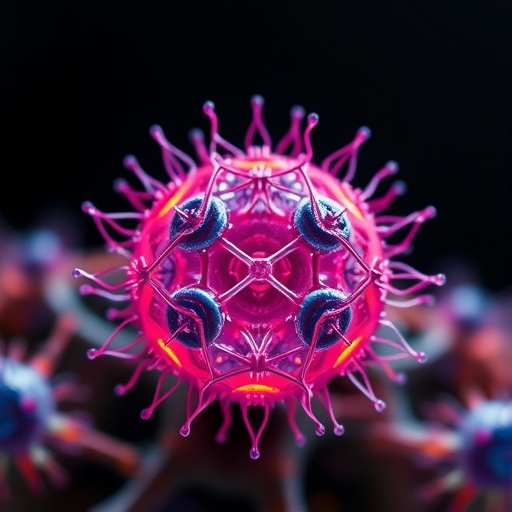
In the realm of cellular biology, the kinetochore stands as one of the most intricate and vital macromolecular machines, orchestrating the precise choreography of chromosome segregation during cell division. This colossal molecular assembly serves as the critical interface between chromosomes and spindle microtubules, ensuring the fidelity of genetic inheritance through every mitotic cycle. Comprising over a hundred individual proteins organized into approximately thirty distinct sub-complexes, the kinetochore is a marvel of cellular engineering, whose complexity has eluded comprehensive understanding for decades.
At the outermost layer of this massive complex lies the corona, a dynamic, crown-like structure that plays a pivotal role in mediating the kinetochore’s functions. Despite its significance, the biogenesis and architecture of the corona had remained enigmatic until recently, due to the kinetochore’s multilayered configuration and intimate association with other cellular components. Efforts to isolate and characterize the kinetochore have historically been stymied by its sheer scale and tight integration with chromosomes and microtubule networks, posing formidable technical challenges to molecular biologists and structural biochemists alike.
Over the past two decades, a dedicated research team led by Director Andrea Musacchio at the Max Planck Institute of Molecular Physiology has embarked on a methodical journey to unravel the structural secrets of the kinetochore. By employing a combination of biochemical reconstitution, high-resolution microscopy, and advanced structural biology techniques, the group has succeeded in gradually assembling progressively larger portions of the kinetochore in vitro. This pioneering approach culminated in the near-complete reconstruction of the kinetochore’s architecture, revealing a detailed three-dimensional blueprint that has propelled the field forward.
A particularly groundbreaking milestone in this endeavor was the experimental reconstitution of the corona itself. For the first time, researchers have mapped its essential components and delineated its overall structural framework, shedding light on how this complex crown arises from its constituent parts. Central to this discovery is the identification of two key proteins, BUB1 and BUBR1, which initiate corona formation. Acting as molecular seeds, these proteins catalyze a cascade of interactions that expand the corona through two independent, yet intertwined assembly pathways, generating a robust and cooperative molecular scaffold.
The biological implications of the corona’s formation and disassembly are profound. Early in mitosis, when chromosomes are captured and aligned along the spindle equator, the corona functions as a dynamic guide, facilitating accurate microtubule attachment and chromosome positioning. This ensures that each chromosome is correctly paired with spindle fibers emanating from opposite poles, a prerequisite for equitable distribution of genetic material. As mitosis advances and stable microtubule attachments form, the corona undergoes regulated disassembly, triggering checkpoint signaling pathways that allow sister chromatids to separate and be pulled apart into daughter cells.
This dual functionality underscores the corona’s essential role in safeguarding genome stability. Any malfunctions in corona assembly or timing can precipitate attachment errors, aberrant chromosome segregation, and aneuploidy—a hallmark of numerous developmental disorders and malignancies. The cooperative architecture unveiled by Musacchio’s team confers resilience to the kinetochore corona, ensuring its persistence amidst fluctuating cellular conditions and precise timing control over chromosome segregation.
Moreover, recent findings illuminate the molecular logic underpinning this robustness. The two parallel assembly routes initiated by BUB1 and BUBR1 generate a self-reinforcing network of interactions that stabilize the corona, enabling it to withstand perturbations during the dynamic mitotic process. This insight challenges previous conceptions of kinetochore assembly as a linear pathway, instead framing it as a complex integration of parallel mechanisms that confer adaptability and fidelity.
The technical achievements that facilitated these discoveries are as impressive as their biological significance. Musacchio’s laboratory employed cutting-edge techniques including cryo-electron microscopy, fluorescence microscopy with super-resolution modalities, and sophisticated biophysical assays. These methods were instrumental in overcoming obstacles posed by the kinetochore’s transient interactions and compositional heterogeneity, allowing the team to visualize molecular arrangements at near-atomic resolution and track dynamic assembly processes in real time.
These advances not only enhance our fundamental understanding of cell division mechanics but also open new avenues for therapeutic intervention. Given the kinetochore’s pivotal role in mitotic checkpoint signaling and chromosomal stability, misregulation of its components—including the corona—has been implicated in cancer progression. Detailed knowledge of corona assembly pathways could inform the design of targeted inhibitors aimed at disrupting aberrant kinetochore function in tumor cells, offering promising strategies for precision oncology.
Looking forward, the field is poised to explore how phase separation phenomena, a recently recognized principle of intracellular organization, might influence kinetochore assembly and corona dynamics. Preliminary research suggests that biomolecular condensates could mediate local concentration and modulation of kinetochore components during cell division, an area ripe for exploration building upon Musacchio’s foundational work.
In sum, the decade-spanning efforts to reconstruct and elucidate the kinetochore, culminating in the demystification of its corona structure, represent a landmark achievement in cellular and structural biology. This knowledge bridges molecular detail with cellular function, enhancing our grasp of how life perpetuates itself with high fidelity through cell division, and highlighting the elegance and complexity of intracellular molecular machines.
Cite Scienmag News
Drew Townsend. (September 15, 2025). Dual pathways, one purpose – unraveling the assembly of the cell division crown. Scienmag. https://scienmag.com/dual-pathways-one-purpose-unraveling-the-assembly-of-the-cell-division-crown/
Drew Townsend. "Dual pathways, one purpose – unraveling the assembly of the cell division crown." Scienmag, 15 September 2025, https://scienmag.com/dual-pathways-one-purpose-unraveling-the-assembly-of-the-cell-division-crown/. Accessed 4 September 2026.
Drew Townsend. "Dual pathways, one purpose – unraveling the assembly of the cell division crown." Scienmag. September 15, 2025. https://scienmag.com/dual-pathways-one-purpose-unraveling-the-assembly-of-the-cell-division-crown/


