


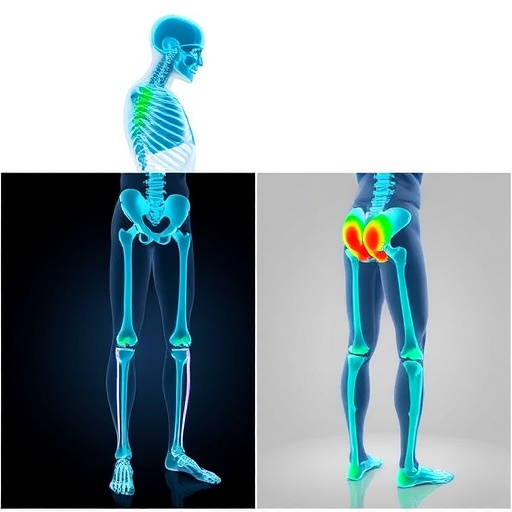
In a groundbreaking advancement in motion capture technology, researchers have unveiled a dual-camera markerless system designed for precise lower-limb kinematic analysis, particularly in patients suffering from osteoarthritis. This innovative system promises to revolutionize the way healthcare professionals monitor and diagnose movement disorders that greatly affect the quality of life for millions. With osteoarthritis being one of the leading causes of disability worldwide, this research is crucial in developing more effective treatment plans and rehabilitation strategies.
The dual-camera system is lauded for its ability to accurately capture the movements of the human body without the need for cumbersome external markers. This markerless approach eliminates the discomfort and restrictions often associated with traditional motion capture techniques, allowing for more natural movement analysis. By utilizing advanced computer vision algorithms and artificial intelligence, the system interprets video data to generate detailed kinematic profiles of the lower limbs. This is particularly vital for conditions such as osteoarthritis, where understanding joint mechanics can provide insights into disease progression and treatment efficacy.
One of the key features of this dual-camera setup is its high frame rate and resolution, which enables it to detect subtle movements that may be indicative of underlying joint issues. Researchers have emphasized that even small deviations in gait or posture can provide significant information regarding a patient’s condition. The ability to capture such intricate details could lead to early diagnosis and intervention, ultimately improving patients’ outcomes in managing their osteoarthritis.
Previous motion capture systems often required participants to be tethered to equipment or wear uncomfortable markers that could interfere with their natural movement. The advent of a markerless system means that individuals can be evaluated in a more relaxed state, thereby producing more accurate and applicable results. This shift is particularly important for elderly patients or those with mobility challenges, as it reduces the barriers to participation in diagnostic assessments.
In addition to its clinical applications, this dual-camera motion capture system has potential uses in research settings. Academics studying gait mechanics and joint function can benefit from its precision and usability. The ability to analyze a diverse range of movements opens new avenues for exploring the complexities of human biomechanics. Researchers can use this technology to publish more detailed studies and data regarding joint health, rehabilitation, and the efficacy of different therapeutic interventions.
The study’s authors have highlighted the robustness of their technology in different environments and scenarios. Whether in a clinical practice or a research laboratory, the system maintains its effectiveness. This versatility makes it a valuable tool for both health professionals and scientists, promising to enhance the understanding of lower-limb biomechanics not just in osteoarthritis but in other related disorders as well.
Furthermore, the implications of this technology extend beyond biomechanics. By integrating this motion capture system with machine learning techniques, medical professionals could develop predictive models that assess the likelihood of disease progression based on kinematic data. Such advancements could lead to more personalized treatment regimens tailored to each patient’s unique movement patterns and needs.
Critically, this research underscores a broader trend in healthcare—using technology to deliver more patient-centered care. As the dual-camera markerless motion capture system evolves, it could empower patients by providing them with clearer insights into their physical health and the state of their osteoarthritis. With timely and accurate data at their disposal, both patients and physicians can engage in more informed conversations around treatment options and lifestyle adjustments.
The implications of this technology also raise important considerations in terms of accessibility and affordability. For comprehensive implementation, it is vital that healthcare systems can adopt these tools without exorbitant costs. Collaborative efforts among researchers, clinicians, and policymakers will be essential to ensure that such innovations are made accessible to a broader patient demographic.
In closing, the development of this dual-camera markerless motion capture system marks a significant leap forward in how we understand and treat lower-limb disorders, particularly osteoarthritis. As research continues to reveal its potential, we can anticipate a future where technology plays an even larger role in the individualized care of patients, leading to improved health outcomes on a global scale.
With the promise this technology holds, the scientific community and healthcare practitioners are not just witnessing a technological evolution but are also being challenged to rethink traditional approaches to diagnosis and therapy in biomechanics. The hope is that soon, widespread implementation of these systems will lead to a decrease in the burden of osteoarthritis and enhance the quality of life for countless individuals.
Hu, B., Wang, J., Xu, W. et al. Dual-Camera Markerless Motion Capture System for Precise Lower-Limb Kinematic Analysis in Osteoarthritis. Ann Biomed Eng (2025). https://doi.org/10.1007/s10439-025-03859-z
Cite Scienmag News
Blake Davidson. (September 22, 2025). Dual-Camera System Enhances Lower-Limb Kinematics in Osteoarthritis. Scienmag. https://scienmag.com/dual-camera-system-enhances-lower-limb-kinematics-in-osteoarthritis/
Blake Davidson. "Dual-Camera System Enhances Lower-Limb Kinematics in Osteoarthritis." Scienmag, 22 September 2025, https://scienmag.com/dual-camera-system-enhances-lower-limb-kinematics-in-osteoarthritis/. Accessed 3 September 2026.
Blake Davidson. "Dual-Camera System Enhances Lower-Limb Kinematics in Osteoarthritis." Scienmag. September 22, 2025. https://scienmag.com/dual-camera-system-enhances-lower-limb-kinematics-in-osteoarthritis/


