


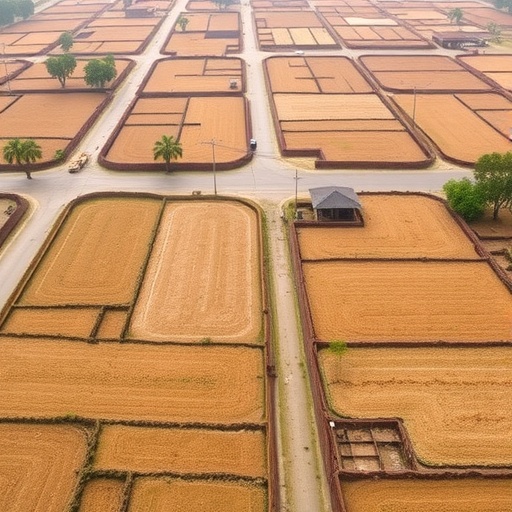
The transformation of a dry sky into dry soil is one of the most consequential processes in the global water cycle, and a new study from China has now mapped that transformation with unprecedented detail across multiple time scales. Published in Theoretical and Applied Climatology, the research by Xinxuan Li, Chongli Di, and Hanqiong Zhang of Tianjin University, together with Haijiang Wu of Northwest A&F University, quantifies how meteorological drought—a sustained deficit in precipitation—propagates into agricultural drought, the depletion of soil moisture that directly threatens crops. By combining probability-based analysis with machine learning, the team reveals that the character and drivers of this propagation depend critically on the time scale at which it is observed, a finding with immediate implications for drought early warning systems and water management across China and beyond.
Droughts are commonly divided into categories that reflect different components of the hydrological system. Meteorological drought describes an extended shortfall in rainfall relative to climatic norms, whereas agricultural drought emerges when that shortfall depletes the water held in the soil column that plants draw upon through their roots. The two are connected but not identical: a few weeks of poor rainfall may or may not translate into stress for crops, depending on how much moisture the soil already holds, how fast water is lost to the atmosphere through evapotranspiration, and what the vegetation itself is doing. Understanding this propagation process—how, how fast, and how reliably a precipitation deficit becomes a soil moisture deficit—is essential for food security, because agricultural drought is the stage at which drought begins to cost yields.
The research team characterized meteorological drought using the Standardized Precipitation Index, or SPI, an index developed in the early 1990s that expresses precipitation anomalies in units of standard deviation from the long-term climatological average. Agricultural drought, in turn, was represented by the Standardized Soil Moisture Index, or SSI, which applies analogous statistical standardization to soil moisture, allowing the two drought types to be compared on a common probabilistic footing. Both indices are widely used in drought research precisely because their standardized nature makes them comparable across regions with very different climates, from the arid northwest of China to the humid monsoon-fed south.
What distinguishes this study is its systematic examination of propagation at three distinct temporal resolutions: daily, 15-day, and monthly. Rather than assuming a single propagation behavior, the researchers quantified the probability that a meteorological drought at each of these scales would be followed by an agricultural drought, generating maps of propagation likelihood across the whole of China. The results show pronounced scale dependence. At the daily scale, propagation is highly sensitive to short-term environmental variability, flipping rapidly with fluctuations in weather and surface conditions. At the monthly scale, propagation is far more stable and coherent, making it the more reliable window for detecting long-term trends. The 15-day scale occupies a transitional middle ground, capturing elements of both regimes.
The team then turned to the question of drivers. Which environmental factors determine whether—and how strongly—a rainfall deficit passes through to the soil? To answer this, the researchers combined Spearman’s rank correlation, a nonparametric statistical measure of the monotonic relationship between two variables, with Random Forest modeling, an ensemble machine learning method introduced by Leo Breiman in 2001. Random Forests build hundreds of decision trees from random subsets of the data and aggregate their predictions, a technique that is particularly well suited to identifying the relative importance of many candidate explanatory variables in complex, nonlinear systems such as the land surface water balance. The combination allowed the researchers not only to confirm statistical associations but also to rank the relative influence of each driver across different regions and scales.
The driver analysis produced striking, scale-specific results. At the daily scale, the single most influential factor was the aridity index, an integrated measure combining precipitation and potential evapotranspiration—the atmospheric demand for water driven by temperature, radiation, humidity, and wind. This factor dominated in approximately 66.6 percent of the regions examined, indicating that day-to-day drought propagation in most of China is governed by the overall dryness of the local environment rather than by any single meteorological variable. In contrast, at the monthly scale, propagation was primarily driven by the precipitation deficit itself, which emerged as the leading driver in 62.5 percent of regions. This suggests that over longer windows, the simple accumulation of rainfall shortfall is the decisive mechanism by which dry skies become dry ground.
The 15-day scale told a more nuanced, transitional story. Here, propagation was jointly shaped by a portfolio of factors: the ratio of potential evapotranspiration to precipitation was dominant in 38.8 percent of regions, precipitation in 23.8 percent, soil moisture itself in 19.5 percent, and vapor pressure deficit—the gap between how much moisture the air holds and how much it could hold at saturation—in 10.4 percent. Vapor pressure deficit is a key variable in plant physiology and land-atmosphere coupling, because high VPD drives rapid transpiration and accelerates the depletion of soil water. Its prominence at the submonthly scale highlights that in this transitional regime, drought propagation is a genuinely interactive process involving the atmosphere, the land surface, and vegetation simultaneously.
Synthesizing across all scales, the study concludes that precipitation deficit is the foremost driver of drought propagation in China, followed by soil moisture and the ratio of potential evapotranspiration to precipitation. Perhaps more surprising is what appeared at the bottom of the hierarchy: agricultural activities, such as irrigation and land management, played a comparatively minor role in governing propagation across most of the country. This finding does not mean that human water use is irrelevant—previous work has shown that irrigation can buffer meteorological drought and alter propagation pathways—but it does suggest that, at the scales examined here and across the vast climatic diversity of China, the physical climate system exerts the dominant control over whether meteorological drought becomes agricultural drought.
The practical implications of the research are considerable. Because daily-scale propagation is noisy and dominated by the ambient aridity of a region, monitoring systems that operate at daily resolution may benefit from incorporating aridity-based measures into their warning algorithms, particularly in the water-limited landscapes of northern and western China. Conversely, the stability of monthly-scale propagation makes it the appropriate foundation for long-term drought risk assessment and climate adaptation planning. The 15-day scale, sitting between these regimes and shaped by an interacting suite of variables, corresponds closely to the time horizon of “flash drought”—rapid-onset drought events that have drawn increasing attention globally—and suggests that effective early warning at this scale requires models that integrate precipitation forecasts with evapotranspiration demand, soil moisture state, and atmospheric humidity.
The study also arrives at a moment of mounting concern. China, with its enormous agricultural sector and pronounced climatic gradients—from the deserts of Xinjiang and the Loess Plateau to the rice paddies of the Yangtze basin—has long been vulnerable to drought, and climate change projections generally indicate intensifying drought risk under continued warming. Previous research has suggested that vegetation greening and rising temperatures are exacerbating the propagation risk from meteorological to soil moisture drought at subseasonal time scales, meaning that the probabilistic framework developed in this study will be essential for tracking how propagation behavior itself evolves in a warming world. By providing quantitative, region-specific estimates of propagation probability and its dominant controls, the work offers a template that can be applied to other countries and used to calibrate drought indices, trigger levels, and adaptive water management strategies in agricultural systems.
The research was supported by the National Natural Science Foundation of China. Its central lesson is deceptively simple but scientifically profound: drought is not a single phenomenon but a chain of processes, and every link in that chain—how a precipitation shortfall becomes a soil moisture crisis—unfolds differently depending on the clock you use to measure it. For the farmers, water managers, and forecasters who must act before drought takes hold, that scale-dependent picture may prove to be one of the most useful tools yet assembled for anticipating when dry skies will truly mean dry fields.
Cite Scienmag News
Alan Morgan. (September 8, 2026). Drought spreads from weather to farms across China, driven by key factors. Scienmag. https://scienmag.com/drought-spreads-from-weather-to-farms-across-china-driven-by-key-factors/
Alan Morgan. "Drought spreads from weather to farms across China, driven by key factors." Scienmag, 8 September 2026, https://scienmag.com/drought-spreads-from-weather-to-farms-across-china-driven-by-key-factors/. Accessed 8 September 2026.
Alan Morgan. "Drought spreads from weather to farms across China, driven by key factors." Scienmag. September 8, 2026. https://scienmag.com/drought-spreads-from-weather-to-farms-across-china-driven-by-key-factors/


