


In the early hours of 4 July 2025, a stalled mesoscale convective system dumped 7 to 12 inches of rain over the headwaters of the Guadalupe River in central Texas, much of it within three hours. The North Fork gage at Hunt rose roughly 26 feet in 45 minutes and crested at 37.52 feet, the highest level in the station's recorded history. Peak flows reached 315,000 cubic feet per second at Hunt, 298,000 at Kerrville and 177,000 at Comfort, all-time records at all three stations, and at least 119 people died in Kerr County.
Yet by the time the flood wave passed Canyon Dam, the region's principal flood-control structure, the release below the dam at Sattler peaked at just 389 cubic feet per second. The reservoir attenuated the event by 98.9 percent, and the corridor downstream was untouched. Twenty-three years earlier, the same reservoir produced the opposite outcome from a smaller flood.
In late June and early July 2002, successive flood waves delivered a peak inflow near 110,000 cubic feet per second and roughly 700,000 acre-feet of water over nine days. The pool, which had started 5.9 feet above the top of the conservation pool, filled to the spillway crest on 4 July and kept rising, peaking at 950.32 feet, 7.32 feet above the uncontrolled emergency spillway. The spillway discharged about 66,800 cubic feet per second into a corridor whose non-damaging capacity is 12,000 cubic feet per second, and the interagency record describes the damage below the dam as catastrophic.
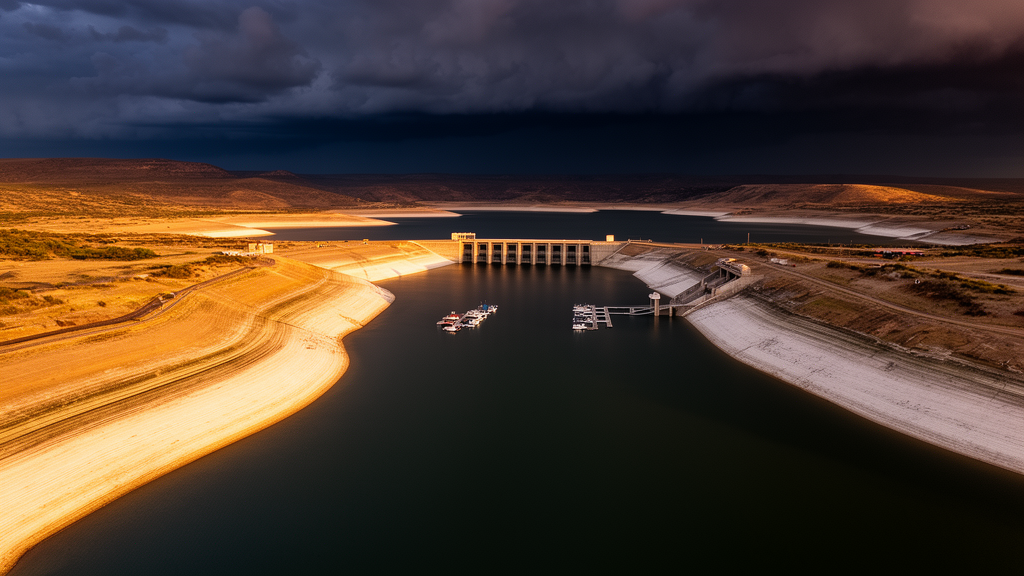
The 2002 event remains the flood of record at Canyon Lake. A new study published in Frontiers in Marine Science argues that the variable separating these two outcomes was not the size of the flood but the state of the reservoir before the rain began. In July 2025, Canyon Lake stood at roughly 46 percent of capacity after three years of drought, and the inflow consumed only 17.4 percent of the 355,000 acre-foot flood-control pool.
In 2002, the pool was already in its flood-control zone when the storms arrived, and the inflow volume was nearly twice the flood pool's capacity. The larger headwater flood produced no downstream damage; the smaller one destroyed the corridor below the dam. The authors describe this pairing as a natural experiment demonstrating that the protection Canyon Dam affords is contingent on antecedent conditions rather than a structural guarantee.
The team, led by researchers at IIT Kharagpur with a co-author from Westlake High School in Austin, quantified that contingency and extended it to its physical limit. The Probable Maximum Precipitation analysis places the controlling basin-average depths above Canyon Dam's 1,425-square-mile drainage at 14.5 inches for six hours, 18.4 inches for 12 hours, 26.3 inches for 24 hours and 32.8 inches for 48 and 72 hours. Every value exceeds the corresponding 1,000-year frequency depth from NOAA Atlas 14, and the six-hour PMP exceeds the maximum gage accumulation observed in the drainage on 4 July 2025.
The controlling storms are the Thrall, Texas event of September 1921 for short-duration local storms and the Vic Pierce, Texas event of June 1954 for tropical storms at longer durations. The volumetric arithmetic is stark. The 2D hydraulic model was calibrated against observed peak water levels from the 2002 flood at Sattler and New Braunfels, reproducing both to within about 0.3 feet.
The authors are careful about what the 2025 event does and does not demonstrate. The fatalities occurred entirely upstream of Canyon Dam, in headwater reaches where catchment response times are measured in minutes and no reservoir-based measure can act, and nothing in the study bears on their prevention. They also note that although July 2025 was extraordinary in the headwaters, it was a moderate-volume event at the reservoir: its combined modelled inflow peaked at 57,693 cubic feet per second, comparable to May 2015, but delivered less than half that event's volume, and floodplain storage and channel attenuation between Comfort and Spring Branch dissipated much of the peak before it reached the dam.
The 98.9 percent attenuation was achieved under the existing water-control manual with no predictive component, and the incumbent policy performed extremely well in the most severe test it has faced. The study's warning concerns the margin that made that performance possible. The attenuation consumed 17.4 percent of the flood pool from a starting elevation depressed by drought, so antecedent storage, not operational skill, supplied the cushion, a matter of hydrological coincidence on which future performance cannot be predicated.
Above the uncontrolled spillway crest, operational authority terminates and discharge becomes a function of pool level alone, making the transition a discrete loss of control. The researchers also flag a subtler hazard: the Sattler-New Braunfels-Seguin corridor has been regulated so effectively for so long that its development and public expectations reflect a river that does not flood, a perception the 2025 event can only have reinforced, while the 2002 spillway release recedes further into institutional memory.
Subject of Research: Reservoir antecedent storage and flood outcomes at Canyon Dam on the Guadalupe River, including the first Probable Maximum Flood analysis for the basin
Article Title: Antecedent storage governs downstream flood outcome at a flood-control reservoir: canyon dam, the 2002 and 2025 Guadalupe River floods, and the probable maximum flood
Article References: Chava, S., Devi, K., & Hanmaiahgari, P. R. (2026). Antecedent storage governs downstream flood outcome at a flood-control reservoir: canyon dam, the 2002 and 2025 Guadalupe River floods, and the probable maximum flood. Frontiers in Marine Science, 13, 1989681. https://doi.org/10.3389/fmars.2026.1989681
Image Credits: AI Generated
DOI: 10.3389/fmars.2026.1989681
Keywords: Canyon Dam, Guadalupe River, antecedent storage, flood attenuation, Probable Maximum Flood, HEC-HMS, HEC-RAS, uncontrolled spillway, Texas flash flooding, reservoir routing, inundation mapping, dam safety
Cite Scienmag News
Violet Maxwell. (October 27, 2026). Drought-emptied Texas reservoir tamed a record 2025 flood, but a bigger storm would overwhelm it. Scienmag. https://scienmag.com/drought-emptied-texas-reservoir-tamed-a-record-2025-flood-but-a-bigger-storm-would-overwhelm-it/
Violet Maxwell. "Drought-emptied Texas reservoir tamed a record 2025 flood, but a bigger storm would overwhelm it." Scienmag, 27 October 2026, https://scienmag.com/drought-emptied-texas-reservoir-tamed-a-record-2025-flood-but-a-bigger-storm-would-overwhelm-it/. Accessed 27 October 2026.
Violet Maxwell. "Drought-emptied Texas reservoir tamed a record 2025 flood, but a bigger storm would overwhelm it." Scienmag. October 27, 2026. https://scienmag.com/drought-emptied-texas-reservoir-tamed-a-record-2025-flood-but-a-bigger-storm-would-overwhelm-it/


