


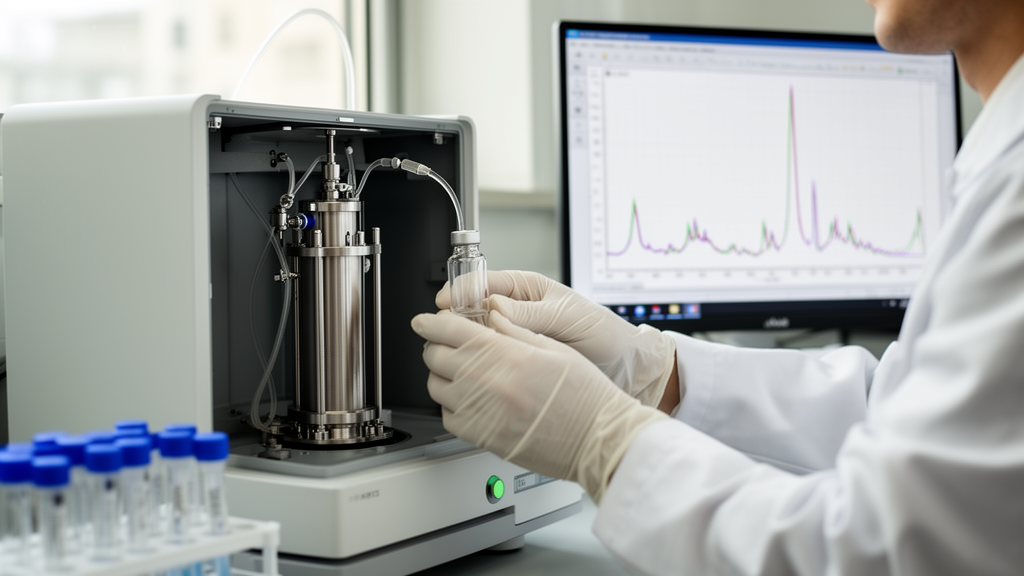
Chemists have developed and validated a single reverse-phase high-performance liquid chromatography method that can simultaneously quantify the active ingredient enalapril maleate, the preservatives methyl paraben and propyl paraben, and six specified related impurities in oral pharmaceutical formulations. The work, published as an open-access research article in Discover Chemistry in October 2026, pairs a full validation package prepared under the International Council for Harmonisation guideline ICH Q2(R2) with a formal environmental assessment using four complementary green analytical chemistry metrics. According to the authors, the method is reliable, reproducible and suitable for routine quality control and regulatory compliance testing.
Enalapril maleate, with the molecular formula C20H28N2O5·C4H4O4 and a molecular weight of 492.53 g/mol, is an orally administered prodrug of the angiotensin-converting enzyme (ACE) inhibitor class. After hepatic hydrolysis it is converted to its active form, enalaprilat, which inhibits ACE and thereby suppresses the renin–angiotensin–aldosterone system, a pathway central to the regulation of vascular tone, blood pressure and electrolyte and fluid homeostasis. For adult patients, enalapril is typically given by mouth starting at 5 mg once daily, reduced to 2.5 mg once daily when therapy is initiated alongside a diuretic to lessen the chance of excessive blood-pressure reduction.
Ongoing treatment generally requires 10 to 40 mg per day, taken as a single daily dose or split into two doses, with a total daily intake not exceeding 40 mg. Like many pharmaceutical preparations, enalapril products can contain minute levels of impurities arising from formulation excipients, manufacturing by-products or degradation during storage. To safeguard product quality and meet regulatory expectations, such impurities must be identified and measured using sensitive, validated analytical methods.
The United States Pharmacopeia provides an official method for enalapril maleate tablets covering assay determination together with limited control of related impurities. Earlier literature approaches described by the research team include simultaneous UV spectrophotometric estimation of enalapril maleate with hydrochlorothiazide in combined tablets, HPTLC-based methods for simultaneous estimation with other components, and Quality by Design-based chromatographic methods for assay determination. The authors report that previously published impurity methods lacked precision, accuracy and robustness data, key parameters of method validation.
The gap the new study addresses is the absence of a combined method for assay, preservative content and impurity profiling, evaluated alongside the greenness of the method using green metric tools. Whereas reported methods primarily focus on the assay and or related-substance determination of enalapril in tablet formulations, the proposed method was developed specifically for enalapril maleate oral solution and enables the simultaneous determination of enalapril maleate, preservative, and multiple specified related impurities, namely Impurities C, D, F, G, H and I, within a single chromatographic procedure. The conclusion also notes that the method covers the known preservative-related impurity 4-hydroxybenzoic acid, and that this combination of analytical objectives represents the principal novelty and practical contribution of the work.
Chromatographic separation was achieved on a Phenomenex Kinetex C18 column measuring 150 by 4.6 mm with 2.6 μm particles, held at 50 °C, with the autosampler maintained at 10 °C. A simple gradient was run at a flow rate of 1.0 mL per minute, using phosphate buffer at pH 2.2 as mobile phase A and acetonitrile as mobile phase B, with the same buffer serving as diluent and blank. The buffer was prepared by dissolving 6.8 g/L of potassium dihydrogen phosphate in water, adding 2 mL of triethylamine, and adjusting the pH to 2.2 with dilute phosphoric acid. A 50 μL injection volume was used, and detection was performed at 215 nm with a photodiode array detector on a Thermo Scientific Dionex Ultimate 3000 system controlled by Chromeleon 7.2.10 ES software.
Method development involved systematic evaluation of mobile phase composition, gradient profile, column temperature, flow rate and injection volume. The authors describe initial trials that could show peak tailing, co-elution, poor resolution or inconsistent retention times, addressed by adjusting analyte interaction with the stationary phase and refining the gradient program to resolve closely eluting compounds while keeping a reasonable run time. Control of column temperature improved mass transfer and reduced peak broadening, producing sharper and more symmetrical peaks, and the chosen detection wavelength ensured sufficient sensitivity for all analytes.
Reproducibility was verified through consistent retention times, peak areas and system suitability parameters across repeated injections. Test preparation was straightforward: approximately 10 mL of the enalapril maleate solution was transferred to a 50 mL volumetric flask, about 35 mL of diluent was added, the mixture was vortex-mixed for 5 minutes and sonicated for 10 minutes with intermittent shaking, made up to volume, and filtered through a 0.45 μm PVDF membrane filter with the first 2 mL of filtrate discarded. Validation results were reported across the standard ICH Q2(R2) characteristics.
Linearity was demonstrated for enalapril from 0.1 to 1.5 μg/mL and for Impurity-C over the same range, while Impurities I, D, F, G and H were linear from 0.1 to 1.6 μg/mL, with correlation coefficients of at least 0.99 for all analytes. Accuracy studies for enalapril, methyl paraben and propyl paraben showed mean recoveries of 99.8 to 100.7 percent, 99.3 to 101.1 percent and 99.3 to 100.1 percent respectively, with relative standard deviations of 0.12 to 0.22 percent, 0.05 to 0.54 percent and 0.35 to 0.63 percent. For the investigated impurities, mean recoveries ranged from 84.6 to 107.1 percent across the LOQ, 100 percent and 150 percent levels.
Sensitivity was confirmed through determination of the limits of detection and quantification, corresponding to signal-to-noise ratios of 3:1 and 10:1, which the authors say establishes suitability for trace-level impurity analysis. Precision and intermediate precision were assessed across six replicate preparations, with relative standard deviations ranging from 0.62 to 3.04 percent for method precision and from 0.00 to 2.27 percent for intermediate precision. For spiked samples, relative standard deviations for both precision levels were at or below 4.3 percent for all detectable impurities, which the authors cite as confirming acceptable precision at trace concentrations.
A filter study compared centrifuged samples with samples passed through 0.45 μm PVDF and 0.45 μm nylon filters, and all observed values fell within the specified accuracy limit of 80 to 120 percent, indicating no significant loss or adsorption of analytes during filtration. Solution stability testing compared impurity levels at initial time points and after 48 hours for Impurities C, D, F, G, H and I, with all results within the 80 to 120 percent accuracy limit, indicating the analytes were stable for at least 48 hours without degradation. Robustness was established by deliberately varying buffer pH between 2.1 and 2.3 and column temperature between 48 and 52 °C, with all spiked-sample results remaining within the 80 to 120 percent limit.
Specificity was established by demonstrating clear separation of enalapril maleate, the preservatives and the related impurities without interference from placebo components or degradation products. When the method was applied to commercial formulations, the assay results obtained for enalapril, methyl paraben and propyl paraben in the analysed tablets were 100.48 percent, 98.00 percent and 100.55 percent respectively, all within the specified acceptance range of 90 to 110 percent, and the individual impurity levels detected were within the limit of not more than 0.20 percent. The authors present these findings as evidence that the method is fit for routine analytical application and regulatory compliance testing.
A distinctive feature of the study is its environmental evaluation using four green analytical chemistry tools. The Analytical Eco-Scale, proposed by Van Aken and colleagues, assigns penalty points for reagent consumption, hazards, energy usage and waste production, with the score calculated as 100 minus total penalty points; scores above 75 indicate excellent greenness, 50 to 75 acceptable greenness, and below 50 inadequate performance. The proposed method scored 73 with a total penalty of 27, placing it in the acceptable, moderately green category, with most penalties arising from a few contributors.
The National Environmental Methods Index provides a qualitative four-quadrant pictogram covering persistent, bioaccumulative and toxic substances, hazardous chemicals, corrosive reagents and waste volume; the method's pictogram showed three green quadrants and one white quadrant, indicating one hazardous aspect due to reagents and solvents. The Modified Green Analytical Procedure Index returned an overall score of 72, with most parameters in the green and yellow zones and a few in the red zone, while AGREE, based on the 12 principles of green analytical chemistry, returned a score of 0.61 on a 0-to-1 scale, in the moderate-to-good yellow-green transition zone. Taken together, the authors conclude that the method offers a balanced integration of analytical performance, comprehensive quality assessment, operational efficiency and environmental consideration, reducing the need for multiple separate analyses compared with conventional HPLC procedures that consume larger volumes of organic solvents such as acetonitrile or methanol and generate greater analytical waste.
Subject of Research: Development and green-metric evaluation of an RP-HPLC method for simultaneous quantification of enalapril maleate, preservatives and related impurities in pharmaceutical formulations
Article Title: Green metric based evaluation of an RP HPLC method for simultaneous quantification of active pharmaceutical ingredient preservative and related impurities in pharmaceutical formulations
Article References: Wagh, V. R., Madane, N. S., Bagul, V. A., & Tiwari, A. R. (2026). Green metric based evaluation of an RP HPLC method for simultaneous quantification of active pharmaceutical ingredient preservative and related impurities in pharmaceutical formulations. Discover Chemistry, 3(1), 591. https://doi.org/10.1007/s44371-026-01044-2
Image Credits: AI Generated
DOI: 10.1007/s44371-026-01044-2
Keywords: RP-HPLC, enalapril maleate, impurity profiling, preservatives, ICH Q2(R2) validation, green analytical chemistry, Analytical Eco-Scale, AGREE, NEMI, MoGAPI, pharmaceutical quality control, method validation
Cite Scienmag News
Bethany Barker. (October 27, 2026). Green-Rated HPLC Method Measures Blood Pressure Drug, Preservatives and Impurities in One Run. Scienmag. https://scienmag.com/green-rated-hplc-method-measures-blood-pressure-drug-preservatives-and-impurities-in-one-run/
Bethany Barker. "Green-Rated HPLC Method Measures Blood Pressure Drug, Preservatives and Impurities in One Run." Scienmag, 27 October 2026, https://scienmag.com/green-rated-hplc-method-measures-blood-pressure-drug-preservatives-and-impurities-in-one-run/. Accessed 27 October 2026.
Bethany Barker. "Green-Rated HPLC Method Measures Blood Pressure Drug, Preservatives and Impurities in One Run." Scienmag. October 27, 2026. https://scienmag.com/green-rated-hplc-method-measures-blood-pressure-drug-preservatives-and-impurities-in-one-run/


