


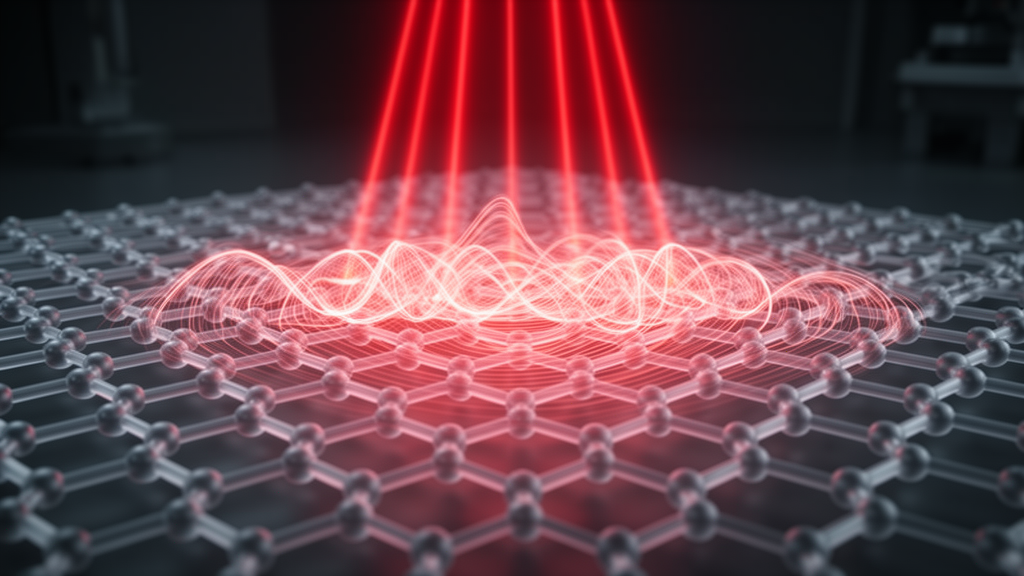
Researchers at the Technion-Israel Institute of Technology and universities in Germany have demonstrated, for the first time, direct optical control of electrons inside a Floquet topological insulator — a temporary quantum state of matter created when graphene is illuminated with ultrashort laser pulses. The study, published in Nature Physics with an article publication date of 31 August 2026, was led theoretically by Dr. Ofer Neufeld of the Technion’s Schulich Faculty of Chemistry and Helen Diller Quantum Center, together with experimental colleagues Prof. Peter Hommelhoff and Dr. Daniel Lesko, affiliated with Friedrich-Alexander-Universität Erlangen-Nürnberg and Ludwig Maximilian University of Munich.
Graphene, a single layer of carbon atoms arranged in a honeycomb lattice, is the working material of the experiment. Although it is chemically related to the graphite in pencil lead, its properties differ dramatically: it is several times stronger than a steel sheet of comparable thickness, nearly transparent, and highly conductive. Under ordinary conditions graphene is not a topological insulator. The team showed that precisely timed laser pulses can temporarily transform the material’s properties, creating the Floquet topological insulator — an out-of-equilibrium quantum phase that exists only while the light is present. Additional light pulses can then be used to control the movement of electrons within this transient phase.
The central experimental signature is a chiral response. The researchers found that the electric current generated in the material behaves differently depending on whether the illuminating light is circularly polarized clockwise or counterclockwise. By mapping the resulting currents against both the polarization and the timing of the laser pulses, they revealed that the light-induced quantum state is sensitive to the phase of the driving field. This phase sensitivity, the authors report, could open new ways of measuring the properties of materials that are driven out of thermodynamic equilibrium.
The demonstration matters because Floquet topological insulators have largely been a theoretical construct: ideas developed in recent years predicted that light could reshape the electronic structure of quantum materials and endow them with topological characteristics they do not possess in the dark. The new measurements provide direct experimental evidence that such a light-dressed state can be created and actively manipulated, rather than merely observed passively. According to the paper’s metadata, the work is classified as an experimental study, with the theoretical effort led from Technion and the experiments conducted by the German partners.
Dr. Neufeld, a Technion alumnus who returned to the institute in 2024 as a faculty member after postdoctoral research at the Max Planck Institute for the Structure and Dynamics of Matter in Hamburg, where he worked in Prof. Angel Rubio’s group, emphasized the potential reach of the result. “The implications of this research extend beyond graphene,” he said. “We believe our findings could help enable faster, more energy-efficient electronic components, as well as communications, sensing, and computing systems based on properties that can be switched on and off with light.”
The research was supported by the German Research Foundation (DFG), the European Union’s FET Open program under Horizon 2020, and the Gordon and Betty Moore Foundation. The published paper, titled “Optical control of electrons in a Floquet topological insulator,” appears in Nature Physics under DOI 10.1038/s41567-026-03429-7.
As with any first demonstration, the reported results describe a controlled laboratory measurement of a transient state rather than a device-ready technology. The chiral currents were produced and mapped under specific laser polarization and timing conditions, and the state itself exists only while the driving pulses illuminate the sample. Nevertheless, the work establishes that the electronic response of an out-of-equilibrium topological phase can be steered optically on ultrafast timescales, a capability the researchers suggest may underpin future light-switchable electronics, sensing, and computing concepts built on materials whose properties are defined by light rather than by their static composition.
Subject of Research: Optical control of electrons in a light-induced Floquet topological insulator state of graphene
Article Title: Team of researchers from the Technion and Germany demonstrates optical control of electrons in an out-of-equilibrium topological state
Article References: Team of researchers from the Technion and Germany demonstrates optical control of electrons in an out-of-equilibrium topological state. Original publication (Bibliographic details unavailable.)
Image Credits: AI Generated
DOI: Not provided
Keywords: graphene, Floquet topological insulator, laser pulses, out-of-equilibrium physics, chiral current, circular polarization, ultrafast optics, quantum materials, topological phases, Nature Physics, Technion, light-matter interaction
Cite Scienmag News
Neil Sanderson. (October 26, 2026). Laser pulses steer electrons in a fleeting Floquet topological state of graphene. Scienmag. https://scienmag.com/laser-pulses-steer-electrons-in-a-fleeting-floquet-topological-state-of-graphene/
Neil Sanderson. "Laser pulses steer electrons in a fleeting Floquet topological state of graphene." Scienmag, 26 October 2026, https://scienmag.com/laser-pulses-steer-electrons-in-a-fleeting-floquet-topological-state-of-graphene/. Accessed 26 October 2026.
Neil Sanderson. "Laser pulses steer electrons in a fleeting Floquet topological state of graphene." Scienmag. October 26, 2026. https://scienmag.com/laser-pulses-steer-electrons-in-a-fleeting-floquet-topological-state-of-graphene/


