


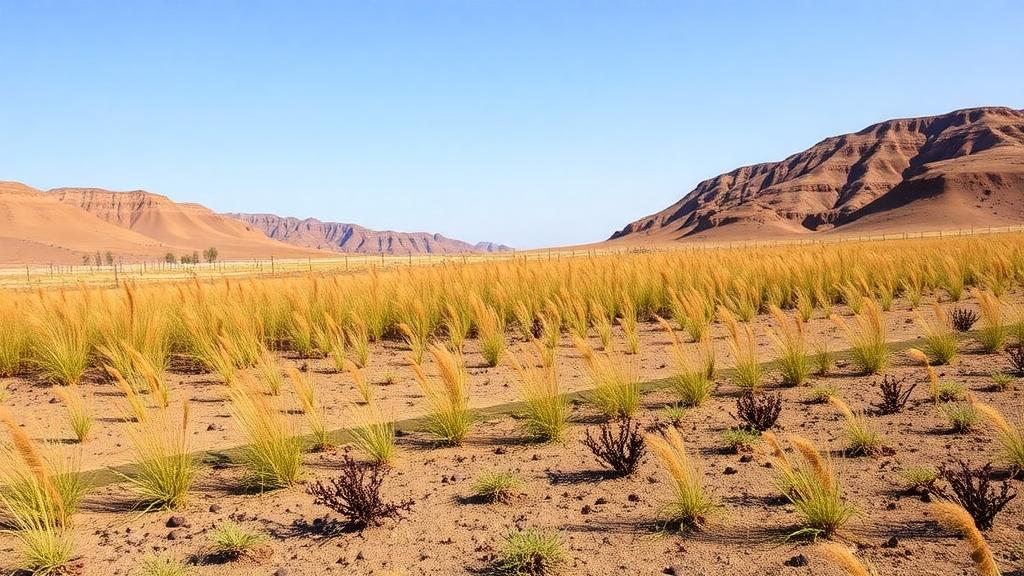
Across the vast grasslands of northern China, life above and below the ground is quietly reorganizing itself as the climate grows drier. A new study published in Communications Earth & Environment reveals that the relationships between plant diversity and soil microbial diversity are not fixed features of these ecosystems. Instead, they shift in predictable, threshold-dependent ways as aridity intensifies, with profound implications for how these landscapes will respond to ongoing climate change-driven aridification.
An international research team led by Congwen Wang and Yingxin Huang of the State Key Laboratory of Black Soils Conservation and Utilization at the Northeast Institute of Geography and Agroecology, Chinese Academy of Sciences, undertook one of the most ambitious field campaigns ever mounted to address this question. The researchers surveyed grasslands along a transect stretching roughly 4,000 kilometers across the arid and semi-arid regions of northern China, sampling soil conditions, plant communities, and the diversity of soil microbes at sites spanning a wide range of dryness. The scale of the survey matters: relationships between biodiversity and climate often only become visible when examined across sufficiently broad environmental gradients, and this transect captures the full transition from semi-arid steppe into genuinely arid terrain.
The central finding is that soil conditions, plant diversity, and microbial diversity do not decline smoothly as aridity increases. Rather, they exhibit sequential threshold responses along the aridity gradient. In ecological terms, a threshold response means a system can absorb incremental stress up to a point and then change abruptly. Beyond these aridity thresholds, the study found that plant, bacterial, and fungal diversity generally decline, whereas archaeal species diversity increases. This divergence among microbial domains is one of the most striking aspects of the work, because bacteria, fungi, and archaea are often lumped together as a single soil microbial community in biodiversity assessments. The new results suggest that doing so obscures fundamentally different responses to drying.
The behavior of archaea deserves particular attention. These single-celled organisms, distinct from bacteria in their genetics and biochemistry, include many lineages famous for tolerating extreme environments. The finding that archaeal species diversity rises as conditions become drier, and that soil salinity becomes increasingly positively associated with archaeal diversity along the gradient, is consistent with the idea that arid, saline soils function as a habitat in which stress-tolerant archaeal lineages can persist or even flourish while less tolerant organisms are filtered out. In other words, what is a catastrophe for plants and many bacteria and fungi may represent an expanding niche for archaea.
Soil salinity emerges as a critical mediator in the study. As aridity increases, the negative effects of salinity on plant, bacterial, and fungal diversity become stronger. This makes mechanistic sense: in drier climates, lower precipitation means less dilution and leaching of salts, so salts accumulate more readily in surface soils, imposing osmotic stress on roots and on microbes that lack adaptations to high solute concentrations. At the same time, salinity shows increasingly positive associations with archaeal species diversity, reinforcing the picture of a taxon-specific restructuring of belowground life. For land managers, this coupling of aridity and salinity suggests that as drying proceeds, salinization may act as an accelerating secondary stressor, compounding the direct effects of water scarcity on grassland biodiversity.
Perhaps the most consequential result concerns the coupling between aboveground and belowground diversity. Plant–bacteria and plant–fungi diversity relationships strengthen in drier regions, whereas plant–archaea relationships become decoupled. This is counterintuitive in an interesting way. One might expect that as conditions harshen, the tight partnerships between plants and their microbial associates would fray. Instead, the study finds that plants and the bacterial and fungal communities they host become more tightly linked in diversity as aridity rises. A plausible interpretation is that aridity acts as a strong environmental filter: only a subset of stress-tolerant plant species and a corresponding subset of tolerant microbial taxa can survive at the dry end of the gradient, and the fates of these surviving groups become increasingly interdependent. The decoupling of plant and archaeal diversity, by contrast, indicates that archaea respond to different environmental drivers than plants do, likely tracking soil physicochemical conditions such as salinity rather than vegetation structure.
The concept of an environmental filter is central to modern community ecology. In benign environments, a wide range of species with varied traits can establish, and community composition is shaped substantially by interactions among species. In harsh environments, the filter eliminates species lacking the physiological tolerance to cope with the stress, leaving a narrower, more deterministic set of survivors. The new study demonstrates that aridity functions as exactly such a filter, selecting stress-tolerant species and restructuring plant–microbial diversity coupling in a manner that differs sharply among taxa. This reframing has practical consequences: models that assume static relationships between plant and microbial diversity across climates may misestimate how grassland ecosystems will respond as aridification proceeds.
The findings also speak directly to the question of ecosystem resilience. Resilience, the capacity of an ecosystem to absorb disturbance and reorganize while retaining its essential functions, depends in part on the diversity of the organisms performing those functions. If plant, bacterial, and fungal diversity decline beyond aridity thresholds, the functional redundancy of these grasslands may be eroded precisely where environmental stress is greatest, potentially leaving dry-end ecosystems with less buffering capacity against further change. Meanwhile, the strengthening of plant–microbial coupling in drier regions suggests that losses in one compartment of the ecosystem may propagate more readily into the other, raising the stakes of any single component’s decline. The authors highlight the importance of aridity-dependent biodiversity coupling for shaping ecosystem resilience in arid and semi-arid grasslands under ongoing aridification.
The broader context makes these results timely. Grasslands cover a substantial fraction of Earth’s land surface and support pastoral economies, carbon storage, and habitat for a wide array of species. Semi-arid and arid grasslands are widely projected to expand and intensify as warming increases evaporative demand. Related recent work, including studies of threshold-dependent ecosystem stability on the Mongolian Plateau and analyses showing that biodiversity effects under climate extremes intensify with aridity in grasslands but not forests, converges on a similar message: drylands may harbor ecological tipping points that smoother, linear models fail to anticipate. The new transect study adds a crucial belowground dimension to this picture, showing that the invisible microbial world beneath the grass responds to drying with its own thresholds, its own winners, and its own changing relationships with the vegetation above.
For conservation and restoration, the study’s implications are sobering but actionable. Threshold responses mean that incremental drying may appear harmless until a critical aridity level is crossed, at which point plant and microbial diversity can decline together in a coupled fashion. Identifying where these thresholds lie along aridity gradients, and protecting sites that remain on the resilient side of them, could help preserve the biodiversity that underpins grassland function. Conversely, the rise of archaeal diversity in the driest, saltiest soils is a reminder that aridification does not simply erase life belowground; it reshuffles it, favoring organisms adapted to stress and loosening some ecological ties while tightening others. As climate change continues to push the world’s drylands toward greater aridity, understanding these taxon-specific, threshold-dependent dynamics will be essential for anticipating which grasslands will bend, which will break, and which may transform into something new.
Subject of Research: Aridity-driven shifts in plant–soil microbial diversity relationships in arid and semi-arid grasslands of northern China
Article Title: Aridity-driven shifts in plant–microbial diversity relationships across the arid and semi-arid grasslands of northern China
Article References: Wang, C., Wang, H., Yang, H., Qiang, W., Fu, C., Fan, J., & Huang, Y. (2026). Aridity-driven shifts in plant–microbial diversity relationships across the arid and semi-arid grasslands of northern China. Communications Earth & Environment. https://doi.org/10.1038/s43247-026-04127-1
Image Credits: AI Generated
DOI: 10.1038/s43247-026-04127-1
Keywords: aridity, grasslands, soil microbiome, plant diversity, bacteria, fungi, archaea, soil salinity, ecological thresholds, environmental filtering, ecosystem resilience, climate change
Cite Scienmag News
Morgan Morrow. (October 10, 2026). Drought Draws New Maps of Life: Aridity Rewires Plant and Microbial Diversity in China’s Grasslands. Scienmag. https://scienmag.com/drought-draws-new-maps-of-life-aridity-rewires-plant-and-microbial-diversity-in-chinas-grasslands/
Morgan Morrow. "Drought Draws New Maps of Life: Aridity Rewires Plant and Microbial Diversity in China’s Grasslands." Scienmag, 10 October 2026, https://scienmag.com/drought-draws-new-maps-of-life-aridity-rewires-plant-and-microbial-diversity-in-chinas-grasslands/. Accessed 10 October 2026.
Morgan Morrow. "Drought Draws New Maps of Life: Aridity Rewires Plant and Microbial Diversity in China’s Grasslands." Scienmag. October 10, 2026. https://scienmag.com/drought-draws-new-maps-of-life-aridity-rewires-plant-and-microbial-diversity-in-chinas-grasslands/


