


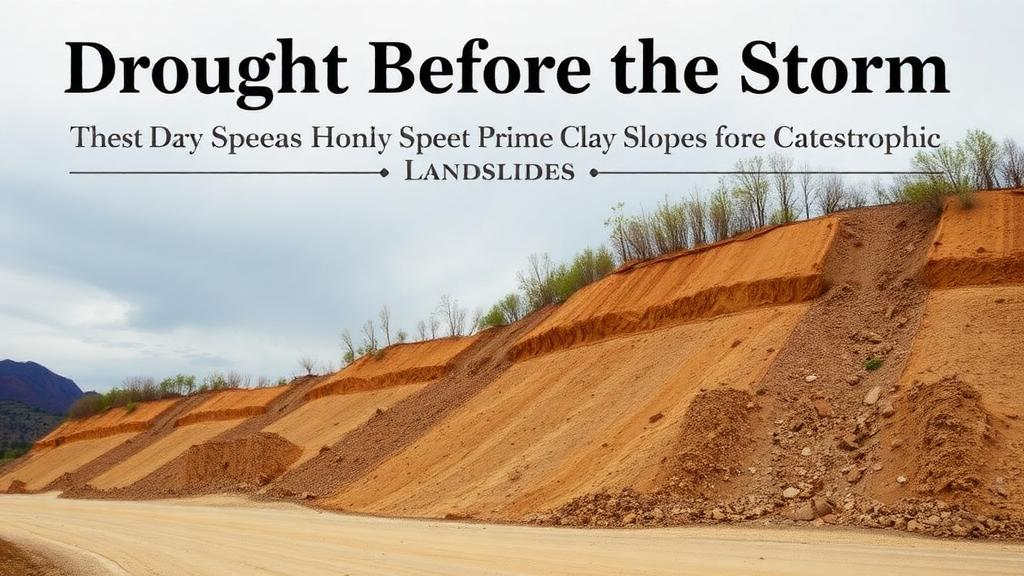
When a hillside collapses after a torrential downpour, the obvious suspect is the rain itself. For decades, landslide early warning systems have been built on exactly that assumption, distilling hazard into simple relationships between rainfall intensity and duration. But a new study from the landslide-prone eastern Black Sea region of Türkiye suggests that one of the most dangerous ingredients in a deadly landslide may arrive weeks before the first raindrop falls. Prolonged drought, the researchers find, can silently re-engineer the near-surface soil in ways that turn an ordinary storm into a slope-shattering trigger, multiplying the number of landslides even when the rainfall itself is weaker.
The research, published in Environmental Earth Sciences by Dogukan Tayyar of Hacettepe University and the University of Twente and colleagues, examined four intense rainfall events at two sites in the provinces of Artvin and Rize. The contrast between paired events at each site is striking. In Hopa, a September 2012 storm dumped roughly 340 millimeters of rain in a single day and triggered 26 landslides. Three years later, an August 2015 event delivered only about 220 millimeters in a day yet produced 1,367 landslides. The critical difference: the 2015 event followed a prolonged dry spell lasting most of the preceding 60 days. Kaptanpaşa told the same story. A November 2015 storm of about 170 millimeters caused 67 landslides, while a September 2017 event preceded by drought and driven by only around 130 millimeters per day unleashed 1,142 failures.
The region where these events unfolded is no ordinary landscape. The eastern Black Sea coast accounts for roughly 55.5 percent of all fatal landslides reported in Türkiye between 1929 and 2019, and according to global records from 1995 to 2014, the area experienced the highest number of landslide-related fatalities in Europe. Steep, deeply incised valleys carved into the volcanic rocks of the Eastern Pontides rise to elevations above 1,500 meters, while orographic winds force moist air against the coastal mountains, sustaining some of the highest rainfall totals in the country, with long-term annual averages reaching nearly 2,000 millimeters along the coast. Despite this hazard, no rainfall-based early warning system currently exists in the study area.
The key to the paradox lies in the mineralogy of the soil. The residual soils mantling these slopes derive from volcanic and volcaniclastic parent rocks and are exceptionally clay-rich: previous geotechnical work using X-ray diffraction and scanning electron microscopy found that clay and mica together make up between 21.7 and 89.9 percent of bulk samples, averaging 66 percent, with the mineral halloysite dominating the clay fraction in 23 of 29 samples tested. Halloysite is notorious for its hydration-dependent behavior, transitioning irreversibly between a fully hydrated and a dehydrated form as it dries. Roughly half of the tested specimens exhibited medium to high swelling potential, meaning the soil shrinks and cracks when dried and swells when wetted, a property that sits at the heart of the drought-landslide connection.
To test whether this mineralogical vulnerability could explain the field observations, the team built a coupled hydro-mechanical numerical model of a representative slope using the SEEP/W and SLOPE/W modules of GeoStudio. They simulated the 60 days preceding both the wet-condition 2015 event and the dry-condition 2017 event at Kaptanpaşa, tracking transient seepage, pore-water pressures, and the slope’s factor of safety. Under wet antecedent conditions, the soil was represented as a single intact layer with a standard unimodal soil-water characteristic curve. Under dry conditions, the model instead featured a one-meter-thick cracked surface layer described by a bimodal curve, capturing the dual-porosity behavior of a soil riddled with desiccation cracks, together with a near-total loss of surface cohesion.
The results were revealing. In the wet-condition simulation, the factor of safety declined only gradually, from about 1.20 to 1.01 by the time the triggering storm arrived, leaving the slope hovering at the edge of stability. In the dry-condition model with the cracked layer, the factor of safety started lower, around 1.10, and then plunged abruptly to 0.84 when the intense rainfall hit, a clear numerical signature of failure. Crucially, when the team re-ran the 2017 dry scenario without the crack-related changes, keeping intact cohesion and a unimodal curve, the factor of safety fell only to about 1.06 and never crossed the failure threshold. Meteorological forcing alone, in other words, could not reproduce the observed landsliding; only the combination of crack-enhanced permeability and cohesion loss could. The model also predicted a shift in failure style: the dry-condition critical slip surface was confined to a shallow zone near the surface, consistent with the numerous small, shallow failures mapped in 2017, whereas the wet-condition surface was deeper and larger, matching the fewer, deeper failures of 2015.
The pore-pressure profiles added further mechanistic insight. Throughout the month before failure, the dry-condition soil sustained substantially more negative pore-water pressures, greater matric suction, at every modeled depth. Yet when the storm arrived, pore pressures at all depths rose sharply from that lower baseline, and the soil entered the triggering rainfall from a far more precarious suction state than its wet-condition counterpart. The cracked macropore network effectively bypasses the low-permeability soil matrix, converting infiltration from slow matrix flow into rapid preferential flow that lubricates a potential sliding surface within days rather than weeks. Laboratory studies cited by the authors support the plausibility of this sequence: desiccation cracks can initiate in clayey soils within just two days at around 22 degrees Celsius, and crack intensity has been reported to increase saturated hydraulic conductivity by more than 85 percent in prolonged dry seasons.
To check whether the pattern held beyond a single modeled slope, the researchers also ran a data-driven statistical analysis across all four event inventories, which together comprised 9,560 slope-unit observations, including 1,203 landslide presences mapped from high-resolution satellite and drone imagery. A binomial generalized additive model related landslide occurrence to landslide-day precipitation, the 30-day Standardized Precipitation Index, local relief, slope steepness, and aspect. The model performed consistently under grouped tenfold cross-validation, achieving an overall ROC AUC of 0.836, well above the 0.5 of random classification. Its most striking output was the fitted interaction surface: predicted landslide probability climbed steeply with rainfall when antecedent conditions were drier than normal, but remained comparatively low under near-normal to wet conditions across most of the rainfall range. Intense rain and drought, in combination, proved far more dangerous than either alone.
The authors are careful to frame the findings as complementary lines of evidence rather than proof. No direct field measurements of cracks, soil profiles, or slip surfaces exist for the studied events, and sensitivity analyses showed the numerical results depend on assumptions about cohesion loss, groundwater depth, and crack thickness, each capable of shifting the computed stability by a similar margin. The mechanism is also inherently specific: it requires fine-grained, shrink-swell-prone soils and is expected to operate mainly in the upper one to one-and-a-half meters of the vadose zone, where evaporation is most intense. Coarse-grained or non-plastic materials would not crack in the same way, although analogous drought effects such as soil-water repellency or root-decay macropores might operate through different physics.
Even with those caveats, the implications for hazard forecasting are profound. Conventional rainfall thresholds derived from intensity-duration relationships may systematically underestimate landslide probability in clay-rich terrain when a storm follows a dry spell, precisely the sequence that climate change is expected to make more common as heat waves and extreme convective rainfall increasingly collide. The authors propose that future early warning systems incorporate drought metrics such as the Standardized Precipitation Index alongside traditional rainfall thresholds, and suggest that satellite-based radar interferometry could eventually monitor the millimeter-scale shrink-swell breathing of clay slopes between seasons, offering remote validation of the mechanism. In the Black Sea region, where deadly landslides recur almost every summer yet no warning system exists, treating drought not as a passive backdrop but as an active co-conspirator in slope failure could mean the difference between a storm that passes and one that reshapes a hillside.
Subject of Research: The amplifying effect of antecedent drought on rainfall-induced shallow landslides in clay-rich terrain
Article Title: Analysis of amplifying effect of antecedent drought on rainfall-induced shallow landslides
Article References: Tayyar, D., Tanyas, H., Comert, R., Yildiz, A., Gorum, T., Isik, N. S., & Ekmekci, M. (2026). Analysis of amplifying effect of antecedent drought on rainfall-induced shallow landslides. Environmental Earth Sciences, 85(16), Article 418. https://doi.org/10.1007/s12665-026-13171-1
Image Credits: AI Generated
DOI: 10.1007/s12665-026-13171-1
Keywords: landslides, drought, desiccation cracks, rainfall thresholds, soil hydrology, slope stability, halloysite, Standardized Precipitation Index, early warning systems, Türkiye, Black Sea region, numerical modeling
Cite Scienmag News
Violet Maxwell. (October 8, 2026). Drought Before the Storm: How Dry Spells Prime Clay Slopes for Catastrophic Landslides. Scienmag. https://scienmag.com/drought-before-the-storm-how-dry-spells-prime-clay-slopes-for-catastrophic-landslides/
Violet Maxwell. "Drought Before the Storm: How Dry Spells Prime Clay Slopes for Catastrophic Landslides." Scienmag, 8 October 2026, https://scienmag.com/drought-before-the-storm-how-dry-spells-prime-clay-slopes-for-catastrophic-landslides/. Accessed 8 October 2026.
Violet Maxwell. "Drought Before the Storm: How Dry Spells Prime Clay Slopes for Catastrophic Landslides." Scienmag. October 8, 2026. https://scienmag.com/drought-before-the-storm-how-dry-spells-prime-clay-slopes-for-catastrophic-landslides/


