


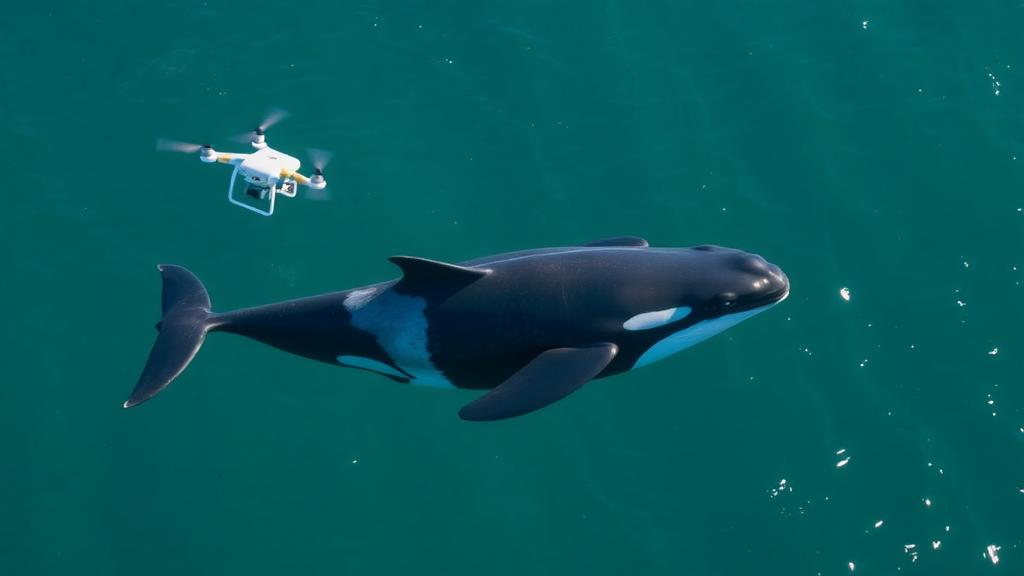
A small unmanned aircraft hovering above the cold waters of the Salish Sea has helped a conservation science team earn international recognition. The San Diego Zoo Wildlife Alliance has won the Academia & Research category at the inaugural 2026 Global Drone Operations Awards, a competition hosted by SPH Engineering that celebrates excellence in civilian drone applications. The award honors senior scientist James Sheppard and his colleagues for developing innovative research methods to study one of the most endangered marine mammals on Earth: the Southern Resident killer whale population, whose remaining members number as few as 75 individuals.
The recognition highlights a growing shift in wildlife biology, where aerial robotics are replacing intrusive boat-based observation techniques that once defined marine mammal research. Instead of approaching whales closely, darting them, or restraining them for examination, scientists can now gather detailed physiological information from dozens of meters above the animals, leaving their behavior undisturbed. For a population teetering on the edge of extinction, that distinction is not merely a matter of convenience. Every unnecessary stressor placed on a dwindling group of long-lived, slow-reproducing mammals carries consequences, and the drone-based approach was designed from the outset to eliminate physical contact entirely.
The work is part of an ongoing research program in the Salish Sea, the intricate network of coastal waterways between Washington State and British Columbia that forms the core summer habitat of the Southern Residents. The project is conducted in collaboration with the SeaDoc Society and the National Oceanic and Atmospheric Administration, drawing on the complementary expertise of a wildlife conservation organization, a marine science institute, and the federal agency responsible for monitoring protected species in United States waters. Credit for the aerial imagery associated with the program reflects this partnership, with breath-collection photography credited to Maya Sears of NOAA under NMFS ESA Permit #21348, a reminder that every aspect of the research operates within strict federal permits governing the study of endangered species.
The technical core of the method is deceptively simple in concept and demanding in execution. Operating from research vessels, the team pilots drones fitted with thermal imaging sensors over surfacing whales. The thermal cameras measure the heat radiating from the animals’ bodies, which can reveal information about their physical condition. At the same time, a specially mounted petri dish is attached to the aircraft, positioned so that when a whale exhales in a forceful burst known as a blow, the droplets from that exhalation drift upward and settle on the dish. These droplets are not merely water vapor. A whale’s breath carries a biological payload of cells, microorganisms, hormones, and other molecular markers that, once captured, can be transported back to the laboratory and analyzed.
From those tiny samples, researchers can extract microbiological and molecular data. Microbiological analysis identifies the bacteria, fungi, and other microbes inhabiting a whale’s respiratory tract, a community whose composition can shift when an animal is sick or immunocompromised. Molecular techniques applied to the same samples can detect genetic material and biochemical signatures associated with physiological state, including indicators of pregnancy, nutritional stress, or infection. Combined with the thermal measurements gathered by the drone during the same flight, each successful sampling event contributes to an individual health profile, effectively a medical record assembled without ever touching the animal.
The value of these profiles compounds over time. By establishing a baseline for the health of the endangered population, the team creates a reference point against which future measurements can be compared. If a particular whale’s thermal signature or respiratory microbiome changes between seasons, researchers can flag the animal for closer attention and investigate whether the shift correlates with environmental pressures such as reduced salmon availability, vessel noise, or contaminant exposure. In a population as small as this one, where the loss of even a single reproductive female can meaningfully alter the trajectory of the species, the ability to detect illness early and non-invasively could directly inform management decisions.
The Southern Resident killer whales occupy a unique and precarious position. Unlike transient or Bigg’s killer whales, which hunt marine mammals, the Southern Residents specialize in Chinook salmon, a fish whose own populations have declined dramatically across the Pacific Northwest. The whales face a compounding set of threats: diminished prey, chronic disturbance and acoustic masking from vessel traffic, and the bioaccumulation of legacy pollutants in their blubber. Because these orcas are fish specialists with small, closed social groups and low reproductive rates, their population has never recovered from the captures and culls of the twentieth century, and conservation managers have long struggled to gather the physiological data needed to assess individual condition without adding to the animals’ burden.
Drone technology has emerged as one of the most powerful answers to that dilemma, and the award-winning San Diego Zoo Wildlife Alliance program illustrates why. Modern multirotor aircraft can hover with centimeter-level stability in maritime conditions, carry interchangeable sensor payloads, and be launched and recovered from the deck of a small research vessel within minutes. Thermal cameras resolve body-surface temperature patterns that correlate with blubber thickness and energetic condition. Mounted collection surfaces intercept exhaled condensate that would otherwise be lost to the wind. And because the aircraft approaches from above at regulated altitudes, the whales below largely continue their natural foraging, resting, and socializing behavior while the sampling takes place. The result is a research platform that turns each whale encounter into a mobile field clinic conducted entirely at a distance.
The Global Drone Operations Awards, in their inaugural year, were established by SPH Engineering to recognize outstanding achievements across sectors where uncrewed aerial systems are transforming professional practice. Winning the Academia & Research category places the killer whale program alongside projects in fields ranging from surveying and mapping to inspection and public safety, and underscores how rapidly conservation science has adopted technologies first commercialized for industrial use. For the San Diego Zoo Wildlife Alliance team, the honor is less about the aircraft than about the scientific framework built around them: rigorous, permit-compliant protocols that convert routine drone flights into longitudinal health data for a critically endangered population.
The broader implications extend well beyond the Salish Sea. The same combination of thermal imaging and breath capture can be adapted to other cetaceans and, with modification, to other wildlife species where handling is risky, impractical, or prohibited. As drone payloads grow more sophisticated, integrating miniature air-quality sensors, high-resolution spectrometers, and automated sample-stabilization systems, the frontier of non-invasive wildlife physiology continues to expand. What began as a novel way to intercept a puff of whale breath has matured into a template for how conservation biologists can monitor the health of vulnerable animals at population scale, generating the evidence needed to protect them while leaving them, quite literally, undisturbed. For the 75 remaining Southern Residents, the drones circling overhead represent something quietly profound: scientists working to understand them without ever coming close enough to change what it means to be a wild killer whale.
Subject of Research: Drone-based non-invasive health monitoring of endangered Southern Resident killer whales in the Salish Sea.
Article Title: San Diego Zoo Wildlife Alliance earns Drone Operations Award
Article References: San Diego Zoo Wildlife Alliance earns Drone Operations Award. (n.d.). Original publication
Image Credits: AI Generated
DOI: Not provided
Keywords: drones, killer whales, Southern Residents, Salish Sea, conservation, San Diego Zoo Wildlife Alliance, thermal imaging, breath sampling, NOAA, SeaDoc Society, wildlife health, endangered species
Cite Scienmag News
Margaret Porter. (October 14, 2026). Drones Take Flight in the Fight to Save Endangered Killer Whales. Scienmag. https://scienmag.com/drones-take-flight-in-the-fight-to-save-endangered-killer-whales/
Margaret Porter. "Drones Take Flight in the Fight to Save Endangered Killer Whales." Scienmag, 14 October 2026, https://scienmag.com/drones-take-flight-in-the-fight-to-save-endangered-killer-whales/. Accessed 14 October 2026.
Margaret Porter. "Drones Take Flight in the Fight to Save Endangered Killer Whales." Scienmag. October 14, 2026. https://scienmag.com/drones-take-flight-in-the-fight-to-save-endangered-killer-whales/


