


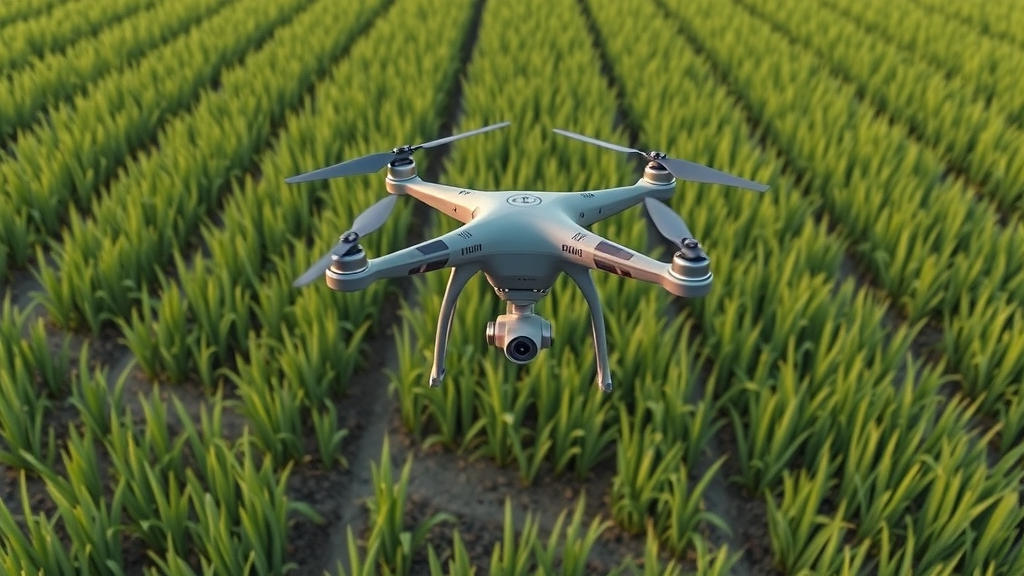
Rice feeds more than half of humanity, yet the crop is under siege. The Food and Agriculture Organization projects that global agricultural production and consumption in 2050 will need to be roughly 60 percent higher than in 2005 to 2007 to satisfy a population of about 9.15 billion people, while every 1 degree Celsius rise in mean temperature is estimated to shave around 3.2 percent off global rice yields. Against that backdrop, a sweeping new systematic review argues that small drones flying a few metres above flooded paddies may be one of the most powerful tools breeders and farmers have for keeping the staple crop productive.
The review, published in Smart Agricultural Technology, synthesises 199 peer-reviewed studies published between 2014 and 2026 that applied unmanned aerial vehicle remote sensing to rice phenotyping, the systematic measurement of plant traits. Led by Xiaoao Yang of Guangdong Province and colleagues including Spyros Fountas of Greece’s Agricultural University of Athens, the team screened 2,327 records from Scopus and Web of Science, ultimately distilling a corpus they call Core-199. Their goal was to build a rice-specific framework connecting platforms, sensors, data-processing methods and agronomic tasks, from nitrogen diagnosis to yield prediction, in a field that has grown explosively but unevenly.
The case for drones rests on a simple observational gap. Manual field surveys are labour-intensive and subjective, demanding an estimated 200 to 500 man-hours per hectare, while destructive sampling rules out repeated monitoring of the same plants. Satellites, meanwhile, revisit fields at best every five days and deliver pixels of 10 to 30 metres, far coarser than the 0.01 to 0.1 metre detail needed to evaluate individual breeding plots. UAVs slot neatly between these extremes, offering centimetre-scale imagery on schedules chosen by the operator, carrying anything from cheap RGB cameras to hyperspectral imagers and laser scanners.
Platform choice matters. Multirotor drones dominate rice phenotyping because they hover stably, need little takeoff space and suit the small, fragmented paddies typical of Asian rice farming. Fixed-wing aircraft cover more ground faster but cannot hover and demand launch infrastructure, so they remain rare in plot-level work. The review also situates UAVs within a three-tier observation system: satellites for broad regional mapping, drones for sub-decimetre plot detail, and handheld or tractor-mounted proximal sensors for calibration and real-time decisions. Economic analyses cited in the review suggest the tiers are complementary, with break-even areas for satellite-based nitrogen management ranging from about 2.5 to 13 hectares depending on imagery resolution.
Each sensor family contributes something distinct. RGB cameras, cheap and sharp, excel at structural traits: plant height from digital surface models, canopy cover, panicle counting and lodging assessment. Multispectral cameras capture the red-edge and near-infrared bands that power vegetation indices such as NDVI, supporting routine retrieval of leaf area index, chlorophyll, nitrogen status and yield. Hyperspectral imagers, with hundreds of narrow bands, detect subtle biochemical signals and early stress but bring high costs and data redundancy. LiDAR actively probes the three-dimensional canopy, and thermal infrared cameras, used in only two of the 199 studies, reveal canopy temperature linked to water status and heat tolerance, a capability the authors flag as a high-priority research frontier as flowering-stage heat stress intensifies.
The application chapters reveal both striking progress and stubborn caveats. Nitrogen monitoring is the most mature task, with reported coefficients of determination ranging from about 0.49 to 0.94 depending on sensor, trait and model, and one machine-learning precision-nitrogen strategy raising yields by 7 to 15 percent and economic returns by 4 to 16 percent. Chlorophyll retrieval has reached R-squared values as high as 0.97 in multistage hyperspectral frameworks. Yet the review repeatedly warns that these numbers cannot be compared across studies, because target traits, units, growth stages, sensors and validation designs differ so widely, and the authors decline to claim any general superiority for multisource fusion over simpler single-sensor approaches.
Lodging and disease monitoring showcase the field’s move toward real-time, on-board intelligence. Semantic segmentation networks now delineate lodged rice at pixel level with mean intersection-over-union above 90 percent, and one edge-computing workflow on an Nvidia Jetson Xavier NX processed imagery at nearly 14,418 square metres per second, covering roughly 10 square kilometres in an 80-minute flight. On the disease front, thermal and optical fusion allowed researchers to identify infection a remarkable 72 hours before visible lesions appeared, with an FPGA implementation consuming just 0.076 watts per classification. A lightweight false-smut detector built on YOLOv12n cut parameters by 25 percent while maintaining a mean average precision of 80.7 percent.
Yield prediction has evolved from single-date vegetation indices into multi-temporal, multisource and even process-coupled models that assimilate drone-derived nitrogen into crop simulation frameworks such as CERES-Rice. Organ-level phenotyping offers an alternative route: detecting and counting panicles from aerial imagery, with one framework classifying yield levels at 83.63 percent accuracy and another reporting yield-estimation errors between 1.4 and 11.7 percent across test plots. The review also cautions that some eye-catching near-perfect R-squared values in the literature describe proxy traits such as panicle counts or plant height rather than direct grain-yield prediction, and one segmentation-based study with R-squared of 0.98 carried relative errors of 21 to 31 percent.
Perhaps the most sobering statistic concerns genetics. Only six of the 199 reviewed studies linked UAV-derived traits to genetic association analysis, three using genome-wide association studies and three using QTL mapping. Those that did recovered known genes such as sd1, Ghd7.1 and TAC1, and one drought study across 240 accessions identified 111 significant loci, but no drone-derived QTL has yet been independently validated by another research group. The authors frame this as the principal evidence gap between high-throughput phenotyping and breeding impact.
Cross-regional generalisation emerges as the field’s central technical challenge. Environmental background interference, especially the standing water, sun glint and mixed pixels of flooded paddies, and site or cultivar bias are the best-documented causes of model failure when models move between regions, years or seasons. The review proposes a staged roadmap: standardised multi-environment public datasets with rich metadata as the foundation, interpretable hybrid models combining radiative-transfer physics with machine learning in the transition, and eventually closed-loop systems connecting drones, cloud processing and field decisions. Until then, the authors conclude, the technology’s promise depends less on fancier algorithms than on standardised data, honest external validation and independent confirmation of genetic findings, the unglamorous infrastructure that will decide whether drone phenotyping graduates from academic demonstration to routine agricultural practice.
Subject of Research: UAV remote sensing for high-throughput rice phenotyping
Article Title: Advances in UAV remote sensing for high-throughput rice phenotyping: a systematic review
Article References: Yang, X., Zhou, Z., Huang, H., Wei, X., Kong, X., Fountas, S., & Tang, Y. (2026). Advances in UAV remote sensing for high-throughput rice phenotyping: a systematic review. Smart Agricultural Technology, 15, Article 102561. https://doi.org/10.1016/j.atech.2026.102561
Image Credits: AI Generated
DOI: 10.1016/j.atech.2026.102561
Keywords: UAV remote sensing, rice phenotyping, precision agriculture, high-throughput phenotyping, hyperspectral imaging, LiDAR, yield prediction, nitrogen monitoring, disease detection, lodging monitoring, GWAS, edge computing
Cite Scienmag News
Alan Morgan. (September 20, 2026). Drones Take Flight in Rice Fields: How UAVs Are Rewriting Crop Breeding. Scienmag. https://scienmag.com/drones-take-flight-in-rice-fields-how-uavs-are-rewriting-crop-breeding/
Alan Morgan. "Drones Take Flight in Rice Fields: How UAVs Are Rewriting Crop Breeding." Scienmag, 20 September 2026, https://scienmag.com/drones-take-flight-in-rice-fields-how-uavs-are-rewriting-crop-breeding/. Accessed 4 October 2026.
Alan Morgan. "Drones Take Flight in Rice Fields: How UAVs Are Rewriting Crop Breeding." Scienmag. September 20, 2026. https://scienmag.com/drones-take-flight-in-rice-fields-how-uavs-are-rewriting-crop-breeding/


