


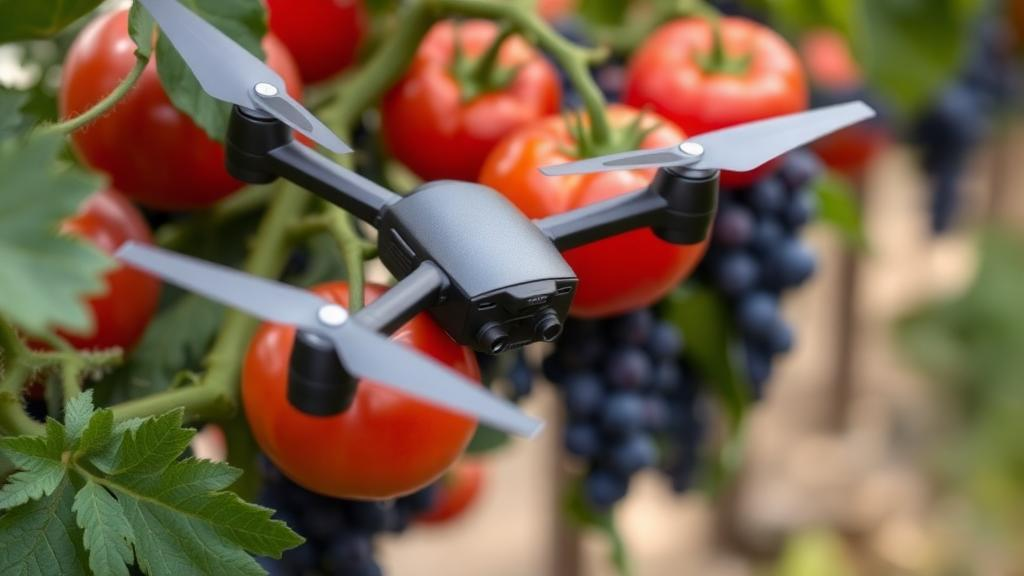
Water is becoming the most contested resource in modern farming, and a new study suggests that technology already sitting on the market can stretch every drop further while making the harvest better, not worse. Research published in the journal Plants, People, Planet reports that an advanced, sensor-driven irrigation system saved up to 15 percent of the water normally required to produce processing tomatoes and table grapes in Italy, and that the water savings came alongside improved yields and higher fruit quality. The finding matters because it challenges a long-standing assumption in agriculture that cutting irrigation inevitably means accepting smaller harvests or inferior produce.
The study, led by investigators at the University of Bari Aldo Moro, was designed as a direct comparison. The team managed two plots of tomatoes and two of table grapes under real field conditions. One set of plots was farmed using traditional methods, in which irrigation decisions typically rest on experience, fixed schedules, and visual inspection of the crop. The other set was managed with an integrated precision agriculture system, in which sensors continuously monitor the state of the plants and the soil, and drones and other non-destructive tools gather detailed information about crop condition from above and within the field. Irrigation in the high-tech plots was then adjusted according to what the plants actually needed, rather than what a calendar suggested.
The logic behind this approach is deceptively simple. Plants do not experience water stress on a schedule; they experience it in response to weather, soil moisture, temperature, and their own growth stage. A traditional irrigation regime that delivers a fixed amount of water on fixed days will inevitably overwater in cool weeks and underwater during heat waves. Sensor-based irrigation closes that gap by measuring the plant’s actual condition and responding to it. In the Italian trials, this responsiveness was enough to shave up to 15 percent off the total water demand of both crops while keeping the plants in a more stable physiological state throughout the season.
What makes the result particularly notable is that the water savings did not come at the expense of the crop. According to the researchers, the precision-managed plots produced improved yields and better fruit quality compared with the conventionally managed plots. For table grapes, fruit quality is the commercial heart of the product, determining everything from sugar content to market appeal. For processing tomatoes, quality parameters shape how much usable product can be extracted from each tonne of harvest. Improving both yield and quality while using less water suggests that the sensor-guided approach allowed the plants to avoid the swings of stress and overwatering that can degrade fruit development under conventional management.
Corresponding author Giuseppe Ferrara, a professor at the University of Bari Aldo Moro, framed the result as proof that conservation and quality are not opposing goals. Precision farming technologies, he said, prove that saving water and improving crop quality can go hand in hand. By using sensors to shield plants from weather stress, he explained, the team made their growth more stable. He also emphasized a second, less obvious advantage of the system: the ability to assess fruit quality directly in the field. With non-destructive technologies, farmers can test the quality of their fruit without damaging or destroying the crop, skipping slow laboratory analyses that traditionally delay such assessments until after harvest decisions have already been made.
That last point deserves attention because it addresses one of the quiet bottlenecks in horticulture. Historically, determining whether grapes have reached their ideal ripeness or whether tomatoes have accumulated the right balance of compounds has required sending samples to a laboratory, a process that is slow, costly, and destructive to the very fruit a farmer hopes to sell. Non-destructive sensing techniques, including spectroscopic methods that can be mounted on drones or handheld devices, allow growers to read the chemical and physical condition of fruit while it is still on the vine. In the context of this study, that capability meant irrigation and harvest decisions could be guided by near-real-time information about the crop itself, tightening the feedback loop between what the plant experiences and what the farmer does.
The broader context gives the findings urgency. Many of the world’s most productive agricultural regions, including the Mediterranean basin where the trials took place, are experiencing more frequent droughts, longer heat waves, and increasing competition for limited water supplies. Agriculture is among the largest consumers of freshwater globally, and irrigation accounts for the dominant share of that use in many countries. Under these pressures, farmers face a double bind: they must produce more food for a growing population with less water, often under weather conditions that are less predictable than at any point in modern record-keeping. The study’s authors position precision agriculture as a practical adaptation strategy, one that helps farmers respond to climate variability rather than simply absorbing its losses.
It is worth being precise about what the technology stack involves. Precision agriculture is an umbrella term for farming systems that use data to tailor inputs such as water, fertilizer, and pest control to the specific needs of specific plants at specific moments. In the configuration tested here, ground-based sensors tracked indicators of plant and soil status, while drones and other remote platforms extended that monitoring across the plots, giving researchers and growers a spatially detailed picture of crop health. The irrigation system then used this information to modulate water delivery. The result is a shift from managing a field as a single uniform unit to managing it as a dynamic system whose needs change day to day and place to place. The 15 percent water saving reported in the study represents the aggregate effect of many small, data-driven corrections accumulated over a growing season.
The choice of crops strengthens the study’s practical significance. Processing tomatoes and table grapes are two of the most economically and culturally important crops in Mediterranean agriculture, and both are highly sensitive to water management. Too little water and the fruit fails to develop properly; too much and quality deteriorates while water is wasted. Demonstrating simultaneous gains in water efficiency, yield, and quality across both a vegetable crop and a vine crop suggests the approach is not a niche trick suited to a single species but a transferable strategy for irrigated horticulture more broadly.
There are, of course, questions that field trials like this one naturally raise and cannot fully answer on their own. The cost of sensors, drones, and the expertise to interpret their data remains a barrier for smaller farms, and the economics of adoption will vary by region, crop value, and the severity of local water constraints. Multi-season and multi-region studies will be needed to confirm how robust the reported gains are across different soils, climates, and management styles. Still, the direction of the evidence is clear and encouraging. As Ferrara put it, the overall smart approach can help secure the food supply against climate change while ensuring consumers receive higher quality produce. In a world where every drop of irrigation water is increasingly precious, a technique that saves water and improves the harvest at the same time is exactly the kind of trade-off farmers have been waiting for.
Subject of Research: Precision agriculture using sensors and drones for water-saving irrigation of tomatoes and grapes
Article Title: Can sensors and drones help farmers improve crop quality while saving water?
Article References: Can sensors and drones help farmers improve crop quality while saving water?. (n.d.). Original publication
Image Credits: AI Generated
DOI: Not provided
Keywords: precision agriculture, sensor-based irrigation, drones, water saving, tomatoes, table grapes, fruit quality, climate change adaptation, drought, University of Bari Aldo Moro, Plants People Planet, non-destructive testing
Cite Scienmag News
Alan Morgan. (October 3, 2026). Drones and Sensors Cut Water Use and Boost Quality in Tomatoes and Grapes. Scienmag. https://scienmag.com/drones-and-sensors-cut-water-use-and-boost-quality-in-tomatoes-and-grapes/
Alan Morgan. "Drones and Sensors Cut Water Use and Boost Quality in Tomatoes and Grapes." Scienmag, 3 October 2026, https://scienmag.com/drones-and-sensors-cut-water-use-and-boost-quality-in-tomatoes-and-grapes/. Accessed 4 October 2026.
Alan Morgan. "Drones and Sensors Cut Water Use and Boost Quality in Tomatoes and Grapes." Scienmag. October 3, 2026. https://scienmag.com/drones-and-sensors-cut-water-use-and-boost-quality-in-tomatoes-and-grapes/


