


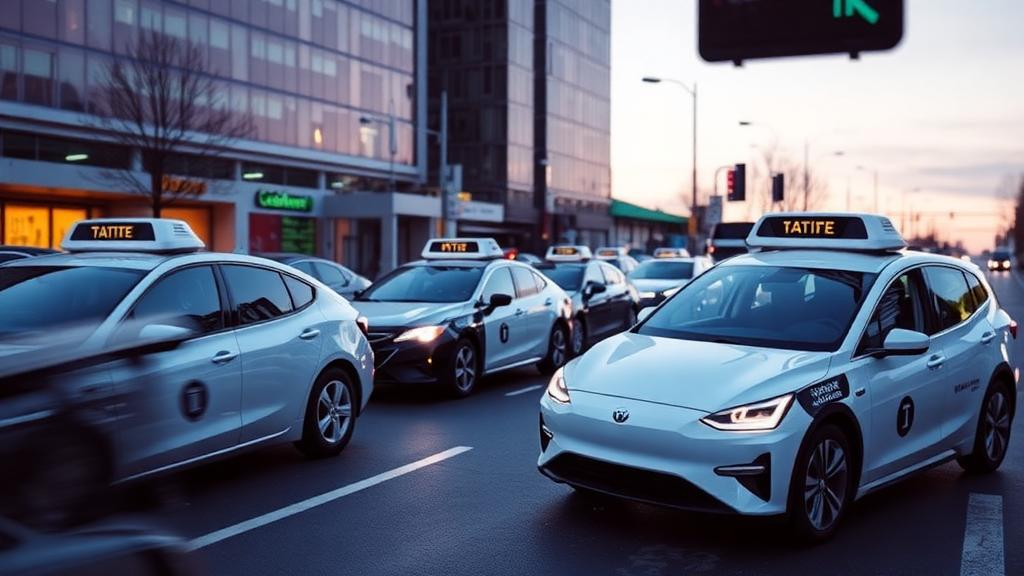
A computational method developed by researchers at Chalmers University of Technology in Sweden can coordinate large fleets of self-driving electric taxis while accounting for uncertain passenger demand, traffic conditions, vehicle availability and charging needs. The approach combines machine-learning forecasts with transparent optimisation models, and testing with historical trip data from San Francisco and Chicago produced fleet-management solutions that were close to optimal while remaining computationally practical. The research was conducted through modelling and simulation rather than a live road trial of autonomous taxis.
The work addresses a central operational problem facing electric autonomous mobility-on-demand services: vehicles and passengers are not distributed evenly across a city. Morning commuter demand may concentrate on routes toward the city centre, while afternoon demand can run in the opposite direction. Taxis may therefore have to travel without passengers to reach new pickup locations, and electric vehicles also must return to chargers at suitable times. If those movements are coordinated poorly, the imbalance can contribute to longer waits, longer passenger queues and additional traffic congestion.
Large-scale electric taxi fleets could offer substantial transport benefits, but only if their movements are managed efficiently and sustainably. A report cited by the researchers from Stanford University estimated that shared, self-driving electric passenger transport operating at scale could reduce an individual passenger’s cost per trip by as much as 60% compared with traditional taxis, while also significantly reducing emissions per trip. Those figures describe a reported scenario rather than a measured result from the new study. The Chalmers project focuses on the control problem that must be solved for such systems to operate reliably.
Sten Elling Tingstad Jacobsen’s doctoral research combines machine learning for forecasting travel demand with optimisation methods for fleet planning and management. It also investigates whether deep reinforcement learning can support real-time decisions in complex transport systems. In the published framework, however, machine learning is used to generate forecasts, while a transparent optimisation model determines where vehicles should go and when they should charge. The authors describe this division of labour as a way for artificial intelligence to support decisions without making the operational choices independently.
For the forecasting component, the researchers used Bayesian neural networks to predict travel demand and charger availability in different parts of a city. The models were trained using historical taxi-trip data from San Francisco and Chicago. A defining feature of Bayesian neural networks is that they can provide uncertainty estimates alongside their predictions. That capability is important because historical patterns may not represent unusual conditions, such as weather events or other disruptions that cause real travel behaviour to differ from a forecast. Fleet-management decisions can then be evaluated against the uncertainty attached to each prediction instead of treating all forecasts as equally certain.
Uncertainty also changes the mathematical problem of controlling a fleet. Demand, traffic conditions and the number of available vehicles change continually, and the combined system quickly becomes too large or complicated to solve directly. The researchers addressed this by dividing fleet control into smaller, manageable components, solving them efficiently and combining the results to estimate the best overall deployment. Their approach is designed to yield a near-optimal solution without requiring an impractically long calculation for a large fleet, allowing the method to make decisions quickly enough for a dynamic transport system.
The research examines two related aspects of fleet control. One concerns how empty taxis should be positioned throughout a city so that they are available when a traveller requests one. The other adds the complications created by operating electric vehicles that require regular charging. The study compared three types of electric vehicles with different battery sizes and energy efficiency, allowing the researchers to assess how those differences affect fleet performance and service availability. This vehicle comparison makes the framework configurable for different fleets rather than tying it to a single vehicle design.
Two peer-reviewed papers report components of the work. “A Predictive Chance Constraint Rebalancing Approach to Mobility-on-Demand Services” was published in Communications in Transport Research. “Combined Stochastic and Robust Optimization for Electric Autonomous Mobility-on-Demand with Nested Benders Decomposition” appeared in Transportation Research Part C: Emerging Technologies. The latter publication was dated 12 August 2026 in the supplied record, while the Chalmers news release was issued on 21 October 2026. The authors are Sten Elling Tingstad Jacobsen and Balázs Kulcsár of Chalmers University of Technology, together with Anders Lindman of Volvo Cars, and the research was carried out in collaboration with Volvo Cars.
The method’s main claimed advantage is not simply that it can produce a favourable fleet plan, according to the researchers, but that it explicitly represents uncertainty while remaining scalable. A model that assumes predictable demand and traffic can become unreliable when those conditions change. By incorporating uncertain forecasts and robust operational rules, the framework is intended to help fleets respond to changing conditions while maintaining efficient and reliable services. Kulcsár said the method could contribute to better traffic coordination and more trustworthy autonomous mobility, although the evidence presented here comes from computational modelling rather than a demonstration in an operating city.
Several limitations are inherent in the reported evidence. The study used historical taxi data from two United States cities to test the modelling framework, and its results were obtained through computational simulation and modelling. It did not establish that a fleet of autonomous electric taxis using the method will achieve a particular reduction in cost, emissions, waiting time or congestion in real service. Autonomous taxi services are already operating in several cities in the United States and China, but interactions with human drivers and uncertain traffic remain difficult operational challenges. The research provides a testable control framework for those conditions, not proof of real-world performance. Further field evaluation would be needed to determine how accurately its forecasts and fleet decisions translate into measurable service benefits at large scale.
Subject of Research: Computational control of large self-driving electric taxi fleets under uncertain travel demand, traffic and charging conditions
Article Title: Driverless electric taxi fleets adapt to the unexpected
Article References: Driverless electric taxi fleets adapt to the unexpected. Original publication (Bibliographic details unavailable.)
Image Credits: AI Generated
DOI: Not provided
Keywords: autonomous taxis, electric mobility, fleet optimisation, Bayesian neural networks, machine learning, urban transport, reinforcement learning, charging logistics, transport modelling, traffic congestion, Driverless, electric
Cite Scienmag News
Denise Maddox. (October 21, 2026). Driverless electric taxi fleets get smarter about uncertainty. Scienmag. https://scienmag.com/driverless-electric-taxi-fleets-get-smarter-about-uncertainty/
Denise Maddox. "Driverless electric taxi fleets get smarter about uncertainty." Scienmag, 21 October 2026, https://scienmag.com/driverless-electric-taxi-fleets-get-smarter-about-uncertainty/. Accessed 21 October 2026.
Denise Maddox. "Driverless electric taxi fleets get smarter about uncertainty." Scienmag. October 21, 2026. https://scienmag.com/driverless-electric-taxi-fleets-get-smarter-about-uncertainty/


