


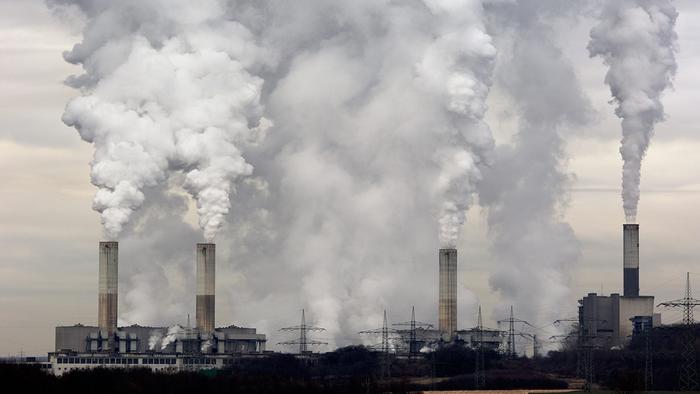
A recent Supreme Court decision to block a federal rule curbing interstate air pollution further complicates efforts to reduce emissions and adds to an already disproportionate burden on “downwind” states, according to researchers at the University of Notre Dame.

Credit: University of Notre Dame
A recent Supreme Court decision to block a federal rule curbing interstate air pollution further complicates efforts to reduce emissions and adds to an already disproportionate burden on “downwind” states, according to researchers at the University of Notre Dame.
“Toxic air pollution is really not as well known by the general public as you would hope, given its impact on human health,” said Paola Crippa, assistant professor in the Department of Civil and Environmental Engineering and Earth Sciences. “Most studies peg it as the, or at least one of the top three, largest causes of early human mortality. It cuts off about three years from global life expectancy. This is especially important for urban communities, where air pollution tends to be the highest.”
Air pollution poses a significant threat to respiratory health, is associated with asthma and can lead to chronic disease, cancer and premature death, according to the National Institutes of Health.
“Each year, air pollution kills 7 to 9 million people worldwide, including 200,000 Americans. And in the United States, much of this toxic pollution crosses state borders,” said Richard Marcantonio, assistant professor of environment, peace and global affairs in the University of Notre Dame’s Keough School of Global Affairs. “The Supreme Court’s decision pressed pause on a plan to help regulate this cross-state pollution.”
The ruling blocked the Environmental Protection Agency’s “Good Neighbor Plan,” housed under the Clean Air Act, which requires “upwind” states to implement improvement plans to reduce ground-level ozone and nitrogen oxide emissions from power plants and other industrial sources. Three states — Indiana, Ohio and West Virginia — along with various large industrial companies and trade organizations sued the EPA after the agency rejected those plans, which it determined to be insufficient, and moved to enforce its own plan. The EPA has stated that nitrogen oxide emissions decreased by 18 percent across 10 states where its plan was enacted in 2023.
Crippa and Marcantonio, with co-authors Danielle Wood, program director of the Notre Dame Global Adaptation Initiative, and Alixandra Underwood at the International Food Policy Research Institute, recently published a study exploring the Clean Air Act in the journal Environmental Management. Their study focuses particularly on Section 126, a measure by which downwind states can take action and petition the EPA to directly regulate sources of interstate air pollution.
The researchers examined all 13 petitions filed through Section 126 by downwind states between 2000 and 2022.
The study showed downwind states face several challenges in using the measure, ultimately rendering it ineffective. Downwind states can petition the EPA to directly regulate sources of air pollution, such as nitrogen oxide, sulfur dioxide and particulate matter, across state lines. However, those states experience lengthy response times, petitions are accepted infrequently and petitioners are required to collect proof showing improvement plans have failed — the kind of internal information from the source facilities that downwind states are not likely to get.
“In order to actually apply the good neighbor rule as it stands today, the burden of proof in court has been placed on the downwind states, and to date, they have been unsuccessful in court,” Crippa said. “If an upwind state is producing pollution that unequally affects a downwind state, they should be able to easily and effectively do something about it — that is the idea behind the federal government supporting federalism amongst the states. Right now, that’s not happening.”
Measuring and attributing air pollution across state lines is a challenge, Crippa said. How a region determines the source or sources contributing to poor air quality comes down to air quality models able to track the wind flow and pollution transport — critical to developing informed air quality assessments. These assessments play a significant role in alerting the public to poor conditions and increasing public awareness.
But, Crippa said, “This information is insufficient when the goal is to develop policies and implementation strategies to reduce local air pollution.” High pollution levels experienced in a local neighborhood may be only partially dictated by nearby emission sources, she said. “We are developing a new way of thinking about air quality management where regulations are not enforced based on political boundaries, but on dynamical physical boundaries that reflect the actual pollution dispersion boundaries.”
Crippa explained that new regulatory boundaries should be defined to include areas experiencing similar air quality conditions, rather than left to political and state boundaries. This type of boundary could ensure that current practices of exporting pollution to neighboring states through energy production and industry are significantly reduced. The research team is currently working on a companion study outlining proposals for air quality management based on these new boundaries.
The Supreme Court’s decision put the plan on hold, leaving the EPA and affected states without an immediate solution.
“It underscores how our regulatory system continues to be hamstrung when attempting to address some of the biggest challenges to its mission: to protect human health and the environment,” Marcantonio said. “Going forward, I hope policymakers will address this issue through an approach that centers human health first and protects the rights of downwind states.”
The study was conducted with support from the Lucy Family Institute for Data and Society.
Journal
Environmental Management
Article Title
Interstate Air Pollution Governance in the United States: Exploring Clean Air Act Section 126
Article Publication Date
19-Jun-2024
Cite Scienmag News
Russell Cooper. (July 31, 2024). Downwind states face disproportionate burden of air pollution. Scienmag. https://scienmag.com/downwind-states-face-disproportionate-burden-of-air-pollution/
Russell Cooper. "Downwind states face disproportionate burden of air pollution." Scienmag, 31 July 2024, https://scienmag.com/downwind-states-face-disproportionate-burden-of-air-pollution/. Accessed 5 September 2026.
Russell Cooper. "Downwind states face disproportionate burden of air pollution." Scienmag. July 31, 2024. https://scienmag.com/downwind-states-face-disproportionate-burden-of-air-pollution/

