


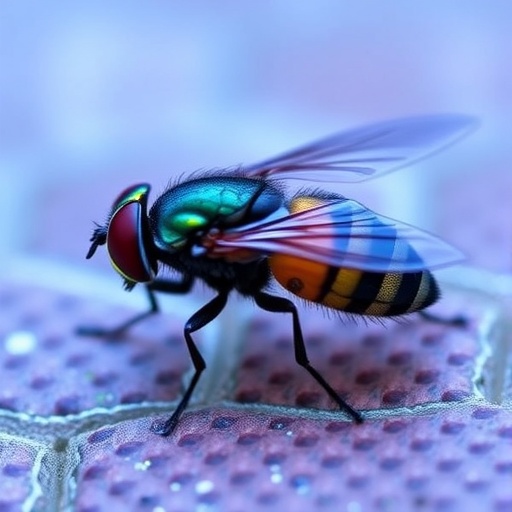
In the intricate world of sensory processing, the ability to modulate auditory responsiveness according to an organism’s internal and external state is of paramount importance. Recent groundbreaking research from Nagoya University in Japan has unveiled a sophisticated neural mechanism by which female fruit flies dynamically adjust their sensitivity to auditory stimuli, specifically the courtship songs produced by males. This adaptation is modulated by dopaminergic signaling in the sensory neurons of Johnston’s organs, specialized auditory sensors located in the antennae. The implications of this discovery provide a critical window into the neural underpinnings of flexible sensory modulation, a phenomenon that appears conserved across different species.
Auditory sensory neurons, particularly those in Johnston’s organs (JOs) of Drosophila melanogaster, are responsible for detecting sound vibrations with remarkable precision. In many species, including humans, it is well-recognized that responsiveness to sound varies according to context, such as the motivation to mate or the presence of potential threats. This study took advantage of the genetic tractability and relatively simple nervous system of the fruit fly to dissect the molecular components governing this sensory plasticity. The researchers hypothesized that dopamine, a neuromodulator classically linked with motivation and reward, could be a critical factor shaping auditory neuron sensitivity based on mating status.
Using single-nucleus RNA sequencing datasets, the team meticulously screened auditory neurons from female fruit flies to identify the expression patterns of various neurotransmitter receptor genes. Their analysis revealed a robust presence of three distinct dopamine receptor subtypes on JO neurons, suggesting direct dopaminergic regulation is plausible. This molecular blueprint laid the groundwork for functional experiments aimed at testing whether dopamine receptor signaling indeed modulates sensory neuron responsiveness.
To probe this question, the researchers employed advanced genetic manipulations to selectively suppress dopamine receptor expression in female JO neurons. Through in vivo calcium imaging techniques, they monitored the amplitude and dynamics of neural responses when exposed to male courtship songs, a complex acoustic signal critical for reproductive communication. Remarkably, unmated females, characterized by heightened reproductive drive, exhibited decreased auditory neuron activity upon dopamine receptor knockdown. Conversely, mated females and recently eclosed juveniles, both with lower mating motivation, showed no significant changes, indicating that dopaminergic modulation is specifically engaged when reproductive urgency is high.
Beyond neural activity, the behavioral consequences of this modulation were assessed by measuring the latency to copulation initiation in unmated females exposed to courtship songs. Females with attenuated dopamine receptor signaling demonstrated delayed mating responses, underscoring the functional relevance of this sensory plasticity. This finding directly ties dopaminergic pathways to an organism’s ability to optimize behavioral output in response to socially relevant stimuli, effectively prioritizing mating behavior under appropriate physiological conditions.
Professor Azusa Kamikouchi, the study’s lead, reflects on the broader implications: “Our investigation illuminates the neural circuitry that fine-tunes auditory sensitivity based on reproductive intent, suggesting a conserved biological principle through which nervous systems allocate resources flexibly. This insight may extend to diverse animal taxa, including mammals, providing a model for understanding sensory modulation across evolution.”
Previous studies have documented auditory plasticity in vertebrates and amphibians, such as humans and frogs, where sensory gating occurs in context-dependent manners. However, dissecting the precise cellular and molecular contributors has often been challenging. The current research advances this frontier by leveraging Drosophila’s genetic accessibility to identify dopamine’s role in direct modulation of peripheral auditory sensory neurons, rather than central auditory processing centers alone.
This neuron-level dopaminergic influence represents a fine-tuning mechanism, enabling priority processing of mating-relevant acoustic cues without broadly altering sensory perception. Such selective amplification or attenuation optimizes neural coding efficiency and behavioral responsiveness in a resource-constrained brain. By adjusting sensory thresholds contingent on mating status, female fruit flies exemplify how internal physiological states interface seamlessly with environmental stimuli to drive adaptive decision-making.
The study’s methodology combined modern neurogenetics with sophisticated imaging, behavioral analytics, and transcriptomics, creating a powerful multidisciplinary approach to unravel complex sensory phenomena. This integrative strategy sets a precedent for future investigations of neuromodulation in sensory systems and raises exciting possibilities for exploring neuromodulatory mechanisms in other contexts, such as learning, stress, or social interactions.
In sum, the discovery of mating status-dependent dopaminergic regulation of auditory sensory neurons in fruit flies offers a compelling example of how neuromodulators sculpt sensory processing with exquisite temporal and contextual precision. This work not only enriches our understanding of insect neurobiology but also provides a conceptual framework to explore conserved mechanisms of sensory plasticity throughout the animal kingdom. As researchers continue to uncover the intricate dialogue between internal states and sensory perception, such insights will be invaluable for devising interventions for sensory processing disorders and enhancing brain-machine interface technologies.
News Publication Date: 29-Jul-2025
Web References:
http://dx.doi.org/10.1016/j.isci.2025.113232
Cite Scienmag News
Drew Townsend. (August 7, 2025). Dopamine Boosts Sound Sensitivity in Female Flies Ready to Mate. Scienmag. https://scienmag.com/dopamine-boosts-sound-sensitivity-in-female-flies-ready-to-mate/
Drew Townsend. "Dopamine Boosts Sound Sensitivity in Female Flies Ready to Mate." Scienmag, 7 August 2025, https://scienmag.com/dopamine-boosts-sound-sensitivity-in-female-flies-ready-to-mate/. Accessed 4 September 2026.
Drew Townsend. "Dopamine Boosts Sound Sensitivity in Female Flies Ready to Mate." Scienmag. August 7, 2025. https://scienmag.com/dopamine-boosts-sound-sensitivity-in-female-flies-ready-to-mate/


