


Serum free light chain (sFLC) measurement has become one of the most consequential laboratory tests in hematology, anchoring the diagnosis and monitoring of plasma cell disorders from multiple myeloma to light-chain amyloidosis. Yet for most laboratories in China, the two assays that dominate the field—Freelite from The Binding Site and N Latex FLC from Siemens Healthineers—are imported reagents tied to dedicated, high-cost analytical platforms. A new method-comparison study published in Frontiers in Oncology now reports that a domestically manufactured latex-enhanced immunoturbidimetric assay from Shanghai Kehua Bio-Engineering tracks the imported systems closely enough to serve as a viable routine alternative, provided laboratories respect method-specific reference intervals and keep each patient on a single platform over time.
The research team, led by investigators at the Institute of Hematology & Blood Diseases Hospital of the Chinese Academy of Medical Sciences and Peking Union Medical College in Tianjin, enrolled residual serum samples from 133 adults with suspected or established monoclonal gammopathies. Every sample was measured in parallel on the Kehua assay and Freelite, and 122 samples with sufficient remaining volume were additionally tested on the Siemens N Latex system. The cohort spanned the full clinical spectrum of plasma cell disorders, including IgG- and IgA-type myeloma of both light-chain classes, IgD-λ myeloma, free light-chain-only myeloma, Waldenström macroglobulinemia, AL amyloidosis, smouldering myeloma and monoclonal gammopathy of undetermined significance (MGUS).
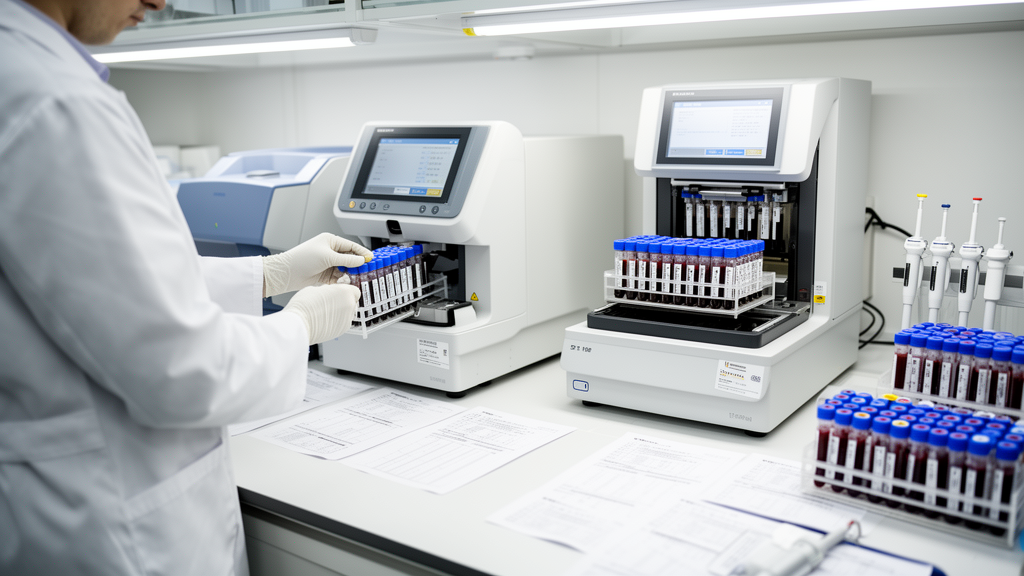
The technical logic of the comparison matters as much as the numbers. Freelite, launched in 2001, uses sheep polyclonal antibodies raised against epitopes that are hidden when light chains are bound within intact immunoglobulins, and it is widely regarded as the reference assay behind the International Myeloma Working Group (IMWG) criteria. N Latex FLC, by contrast, employs a defined mixture of monoclonal antibodies on a nephelometric platform. The Kehua reagent takes a third route: anti-human free κ and free λ antibodies immobilized on latex particles, with antigen-antibody complex formation increasing turbidity that can be quantified on a routine automated chemistry analyzer—in this study a Beckman Coulter AU5800. That architecture could, in principle, bring sFLC testing into laboratories that already run standard biochemistry workloads without a separate nephelometer investment.
Precision came first in the validation hierarchy. Using low- and high-level commercial quality-control materials analyzed five times consecutively, the Kehua assay delivered within-run coefficients of variation below 5 percent for both κ and λ controls—ranging from 0.95 to 3.88 percent for FLC-κ across four independent run dates and from 0.67 to 4.66 percent for FLC-λ across two runs. All mean control values fell within manufacturer-specified acceptance windows, satisfying the less-than-10-percent precision goal set by the Clinical and Laboratory Standards Institute guideline EP05-A3. The authors are careful to note that this dataset documents short-term within-run performance across the reagent lots used during recruitment rather than a full long-term precision study.
Quantitative agreement against Freelite was the strongest result in the study. Pearson correlation coefficients reached 0.988 for FLC-κ, 1.000 for FLC-λ and 0.999 for the κ/λ ratio, with Lin’s concordance correlation coefficients between 0.983 and 0.999. Passing-Bablok regression, a robust method for estimating systematic and proportional bias, produced slopes close to unity for all three analytes—0.989 for κ, 1.077 for λ and 1.022 for the ratio—indicating near-identity across a concentration range spanning more than four orders of magnitude. Bland-Altman analysis showed mean relative differences of −3.75 percent for κ, +3.63 percent for λ and −7.34 percent for the ratio, with no concentration-dependent drift in relative bias.
Agreement with the N Latex system was also strong, with Pearson correlations of 0.991 to 0.998, but the regression analysis revealed a clinically relevant proportional bias in the κ/λ ratio. The Passing-Bablok slope of 0.733 means that at very high ratios the Kehua-derived value underestimates the N Latex result, while at low ratios it overestimates it. Because the involved/uninvolved sFLC ratio is embedded in IMWG diagnostic criteria—a ratio of 100 or more counts as a myeloma-defining biomarker when the involved light chain exceeds 100 mg/L—and in the 2/20/20 risk-stratification model for smouldering myeloma, the authors emphasize that absolute ratio values from Kehua and N Latex should not be used interchangeably around decision thresholds.
Qualitative concordance—the question of whether the assays classify the same samples as abnormal or normal—landed within the range reported for comparisons between the two imported assays themselves. Against Freelite, total concordance was 93.23 percent for FLC-κ, 90.98 percent for FLC-λ and 89.47 percent for the κ/λ ratio, with Cohen’s kappa values of 0.848, 0.799 and 0.675 respectively. Against N Latex, the corresponding figures were 91.80, 83.61 and 90.16 percent, with kappas of 0.836, 0.673 and 0.710. The largest discordance burden involved N Latex FLC-λ classification, where 20 of 122 samples (16.39 percent) were called differently—a pattern consistent with the known greater inter-method variability of λ measurement, partly attributable to polymerization artifacts that affect λ chains more frequently than κ.
Comparator-defined receiver-operating characteristic analysis added a practical layer: treating each imported method in turn as the qualitative reference, the Kehua assay achieved areas under the curve of 0.994 to 0.999 for reproducing elevated FLC-κ or FLC-λ calls, with Youden-optimal cut-offs closely matching the published upper reference limits of the comparator assays. For κ/λ ratio abnormality, AUCs were lower at 0.869 versus Freelite and 0.796 versus N Latex, reflecting the compounding of two assays’ individual biases in the composite biomarker. Notably, samples reaching the markedly abnormal ratio range used for the IMWG ≥100 biomarker were concordantly identified by all three platforms in this cohort, suggesting the residual discordance mainly affects borderline reference-interval calls rather than obviously extreme monoclonal patterns.
The authors frame the implementation implications conservatively. Multiple myeloma is the second most common hematological malignancy worldwide, and China’s disease burden has shown a particularly steep upward trajectory, with incidence rates projected to keep rising through 2050. Population screening programs such as iStopMM have demonstrated that subclinical light-chain MGUS is far more prevalent than previously estimated when sensitive sFLC assays are deployed. A serum test compatible with routine biochemistry analyzers could broaden laboratory access and support serial monitoring of oligosecretory myeloma and AL amyloidosis, though the study did not collect cost, distribution or workflow data, so affordability claims require separate health-economic validation.
The study’s limitations are clearly delineated: it was a single-center evaluation with a moderate sample size enriched for established disease; it was a method comparison rather than a complete analytical validation, leaving limits of detection, carry-over, lot-to-lot reproducibility and interference studies unassessed; only serum was tested, so findings cannot be extrapolated to urine or cerebrospinal fluid; and the manufacturer did not disclose the clonality or production route of the immobilized antibodies. Discordant calls were not adjudicated against an independent clinical gold standard. Still, the bottom line stands: with within-run precision under 5 percent, correlations above 0.99 against both imported systems, and kappa agreement of 0.67 to 0.85, the Kehua assay offers a credible domestic option for routine sFLC quantification—so long as laboratories maintain method-specific intervals and commit to a single platform for each patient’s longitudinal follow-up.
Subject of Research: Analytical validation of a domestic serum free light chain assay against two imported systems for plasma cell disorder testing
Article Title: Consistency and correlation of a domestic Kehua serum free light chain assay with two imported analytical systems
Article References: Ren, Y., Wang, S., Han, L., Wang, Y., Ren, Q., Wang, M., Xia, Y., & Zhu, G. (2026). Consistency and correlation of a domestic Kehua serum free light chain assay with two imported analytical systems. Frontiers in Oncology, 16, Article 1900671. https://doi.org/10.3389/fonc.2026.1900671
Image Credits: AI Generated
DOI: 10.3389/fonc.2026.1900671
Keywords: serum free light chain, multiple myeloma, monoclonal gammopathy, Kehua assay, Freelite, N Latex, immunoturbidimetry, method comparison, laboratory medicine, plasma cell disorders, diagnostic assay validation, AL amyloidosis
Cite Scienmag News
Ophelia Keating. (October 16, 2026). Domestic Kehua Serum Free Light Chain Assay Matches Imported Systems in Head-to-Head Test. Scienmag. https://scienmag.com/domestic-kehua-serum-free-light-chain-assay-matches-imported-systems-in-head-to-head-test/
Ophelia Keating. "Domestic Kehua Serum Free Light Chain Assay Matches Imported Systems in Head-to-Head Test." Scienmag, 16 October 2026, https://scienmag.com/domestic-kehua-serum-free-light-chain-assay-matches-imported-systems-in-head-to-head-test/. Accessed 16 October 2026.
Ophelia Keating. "Domestic Kehua Serum Free Light Chain Assay Matches Imported Systems in Head-to-Head Test." Scienmag. October 16, 2026. https://scienmag.com/domestic-kehua-serum-free-light-chain-assay-matches-imported-systems-in-head-to-head-test/


