


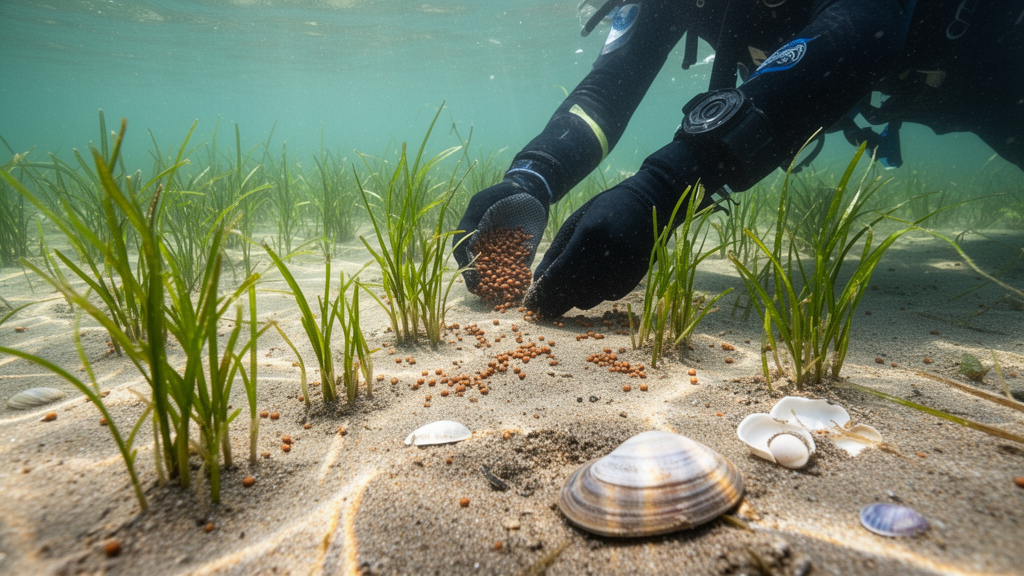
Seagrass meadows rank among the most valuable ecosystems on the planet, buffering shorelines, storing carbon, and sheltering juvenile fish, yet they continue to vanish at alarming rates worldwide. Restoring them at scale has long been a logistical nightmare, and seed-based approaches—while promising because they can cover far larger areas than transplanting shoots without damaging donor meadows—suffer from notoriously low and variable establishment rates. Now, a field experiment off the coast of North Carolina has put one of the most creative seed-delivery ideas in marine restoration to the test: glue eelgrass seeds onto live clams and let the bivalves do the burying. The verdict, published in Frontiers in Marine Science, is both encouraging and instructive: the clam technique works, but how many seeds you attach matters far more than how you deploy them.
The study, led by Cori Lopazanski and colleagues at the Duke University Marine Lab, focused on eelgrass (Zostera marina), a temperate seagrass whose reproductive shoots were collected from beds in Back Sound in May 2025. Mature seeds were naturally released in indoor flow-through tanks at the Duke facility in early July, harvested from the tank bottoms, and stored in fine nylon mesh bags until deployment that October. Before planting, the team randomly tested 100 seeds for viability using tetrazolium staining and found 89 percent viable—a solid starting point for any restoration effort.
The delivery mechanism is where the experiment gets genuinely novel. Juvenile hard clams (Mercenaria mercenaria), roughly two centimeters long and sourced from an aquaculture program at Carteret Community College, served as living seed taxis. A gelatin-based adhesive—dissolved in saltwater at 9 percent weight per volume, heated to 35 degrees Celsius, then cooled to 25 before application—was pipetted onto one shell of each clam. Seeds were arranged in a single layer and sealed under a second thin coat. The clams were refrigerated at 9 degrees for 30 minutes to set the adhesive, transported in coolers, and deployed the same day, with total handling time under four hours. Preliminary lab trials showed the adhesive dissolved and seeds detached within 8 to 12 hours in 22-degree saltwater—roughly the ambient October temperature in Back Sound—while clams placed in tanks with sediment typically buried themselves fully within 75 minutes, reaching a mean depth of about three centimeters.
The experimental design crossed ten seed densities (10 to 100 seeds per clam in increments of 10) with two placement treatments—manually buried to two centimeters or simply placed on the sediment surface—in a fully factorial layout with four replicates per combination, totaling 80 plots of 0.25 by 0.25 meters arranged in a gridded configuration. The site, a sheltered shallow subtidal sandy area near Harker’s Island separated from adjacent salt marsh, oyster reef, and seagrass habitat by at least 10 meters, was monitored biweekly from November 2025 through April 2026, with researchers counting live shoots and measuring the heights of up to five randomly selected shoots per plot each visit.
The results tell a clear quantitative story. Shoot establishment rose significantly with seed density: each additional 10 seeds planted increased the expected number of established shoots by 24.2 percent (95 percent CI: 6.6 to 44.6 percent). Model predictions indicated that going from 10 to 100 seeds per clam raised expected shoot counts from 1.4 to 9.8 per plot. Shoots appeared from December onward, and higher densities showed progressively greater shoot abundance through time, supported by a temporal hurdle analysis showing the probability of observing at least one live shoot increased more strongly at higher densities. But here is the crucial nuance: the proportion of seeds that actually produced shoots did not vary with density. Per-seed establishment hovered between roughly 5 and 12 percent across all planting rates, with no statistically significant differences—meaning more seeds yielded more shoots, but did not improve the odds for any individual seed.
Clam placement, meanwhile, turned out to be nearly irrelevant to the restoration outcome. Manually buried clams were more likely to be detected during the first two post-deployment surveys, and shell fragments were more common in surface treatments (62.5 percent of surface plots versus 40 percent of buried plots), hinting at greater predation or mortality among surface-deployed clams. Yet confirmed clam presence showed no association with final shoot density, per-seed establishment, or final shoot height. Shoot growth trajectories were broadly comparable between placement treatments, though shoots in higher-density treatments became consistently taller during the latter half of the experiment—possibly an early sign of positive interactions among neighbors, or of competition for light as local canopy density increased.
The low clam persistence in both treatments is striking. Juvenile clams are vulnerable to blue crabs, mud crabs, gastropods, and rays, and the team suggests predation is a plausible explanation for the losses. But the key insight is that seed incorporation likely occurred rapidly regardless of clam fate: because the gelatin adhesive released seeds within 8 to 12 hours, seeds probably detached soon after deployment—potentially after clams had burrowed, carrying them below the sediment surface where conditions favor germination. This timing, the authors argue, is likely the critical design variable for the technique, with the goal of synchronizing seed release with initial sediment incorporation rather than maintaining long-term attachment. Further optimization could examine different adhesive formulations across temperatures, salinities, sediment types, and hydrodynamic conditions, and predator-exclusion treatments could distinguish direct seed consumption from displacement during clam predation.
Importantly, the authors caution that the limited relationship between clam persistence and restoration outcomes should not be read as evidence that bivalves do not facilitate seagrass. Previous work has shown persistent bivalve populations can enhance seagrass biomass, growth, patch expansion, and disturbance resilience through mechanisms including reduced herbivory, enhanced nutrient availability, and improved water clarity. But this experiment tracked only the first six months post-deployment and used a single juvenile clam per plot—a density and timescale likely insufficient to generate the ecosystem-engineering effects associated with mature bivalve populations. The absence of density dependence in per-seed establishment also suggests that neither competition nor facilitation strongly shaped seedling establishment during the first growing season; instead, establishment appears governed by seed viability and local environmental conditions.
From a practical standpoint, the findings reframe the central question of seed-based restoration. Because per-seed establishment remained constant across a tenfold range of densities, practitioners can select seed density per clam based on the desired restoration configuration rather than per-seed performance. Concentrating many seeds on fewer clams should produce dense patches; spreading the same number of seeds across more clams should yield a similar total number of shoots distributed over a larger area. And because manually burying clams offered little measurable benefit over surface placement, the less labor-intensive surface deployment may be sufficient for large-scale efforts—a meaningful efficiency gain when seed availability frequently constrains restoration scale.
The study also carries a caveat about its design: seed densities were assigned by row rather than fully randomized, limiting the ability to separate density effects from unmeasured spatial variation, though the experiment occupied a small, visually uniform 5.5 by 7 meter area where strong gradients were unlikely. Whether these results hold in higher-energy environments, at larger scales, or over longer timescales—when density-dependent facilitation or competition may emerge as patches develop—remains an open question. Still, the work positions clam-mediated seed deployment as a practical addition to the growing suite of seed-based restoration tools and illustrates a broader principle the authors call ecosystem technology, or ecotech: harnessing natural organismal behaviors to design restoration techniques that work with, rather than against, ecological processes. As seagrass losses accelerate globally, approaches that let clams do the digging may prove exactly the kind of scalable innovation coastal restoration has been waiting for.
Subject of Research: Clam-mediated seed deployment for eelgrass seagrass restoration
Article Title: More seeds yield more shoots, but not higher per-seed establishment in a clam-mediated seagrass restoration experiment
Article References: More seeds yield more shoots, but not higher per-seed establishment in a clam-mediated seagrass restoration experiment. (n.d.). https://doi.org/10.3389/fmars.2026.1972882
Image Credits: AI Generated
DOI: 10.3389/fmars.2026.1972882
Keywords: seagrass restoration, eelgrass, Zostera marina, seed density, hard clams, Mercenaria mercenaria, bivalve facilitation, seed-based restoration, marine conservation, North Carolina, ecomimicry, coastal ecosystems
Cite Scienmag News
Alan Morgan. (October 16, 2026). More Seeds Yield More Shoots, but Not Higher Per-Seed Establishment in a Clam-Mediated Seagrass Restoration Experiment. Scienmag. https://scienmag.com/more-seeds-yield-more-shoots-but-not-higher-per-seed-establishment-in-a-clam-mediated-seagrass-restoration-experiment/
Alan Morgan. "More Seeds Yield More Shoots, but Not Higher Per-Seed Establishment in a Clam-Mediated Seagrass Restoration Experiment." Scienmag, 16 October 2026, https://scienmag.com/more-seeds-yield-more-shoots-but-not-higher-per-seed-establishment-in-a-clam-mediated-seagrass-restoration-experiment/. Accessed 16 October 2026.
Alan Morgan. "More Seeds Yield More Shoots, but Not Higher Per-Seed Establishment in a Clam-Mediated Seagrass Restoration Experiment." Scienmag. October 16, 2026. https://scienmag.com/more-seeds-yield-more-shoots-but-not-higher-per-seed-establishment-in-a-clam-mediated-seagrass-restoration-experiment/


