


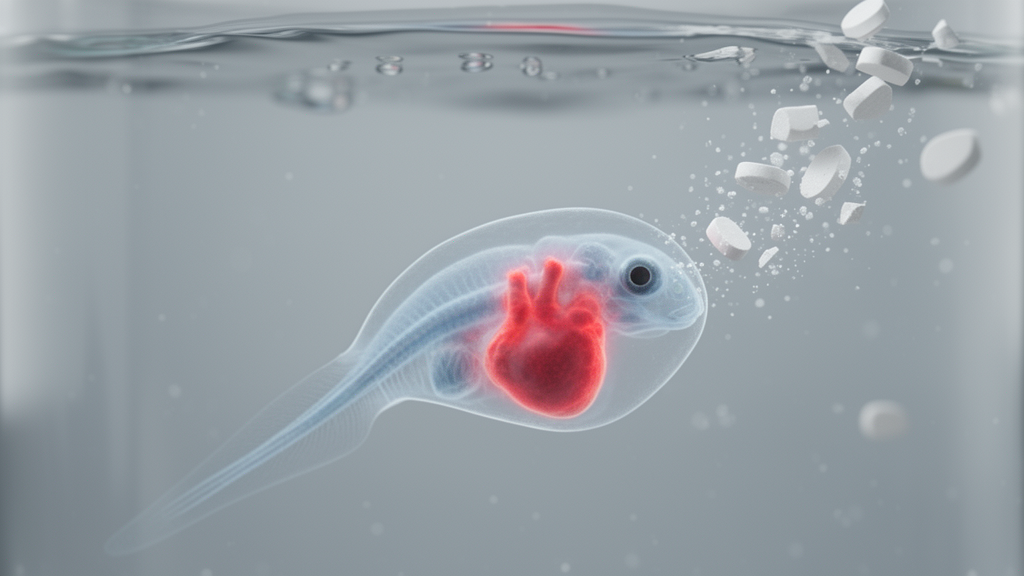
Dolutegravir, one of the most widely prescribed antiretroviral drugs in the world, may interfere with the developing heart and blood vessels of an embryo, according to a new study published in Scientific Reports. A team of researchers from the University of Brescia in Italy exposed zebrafish embryos to the HIV integrase inhibitor and found that, at a concentration of one micromolar, the drug caused a profound impairment of cardiovascular function, marked by slowed blood flow, a reduced heartbeat, shrunken heart chambers, altered cardiac looping and defects in angiogenesis. The findings add a new dimension to an ongoing debate about the safety of dolutegravir in pregnancy, which has until now focused almost entirely on the risk of neural tube defects.
Dolutegravir belongs to a class of antiretroviral drugs known as integrase strand-transfer inhibitors, or INSTIs. These compounds block the integrase enzyme that HIV uses to insert its genetic material into the DNA of host cells, and they have become a cornerstone of modern antiretroviral therapy because of their potency, high genetic barrier to resistance and generally favorable tolerability. The widespread adoption of INSTI-based regimens has contributed significantly to the reduction in mortality associated with HIV infection, transforming the disease into a manageable chronic condition for millions of people. Dolutegravir in particular is recommended by major treatment guidelines as a first-line option and is a key component of the fixed-dose combination therapies used across both high-income and resource-limited settings.
Yet the drug’s safety profile in pregnancy has been scrutinized since 2018, when preliminary data from a Botswana surveillance study suggested an elevated incidence of neural tube defects among infants born to women who conceived while taking dolutegravir. The concern temporarily led the World Health Organization to advise caution in prescribing the drug to women of childbearing age, although subsequent and more extensive analyses substantially lowered the estimated risk, and the WHO eventually restored dolutegravir to its preferred first-line recommendations. Even so, the episode left open important questions about how the drug might affect other aspects of embryonic development, particularly in organ systems whose formation depends on precisely choreographed genetic programs during the earliest weeks of life.
The Brescia team, led by Sara Ferretti and Isabella Zanella together with clinical colleagues including Eugenia Quiros-Roldan and Francesco Castelli, turned to the zebrafish embryo to address those questions. Zebrafish have become a mainstay of developmental toxicology for good reason. Their embryos develop externally, are optically transparent, and form a functioning heart and circulatory system within the first days of life, which allows researchers to observe blood flow, heart rhythm and vessel formation directly under a microscope in a living vertebrate. Many of the molecular pathways governing cardiovascular development are conserved between fish and humans, making the model well suited for probing the mechanisms behind drug-induced developmental defects.
In the experiments, embryos were treated with dolutegravir at several concentrations. The drug produced clear signs of cardiovascular toxicity, including pericardial edema, an accumulation of fluid around the heart, and hemorrhage. At the one micromolar dosage, the researchers documented a deep impairment of cardiovascular function: the flow of blood through the vessels decreased, and the heartbeat slowed. These functional deficits were accompanied by morphological defects, with the atria and ventricles appearing shrunken, the normal looping of the developing heart altered, and the formation of new blood vessels disrupted. The combination of functional and structural abnormalities indicated that dolutegravir was not merely slowing development in a general way, but was specifically targeting the programs that build and operate the embryonic cardiovascular system.
To trace the molecular roots of these effects, the team analyzed the expression of genes that are crucial for cardiac myofibrillar organization, cardiomyocyte contractility and vascular morphogenesis and function. Dolutegravir exposure disturbed the regulation of several key players, including myh6, known in zebrafish as amhc, and myl7, known as cmlc2, both of which encode components of the contractile machinery of heart muscle cells. The drug also impaired vegfaa, a central driver of blood vessel growth, along with kdrl, the zebrafish counterpart of the vascular receptor vegfr2a, and flt1, the receptor vegfr1, which together mediate the signaling that guides endothelial cells as they assemble into vessels. In addition, the expression of hif1aa, a hypoxia-responsive factor involved in vascular adaptation, and of runx1 and gata1a, transcription factors essential for blood cell lineage development, was affected.
The pattern of gene disturbance offers a mechanistic explanation for what the researchers observed under the microscope. If the contractile genes of cardiomyocytes are downregulated, the heart muscle cannot organize its myofibrils properly and cannot beat with normal force or rhythm, which is consistent with the reduced heartbeat and diminished blood flow recorded in the treated embryos. If the vascular signaling axis centered on vegf and its receptors is disturbed, angiogenesis falters, and the embryonic vasculature fails to develop the network needed to perfuse the growing body. The involvement of runx1 and gata1a further suggests that the drug’s effects may extend into the hematopoietic system, since these transcription factors orchestrate the emergence of blood cells that the developing circulation depends on. The authors describe their findings as exploratory, but the coherence between the molecular data and the visible phenotypes strengthens the case that dolutegravir can perturb the genetic regulation of cardiovascular development.
The clinical implications of the work are cautious rather than alarmist. The concentration used in the zebrafish experiments, one micromolar, is a laboratory dosage chosen to probe mechanisms, and the study does not establish that pregnant people taking dolutegravir at therapeutic doses will experience the same embryonic effects. Pharmacokinetics, placental transfer, species differences and the timing of exposure all matter enormously in developmental toxicology, and the authors themselves frame their results as a prompt for further investigation rather than a verdict on the drug. Nonetheless, the study provides concrete mechanistic evidence that dolutegravir has an embryotoxic potential for the cardiovascular system in a vertebrate model, complementing the earlier literature that described cardiovascular defects alongside neural tube concerns in in vivo studies aimed primarily at neurodevelopment.
That evidence arrives at a moment when dolutegravir-based therapy is being scaled up globally, including in regions with high HIV prevalence among women of childbearing age. The drug remains a highly effective and generally well tolerated treatment, and the benefits of suppressing HIV in pregnancy, for both the parent and the infant, are well established. The task for researchers now is to refine the risk picture: to determine which embryonic windows are most sensitive, how the drug reaches embryonic tissues, and whether the cardiovascular gene programs identified in zebrafish are affected in mammalian models as well. The Brescia team’s work, funded by the University of Brescia, offers a clear starting point for that effort, having identified a specific set of genes, from the contractile markers myh6 and myl7 to the vascular regulators vegfaa, kdrl and flt1, whose disturbed regulation could mechanistically link dolutegravir exposure to embryonic cardiovascular impairment.
For a drug class that has reshaped HIV therapy worldwide, the study is a reminder that safety evaluation is never finished. Integrase inhibitors have delivered extraordinary clinical gains, and the reduction in HIV-associated mortality attributable to modern antiretroviral therapy is one of the great achievements of contemporary medicine. But the developing embryo is a system of exquisite sensitivity, in which transcription factors, growth factor signaling and contractile machinery must align within narrow developmental windows. The zebrafish experiments show that dolutegravir, at least under laboratory conditions, can disturb that alignment, producing pericardial edema, hemorrhage, slowed heartbeats and defective vessel formation in a living vertebrate. As the authors conclude, exposure of zebrafish embryos to one micromolar dolutegravir results in embryonic cardiovascular functional and morphological impairments that could be mechanistically linked to the disturbed regulation of key genes involved in cardiovascular development. Translating that insight into clinical guidance will require careful follow-up studies, but the study has already given investigators a molecular map of where to look next.
Subject of Research: Cardiovascular Development
Article Title: Insights into cardiovascular development of zebrafish embryo after exposure to dolutegravir
Article References: Ferretti, S., Zizioli, D., Manenti, M., Tiecco, G., Monti, E., Castelli, F., Quiros-Roldan, E., & Zanella, I. (2026). Insights into cardiovascular development of zebrafish embryo after exposure to dolutegravir. Scientific Reports. https://doi.org/10.1038/s41598-026-75116-9
Image Credits: AI Generated
DOI: 10.1038/s41598-026-75116-9
Keywords: Insights, cardiovascular, development, zebrafish, embryo, exposure, dolutegravir, scientific research
Cite Scienmag News
Denise Maddox. (October 17, 2026). Dolutegravir Disrupts Heart Development in Zebrafish Embryos, Study Finds. Scienmag. https://scienmag.com/dolutegravir-disrupts-heart-development-in-zebrafish-embryos-study-finds/
Denise Maddox. "Dolutegravir Disrupts Heart Development in Zebrafish Embryos, Study Finds." Scienmag, 17 October 2026, https://scienmag.com/dolutegravir-disrupts-heart-development-in-zebrafish-embryos-study-finds/. Accessed 17 October 2026.
Denise Maddox. "Dolutegravir Disrupts Heart Development in Zebrafish Embryos, Study Finds." Scienmag. October 17, 2026. https://scienmag.com/dolutegravir-disrupts-heart-development-in-zebrafish-embryos-study-finds/


