


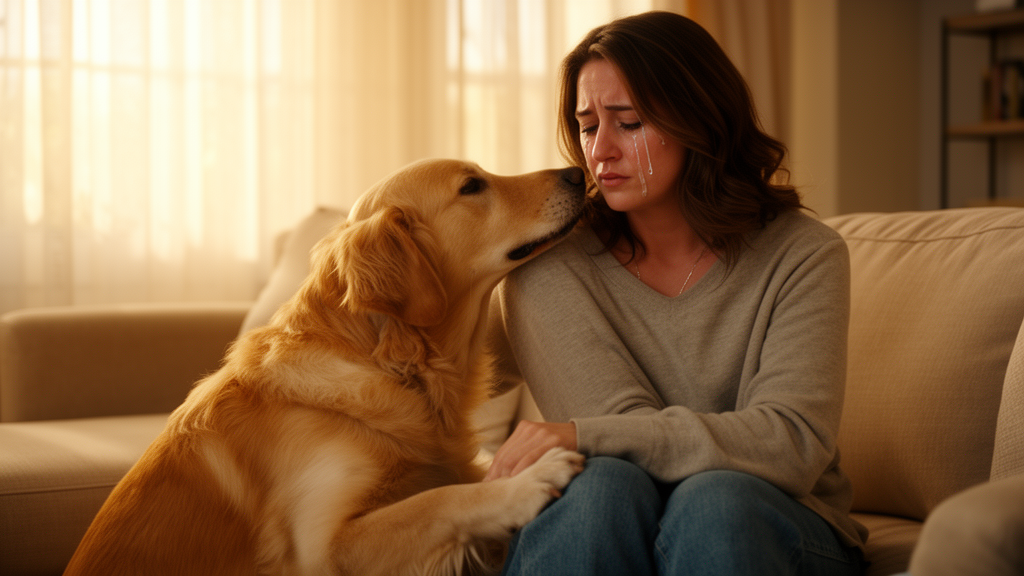
When a dog trots over to console a crying person, it looks like empathy. But what is actually happening inside the animal? A new study from Ripon College and the University of Portsmouth, published in Frontiers in Ethology, put that question to one of its most rigorous tests yet. Researchers led by Kalyn Otzelberger, Teresa Romero, and Julia Meyers-Manor measured dogs’ responses to human emotions across four different metrics at once—behavior, heart rate variability, a cognitive judgment task, and owner-reported surveys—to see whether they all tap into the same underlying capacity. The answer, it turns out, is more complicated than a simple yes.
The team recruited 35 dogs and their owners, ranging in age from 1 to 12 years, and brought them into the lab for two sessions spaced about a week apart. During each visit, dogs wore a Polar H9 heart rate monitor strapped to their chest, with data streamed via Bluetooth and later processed using Kubios software. The dogs were trained on a cognitive bias task, in which they learned that a bowl placed in one location always contained a treat while a bowl in another location never did. Once they had learned the difference, researchers introduced an ambiguous middle location. How quickly a dog approached that uncertain bowl is thought to reflect its internal emotional state: fast approaches suggest optimism, slow ones pessimism.
Between cognitive bias tests, dogs were exposed to human emotional displays. Their owner and an unfamiliar experimenter sat in chairs facing each other and, in counterbalanced order, either read aloud from a book as a neutral baseline or acted out crying or laughing for 20 seconds at a time. Throughout these presentations, both humans were instructed to completely ignore the dog, avoiding eye contact and physical interaction. Cameras recorded everything, and coders who had not been present in the room scored the dogs’ person-oriented behaviors—looking at, approaching, contacting, or vocalizing toward a person—second by second.
The behavioral results were striking. Dogs showed by far the most person-oriented behaviors when someone was crying, followed by when someone was laughing, and the least during the neutral reading conditions. Statistical analysis revealed a large effect of emotion type, with crying eliciting roughly five times more person-oriented behaviors than baseline. Notably, it did not matter whether the distressed person was the owner or a stranger: dogs directed their attention and contact toward whoever was expressing the emotion. When the owner cried, dogs oriented toward the owner; when the stranger cried, they oriented toward the stranger. This pattern held for laughter too, though with fewer overall responses.
The tone of the dogs’ first approach was also revealing. During crying conditions, 35 of the 44 total approaches were coded as submissive—a proportion far above what chance would predict. During laughing conditions, 17 of 24 approaches were similarly submissive. This suggests that dogs were not simply curious or playful when humans displayed strong emotions; they approached in a deferential, possibly conciliatory manner, consistent with prior research showing that dogs respond to human distress with contact-seeking behavior.
Physiological measures told a more nuanced story. Heart rate variability, or HRV, reflects the activity of the autonomic nervous system, with lower variability generally indicating greater sympathetic activation and stress. While overall HRV did not differ significantly across the emotional conditions, correlations emerged at the individual level. Dogs that showed more person-oriented behaviors while a stranger cried had significantly lower HRV during that same period, suggesting that the most behaviorally responsive dogs were also the most physiologically stressed. Intriguingly, a similar relationship appeared when the owner laughed: dogs who approached their laughing owner more showed lower HRV, hinting that even positive human emotions can produce mild arousal that motivates contact-seeking.
The cognitive bias task, however, told a different story entirely. Of the 35 dogs, 26 successfully completed the training, taking an average of just over 20 trials to learn the task. But when researchers compared the dogs’ latency to approach the ambiguous middle bowl after exposure to crying versus laughing versus neutral reading, they found no significant differences. Dogs showed no evidence of a more pessimistic or optimistic outlook depending on which emotion they had just witnessed. This null result raises an important question: does witnessing human distress simply fail to shift a dog’s emotional state, or does the cognitive bias task fail to capture short-term emotional changes?
The researchers lean toward the latter interpretation. Cognitive bias tasks have historically been used to measure long-term affective states—such as the pessimism of shelter dogs compared to pet dogs, or the effects of fluoxetine treatment on separation anxiety. Only a handful of studies have applied them to brief emotional shifts, and those involved exposing dogs to human odors during the test itself. In the current study, there was a delay between the emotional presentation and the cognitive bias test, which may have been long enough for any transient emotional change to dissipate. The authors suggest that future studies present emotional stimuli concurrently with the bias task, or use intermediate bowls positioned closer to the negative location, where subtle biases may be more detectable.
Owner surveys added another layer of insight. Owners completed the Dog Emotional Reactivity Survey, which includes a subscale measuring how reactive a dog is to its owner’s emotions, as well as the Canine Behavioural Assessment and Research Questionnaire, which assesses aggression, fear, and attachment. Dogs with higher owner-reported empathy scores did indeed show more person-oriented behaviors while their owner cried, and their empathy scores correlated marginally with higher attachment scores. This suggests that owners can accurately predict how their dogs respond to their distress, and that dogs perceived as more empathetic may also be more strongly bonded to their owners. However, the survey scores did not predict how dogs responded to a crying stranger, indicating that owners’ assessments are specific to their own relationship rather than a general trait.
Contagious yawning, often used as a proxy for empathy in other species, largely failed to materialize. Only 4 of the 35 dogs yawned when a stranger performed exaggerated yawns for three minutes, far below the rates of roughly 30 to 72 percent reported in previous studies. The researchers note that prior work often used familiar individuals as the yawning stimulus, and that the preceding experimental procedures may have suppressed the behavior. Without sufficient yawning data, they could not test whether it correlates with other empathy measures.
Taken together, the findings paint a picture of dogs as highly sensitive to human emotional signals, particularly distress, and responsive in ways that are both behavioral and physiological. But whether that responsiveness reflects genuine emotional contagion—the internal matching of another’s state—remains unproven. The lack of cognitive bias effects suggests dogs may not be feeling the sadness they witness, or that our tools for measuring transient emotional states in dogs are not yet sharp enough. What is clear is that no single measure captures the full picture. Behavior, physiology, cognition, and owner perception each reveal a different facet of the dog-human emotional bond, and integrating them will be essential for understanding not just what dogs do when we cry, but what, if anything, they feel.
Subject of Research: Comparing behavioral, physiological, cognitive bias, and survey measures of empathy-like responses in domestic dogs exposed to human emotional expressions
Article Title: Let’s get it together: the relationship between different measures of empathy in dogs
Article References: Otzelberger, K. A., Romero, T., & Meyers-Manor, J. E. (2026). Let’s get it together: the relationship between different measures of empathy in dogs. Frontiers in Ethology, 5, Article 1944284. https://doi.org/10.3389/fetho.2026.1944284
Image Credits: AI Generated
DOI: 10.3389/fetho.2026.1944284
Keywords: dogs, empathy, human-animal bond, heart rate variability, cognitive bias task, contagious yawning, owner surveys, emotional contagion, animal cognition, canine behavior, distress signals, attachment
Cite Scienmag News
William Thompson. (October 16, 2026). Dogs Rush to Comfort Crying Humans, but New Study Reveals What Empathy Really Looks Like. Scienmag. https://scienmag.com/dogs-rush-to-comfort-crying-humans-but-new-study-reveals-what-empathy-really-looks-like/
William Thompson. "Dogs Rush to Comfort Crying Humans, but New Study Reveals What Empathy Really Looks Like." Scienmag, 16 October 2026, https://scienmag.com/dogs-rush-to-comfort-crying-humans-but-new-study-reveals-what-empathy-really-looks-like/. Accessed 16 October 2026.
William Thompson. "Dogs Rush to Comfort Crying Humans, but New Study Reveals What Empathy Really Looks Like." Scienmag. October 16, 2026. https://scienmag.com/dogs-rush-to-comfort-crying-humans-but-new-study-reveals-what-empathy-really-looks-like/


