


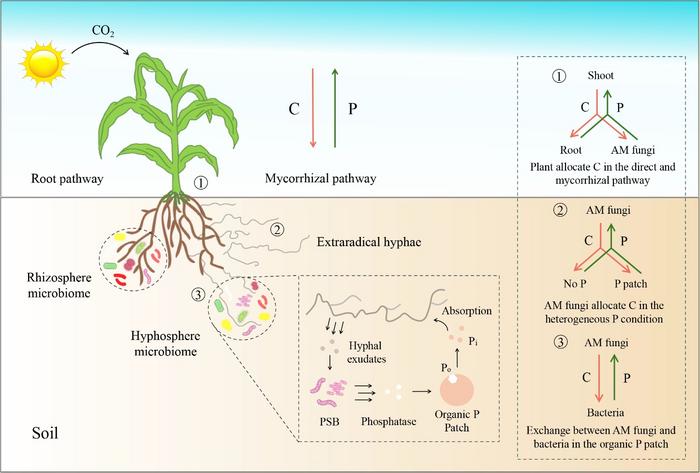
In the intricate fabric of terrestrial ecosystems, phosphorus emerges as a cornerstone nutrient vital for plant development and productivity. Despite its abundance in terrestrial soils, phosphorus predominantly exists in forms that are chemically unavailable to plants, rendering it one of the most limiting nutrients in agriculture and natural vegetation. Over millennia, plants have evolved complex strategies to navigate this challenge, optimizing their ability to acquire this elusive element through two primary and complementary pathways: the direct root uptake pathway and the symbiotic mycorrhizal pathway.
The direct pathway is characterized by the plant roots’ intrinsic capacity to absorb inorganic phosphate ions directly from the soil solution. This uptake occurs predominantly through root epidermal cells and root hairs, where specialized phosphate transporters facilitate the movement of phosphorus into the root system. However, the mobility of phosphorus in soil is notoriously low due to its strong adsorption to mineral surfaces and precipitation as insoluble compounds, confining root access to only a limited soil volume immediately surrounding the roots.
To overcome these physical and chemical constraints, plants engage in a mutually beneficial symbiosis with arbuscular mycorrhizal (AM) fungi, constituting the mycorrhizal pathway. The hyphal networks of these fungi extend far beyond the depletion zone of the roots, exploring a larger soil volume and accessing phosphorus unavailable to the plant alone. Upon absorption, AM fungi translocate phosphorus to their plant hosts in exchange for photosynthetically derived carbon compounds, highlighting an elegant trade-off central to ecosystem nutrient cycling.
While these two acquisition strategies coexist, a critical question concerns the regulatory mechanisms underpinning their balance. Recent insights from the research team led by Professor Lin Zhang at China Agricultural University provide compelling evidence that plants dynamically adjust carbon allocation between their roots and mycorrhizal partners in response to soil phosphorus availability. Under phosphorus-deficient conditions, plants intensify carbon investment into root growth and direct uptake pathways, capitalizing on root morphological and physiological plasticity to scavenge scarce phosphorus. Conversely, in phosphorus-replete soils, the investment shifts towards sustaining mycorrhizal symbiosis, which becomes a more energy-efficient strategy for phosphorus acquisition.
This sophisticated balancing act is further refined by the plant’s ability to discern and modulate interactions with distinct AM fungal species based on their efficacy in delivering phosphorus. Plants preferentially allocate carbon resources to fungal partners that provide superior nutritional benefits, a selectivity that reflects intricate signaling dialogues between host and symbiont. This selective carbon allocation is crucial for optimizing the mutualistic relationship and ensuring maximal phosphorus uptake efficiency, marking an adaptive strategy shaped by evolutionary pressures.
Beyond this binary interaction lies a subtle yet vital role for rhizosphere bacteria, particularly phosphate-solubilizing bacteria (PSB), which augment phosphorus availability in conjunction with AM fungi. Soils display marked heterogeneity in nutrient distribution, and the limited capacity of AM fungi to degrade complex organic phosphorus compounds necessitates microbiological assistance. PSB secrete extracellular enzymes such as acid phosphatases, mineralizing recalcitrant organic phosphorus into orthophosphate ions accessible to plants. Intriguingly, AM fungi influence the composition and activity of rhizosphere microbial consortia through hyphal exudates, fostering an ecological niche enriched in beneficial PSB that synergize phosphorus cycling.
Despite significant advancements in understanding the “dual pathways” of phosphorus acquisition, critical gaps persist. One unresolved challenge pertains to the precise molecular and physiological regulators that calibrate carbon partitioning between roots and mycorrhizal fungi. How do plants integrate environmental phosphorus cues and internal nutritional status to fine-tune this distribution? Furthermore, the temporal coordination between the direct and mycorrhizal routes across varying developmental stages and soil conditions remains enigmatic, warranting longitudinal studies.
Additionally, the tripartite interface involving plants, AM fungi, and rhizosphere bacteria presents a complex signaling landscape yet to be fully elucidated. Molecular cross-talk, including hormonal signals and secondary metabolites, likely governs the establishment and maintenance of these interactions. Unraveling these communication networks promises to illuminate new avenues for enhancing phosphorus use efficiency in agroecosystems.
To address these challenges, cutting-edge interdisciplinary methodologies are essential. Emerging technologies such as quantum dot fluorescence labeling enable visualization of phosphorus trafficking at cellular and subcellular resolutions, offering unprecedented insights into the dynamics of nutrient exchange. Similarly, high-throughput stable isotope probing facilitates the tracing of phosphorus flow through complex microbial communities and plant tissues, uncovering functional contributions of individual microbial taxa.
Understanding and manipulating the interplay between direct root uptake and mycorrhizal symbiosis holds profound implications for sustainable agriculture. By optimizing these natural nutrient acquisition strategies, it is possible to reduce reliance on phosphorus fertilizers, mitigate environmental pollution, and enhance crop resilience under nutrient-limiting conditions. This research area is thus pivotal for developing technologically advanced, ecologically informed approaches to food security.
Moreover, the interplay among plants, fungi, and bacteria exemplifies the broader principle of networked biological cooperation underpinning ecosystem productivity. Phosphorus acquisition serves as a model system illustrating how multi-organism interactions are finely tuned through evolutionary and ecological processes to optimize resource use efficiency. Realizing the full potential of this knowledge requires bridging plant physiology, soil microbiology, molecular biology, and ecological theory.
In conclusion, the dual pathways for phosphorus acquisition—direct root uptake and mycorrhizal symbiosis—represent a masterclass in evolutionary innovation, environmental sensing, and resource allocation strategy. Ongoing research continues to uncover layers of complexity regarding their regulation, coordination, and synergistic interactions with rhizosphere microbiota. As agriculture faces escalating challenges in nutrient management and environmental sustainability, deepening our understanding of these mechanisms will be indispensable in designing the next generation of crop systems that leverage natural biological partnerships for optimal phosphorus nutrition.
News Publication Date: 22-Nov-2024
Web References: https://doi.org/10.15302/J-FASE-2024589
References: Research published in Frontiers of Agricultural Science and Engineering
Cite Scienmag News
Alan Morgan. (May 15, 2025). Do Plants Employ a “Dual Insurance” Strategy to Secure Phosphorus? Scienmag. https://scienmag.com/do-plants-employ-a-dual-insurance-strategy-to-secure-phosphorus/
Alan Morgan. "Do Plants Employ a “Dual Insurance” Strategy to Secure Phosphorus?" Scienmag, 15 May 2025, https://scienmag.com/do-plants-employ-a-dual-insurance-strategy-to-secure-phosphorus/. Accessed 4 September 2026.
Alan Morgan. "Do Plants Employ a “Dual Insurance” Strategy to Secure Phosphorus?" Scienmag. May 15, 2025. https://scienmag.com/do-plants-employ-a-dual-insurance-strategy-to-secure-phosphorus/


