


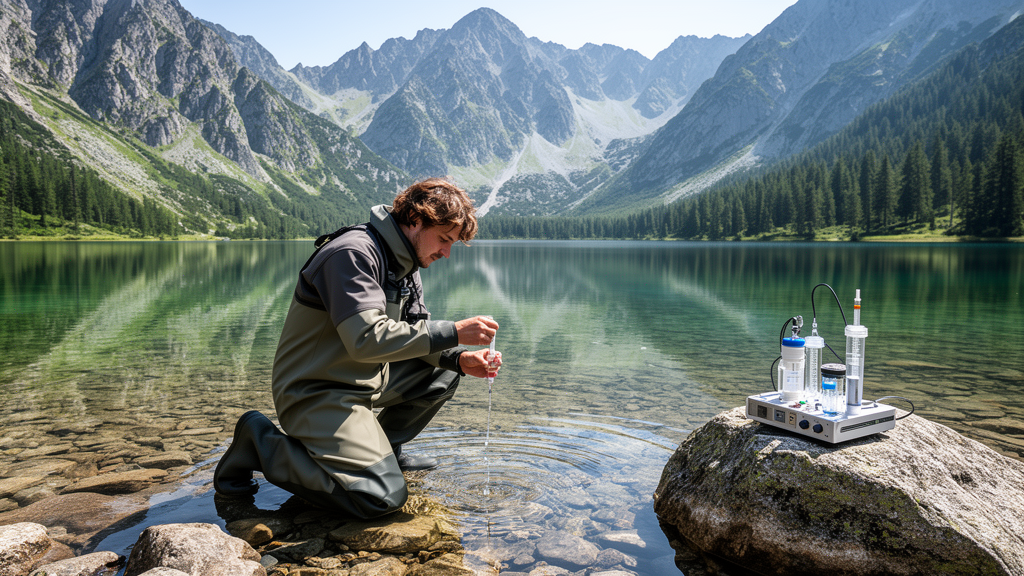
High in the Carpathians, where glacial lakes sit scattered along valleys that climb from dwarf pine into bare rock, a team of researchers has re-read one of Europe’s classic altitudinal biodiversity gradients using DNA instead of microscope keys. In a study published in Metabarcoding and Metagenomics, scientists applied DNA metabarcoding to littoral benthic invertebrates from 17 lakes across four gradient series in the Tatra Mountains, the highest part of the Carpathian chain at up to 2,655 meters above sea level. The results confirm a long-standing ecological pattern—species richness falls as elevation rises—while also revealing that some lakes have quietly shifted their ecological identity over the past two decades, a change the authors attribute to recovery from acidification, catchment characteristics, and potentially climate change or lake connectivity.
The Tatra lakes are almost ideal natural laboratories. Nearly all 260 of them are of glacial origin, most lying above 1,800 meters, and they share a common macroclimate and history of acid deposition yet differ in microclimate, nutrients, and catchment vegetation. Because these remote aquatic islands host frequently isolated invertebrate communities with distinct features, they have long been considered sensitive sentinels of climate change and air pollution. Earlier classifications of their fauna, however, rested entirely on morphological identification, which is labor-intensive, dependent on expert taxonomists, and easily confounded by cryptic or poorly described species.
The research team selected lakes in three valleys—Bielovodská, Veľká Studená, and Mlynická—each with a chain of at least three permanent (sub)alpine lakes separated by more than 50 meters of altitude, plus a fourth triplet of lakes with similar hydromorphology but altitudinal differences of roughly 215 meters. Two exceptional lakes were added: Starolesnianske pleso, which was severely acidified in the 1980s, and Štrbské pleso, exposed to intense human activity. Fieldwork ran each early September from 2017 to 2022, with every lake sampled in at least two years to guard against year-to-year fluctuations. In total, 42 lake visits produced 336 sample replicates.
The sampling protocol was deliberately simple. At each visit, a single bulk sample of benthos was collected by kicking technique with a 0.3-millimeter mesh net at depths of up to one meter, gathering material from all accessible littoral habitats in ten minutes of effort. The samples were fixed with 96% ethanol and stored at −20 °C. Alongside each bulk sample, the team collected about 25-milliliter portions of surface sediment from the shore using tubes mounted on a pole, testing whether sediment—a natural trap for shed environmental DNA and a habitat for organisms that bulk sampling might miss—could add value to the survey.
In the laboratory, animal material was picked from each bulk sample, dried, and homogenized in a ball mill before DNA extraction with a commercial kit. Sediment samples were dried, rehydrated in phosphate buffer, mixed, centrifuged, and filtered before extraction. The team then amplified a 418-base-pair fragment of the standard cytochrome oxidase subunit I (COI) barcoding region using BF3/BR2 primers in a two-step PCR performed in duplicates, and sequenced the libraries on an Illumina MiSeq with 2 × 300 base pair chemistry. Stringent anti-contamination measures—sterile equipment, dedicated workspaces, and 122 negative controls across extraction, amplification, and indexing—accompanied every batch.
Bioinformatic processing was equally rigorous. From 12,776,087 demultiplexed reads, the pipeline merged paired ends, filtered for a maximum expected error of one, checked length and codon compliance, removed chimeras, and clustered sequences into operational taxonomic units (OTUs) at 97% identity. Further curation—co-occurrence filtering, requiring at least 85% similarity to invertebrate reference sequences, negative-control subtraction, and minimum read abundance—left a final bulk dataset of 5,693,319 reads and 343 aquatic invertebrate OTUs, averaging 35 OTUs per bulk sample. Diptera dominated with 141 OTUs, followed by the mayfly, stonefly, and caddisfly orders and annelids, with smaller fractions of other arthropods, rotifers, mollusks, and a planarian.
The central result was strikingly clean. Hierarchical clustering of Jaccard dissimilarities revealed two distinct lake groups, and distance-based redundancy analysis placed them along an axis related to calcium and sulfate concentrations and altitude—parameters that themselves correlate with pH, conductivity, and alkalinity. The high-altitude group comprised eight lakes, while the low-altitude group included the rest, even though two of its members lie above 1,950 meters. A linear mixed model confirmed that the high-altitude lakes held significantly fewer OTUs, with the difference highly significant at p < 0.001. Notably, variability in community composition was greater among lakes than among valleys, supporting the idea that altitude is a stronger structuring factor than geographic proximity for these sites.
The indicator species analysis delivered some of the study’s most compelling evidence for metabarcoding’s power. Two OTUs, assigned to the worm Tubifex tubifex and the non-biting midge Micropsectra notescens, were detected only in the low-altitude lake group and in every one of those lakes—100% specificity and 100% fidelity. In total, 35 indicator OTUs were identified, more than twice as many for the low-altitude group, roughly half belonging to chironomids. Several species previously proposed as indicators of subalpine or alpine conditions—Pseudodiamesa nivosa, Micropsectra radialis, Capnia vidua, Eukiefferiella minor, Prodiamesa olivacea, Nemurella pictetii, and Agabus bipustulatus—were confirmed, while four previously proposed indicators went undetected, likely because they are poorly represented in reference barcode databases.
Perhaps the most intriguing finding concerns lakes that changed camps. Pusté and Vyšné Zbojnícke, previously classified as alpine, now grouped with the subalpine lakes, consistent with their intermediate chemistry and enriched taxon lists that now include genera such as Cernosvitoviella, Tubifex, Pisidium, and Hydroporus. Meanwhile, the neighboring Ľadové Zbojnícke remained firmly alpine, likely because its greater depth and smaller catchment limit warming and nutrient input. The apparent upward expansion of the midge Macropelopia nebulosa, detected in nearly all lakes in 2022 after being absent from most high-altitude sites, adds a further hint of ecological transition. Signs of post-acidification recovery were also visible, including acidophobic species such as Diura bicaudata and Ameletus inopinatus in high-altitude lakes.
Sediment metabarcoding, by contrast, proved a mixed blessing. The majority of sediment sequences were not invertebrate DNA, and curation discarded 87% of sediment reads compared with just 5% from bulk samples, leaving only 176 OTUs and an average of six per sample. Yet the sediment ordination patterns aligned with those from the bulk analyses, and Mantel and coinertia tests confirmed nonrandom similarity between the two datasets. Primer degeneracy also allowed the unique detection of the phylum Gastrotricha and specific taxa such as the harpacticoid Attheyella wierzejskii and the ostracod Cypria. The authors conclude that bulk samples currently provide the more comprehensive taxonomic coverage, but that improved primer specificity and sampling strategy could make sediment DNA far more informative. Overall, the study reinforces a broader trend in freshwater science: DNA metabarcoding offers high taxonomic resolution and valuable insights into invertebrate biodiversity, and as barcode libraries grow, it is poised to become a standard tool for tracking how mountain lake communities respond to a changing environment.
Subject of Research: DNA metabarcoding of benthic invertebrate communities along an altitudinal gradient in the Tatra Mountain lakes
Article Title: Gradient patterns in the Tatra Mountain lakes revisited with invertebrate DNA metabarcoding
Article References: Vargovčík, O., Tuhrinová, K., Beracko, P., Kopáček, J., Čiamporová-Zaťovičová, Z., Macko, P., Šamulková, M., & Čiampor, F. (2025). Gradient patterns in the Tatra Mountain lakes revisited with invertebrate DNA metabarcoding. Metabarcoding and Metagenomics, 9, Article e150825. https://doi.org/10.3897/mbmg.9.150825
Image Credits: AI Generated
Keywords: DNA metabarcoding, Tatra Mountains, alpine lakes, benthic invertebrates, COI barcoding, environmental DNA, acidification recovery, altitude gradient, indicator species, freshwater biomonitoring, chironomids, sediment DNA
Cite Scienmag News
Sloane Callahan. (October 18, 2026). DNA metabarcoding redraws the map of life in the Tatra Mountain lakes. Scienmag. https://scienmag.com/dna-metabarcoding-redraws-the-map-of-life-in-the-tatra-mountain-lakes/
Sloane Callahan. "DNA metabarcoding redraws the map of life in the Tatra Mountain lakes." Scienmag, 18 October 2026, https://scienmag.com/dna-metabarcoding-redraws-the-map-of-life-in-the-tatra-mountain-lakes/. Accessed 18 October 2026.
Sloane Callahan. "DNA metabarcoding redraws the map of life in the Tatra Mountain lakes." Scienmag. October 18, 2026. https://scienmag.com/dna-metabarcoding-redraws-the-map-of-life-in-the-tatra-mountain-lakes/


