


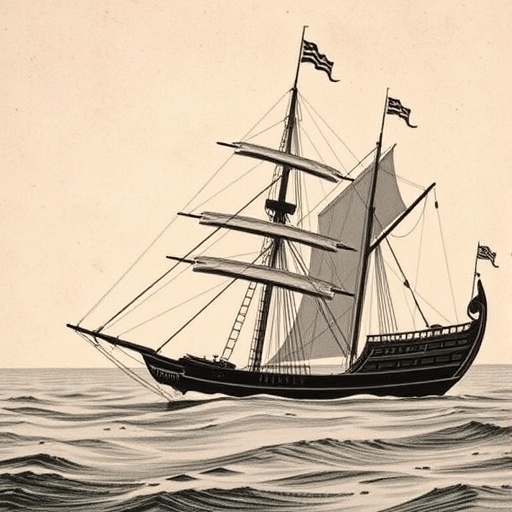
In a remarkable breakthrough that illuminates a long-standing enigma of Arctic exploration history, scientists from the University of Waterloo have successfully identified four additional members of Sir John Franklin’s ill-fated 1845 expedition. This pioneering work harnessed advanced DNA analysis of skeletal remains recovered from the harsh and desolate Arctic terrain, bringing clarity to a mystery that has persisted for over 166 years. The expedition, notorious for its tragic disappearance, involved two ships, HMS Erebus and HMS Terror, which became icebound in the unforgiving Arctic ice, leading to the eventual deaths of all crew members.
The identification process was led by anthropologists specializing in forensic and genetic anthropology within Waterloo’s Faculty of Arts. By extracting mitochondrial and Y-chromosome DNA from human remains found on King William Island and the Adelaide Peninsula, combined with genealogical records of living descendants, researchers established unambiguous genetic linkages. These findings augment the number of Franklin sailors positively identified through DNA to six, thus significantly advancing our forensic understanding of this historical disaster.
In 1848, after two years of entrapment in Arctic ice, the surviving crew of 105 men abandoned their stranded vessels and embarked on a desperate overland journey. They dragged sledges and lifeboats along the western coast of King William Island, a perilous trek in extreme cold that ultimately resulted in the demise of every individual. Over the decades, scattered human remains have been retrieved from various sites across the island and neighboring regions, but conclusive identification had eluded investigators until recent genetic methodologies were applied.
The newly identified sailors provide crucial insight into the final episodes of the Franklin expedition, shedding light on the geographic distribution of remains and the fate of individual crew members. Among these, three men belonged to HMS Erebus and were discovered at Erebus Bay, a significant location where some of the expedition’s last moments unfolded. The fourth identified individual is notable as the sole sailor from HMS Terror positively identified through DNA. His remains were located 130 kilometers away from Erebus Bay, demonstrating the spatial extent of the crew’s dispersal during the escape attempt.
This uniquely identified sailor was Harry Peglar, who served as Captain of the Foretop aboard HMS Terror. The resolution of Peglar’s identity addresses a historical conundrum dating back to at least 1859, when a body was found containing his authentic personal papers but dressed incongruously with clothing inappropriate for his rank. Among the few surviving written records from the expedition, known as the “Peglar Papers,” were seaman’s certificates, poetry, and descriptive notes on expedition events. These writings provide both a poignant and rare literary window into the tragic voyage.
Alongside Peglar, the research team confirmed the identities of William Orren, Able Seaman; David Young, Boy 1st Class; and John Bridgens, Subordinate Officers’ Steward. Each of these men endured the grueling Arctic winter and was among those who attempted to flee the icebound ships, offering a sobering testament to human resilience and desperation under extreme conditions. Their identifications help clarify the crew’s hierarchical composition during the final days and allow historians to piece together the social fabric aboard the ships.
Previous genetic identifications made by this team included John Gregory, the engineer of HMS Erebus, identified in 2021, and James Fitzjames, the commanding captain of Erebus, identified in 2024. Remarkably, unlike Fitzjames, whose remains bore evidence of postmortem cannibalism, the recent identifications show no such indications, suggesting varying conditions or experiences among the crew members during their terminal ordeal.
The implications extend beyond academic interest, offering living descendants profound emotional and historical context concerning their ancestors’ final moments. The use of mitochondrial DNA, transmitted solely through the maternal line, and Y-chromosome DNA, passed along paternal lines, allowed for stringent genealogical verification of kinship. This methodology ensures that identifications meet the highest standards of genetic resolution, eliminating doubt and speculation.
An intriguing consequence of the research emerged through collaboration with media, when Rich Preston, a journalist known for genealogy programming with the BBC, was revealed to descend directly from John Bridgens, one of the identified sailors. Preston expressed a deep personal connection and fascination upon learning of his ancestry, underscoring the interdisciplinary and humanistic dimensions of the project.
The laboratory work involved extracting ancient DNA from archaeological bone samples, a process complicated by DNA degradation over time and environmental factors. Combining these fragmentary genetic sequences with carefully curated modern descendant DNA required innovative bioinformatic analyses and strict contamination controls. The genetic distances obtained—measures of relatedness—were zero in all four new cases, providing unequivocal evidence of familial descent.
Researchers emphasize the importance of genealogical documentation for eligibility, requiring clear maternal or paternal lineage records to match DNA samples successfully. They invite other Franklin expedition descendants to collaborate by providing genetic material, which could enable further identifications and enrich the historical narrative of this epochal Arctic tragedy.
Findings from this research have been published in two peer-reviewed articles. The first, appearing in the Journal of Archaeological Science: Reports, details the DNA identifications of three HMS Erebus sailors, while the second, titled ‘Some very hard ground to heave,’ slated for publication in Polar Record, focuses on Captain Harry Peglar and the complexities surrounding his identification. These papers provide both technical underpinnings and contextual interpretations, enhancing scientific and public understanding of the Franklin expedition.
This breakthrough embodies the power of cutting-edge molecular genetics integrated with traditional anthropology and historical records. It exemplifies how modern science can breathe life into history, resolving mysteries once thought impenetrable and connecting the past with descendants who carry these legacies forward.
News Publication Date: 6-May-2026
Web References:
– https://www.sciencedirect.com/science/article/pii/S2352409X26001744
– https://doi.org/10.1017/S003224742610031X
References:
– Journal of Archaeological Science Reports (DOI: 10.1016/j.jasrep.2026.105739)
– Polar Record (forthcoming article on Harry Peglar identification)
Cite Scienmag News
Courtney Benton. (May 6, 2026). DNA Analysis Reveals Identities of Four Additional Sailors from Franklin Expedition. Scienmag. https://scienmag.com/dna-analysis-reveals-identities-of-four-additional-sailors-from-franklin-expedition/
Courtney Benton. "DNA Analysis Reveals Identities of Four Additional Sailors from Franklin Expedition." Scienmag, 6 May 2026, https://scienmag.com/dna-analysis-reveals-identities-of-four-additional-sailors-from-franklin-expedition/. Accessed 4 September 2026.
Courtney Benton. "DNA Analysis Reveals Identities of Four Additional Sailors from Franklin Expedition." Scienmag. May 6, 2026. https://scienmag.com/dna-analysis-reveals-identities-of-four-additional-sailors-from-franklin-expedition/


