

Tuesday, October 20, 2026
Science
No Result
View All Result
  • Login
  • HOME
  • SCIENCE NEWS
  • CONTACT US
  • HOME
  • SCIENCE NEWS
  • CONTACT US
No Result
View All Result
Scienmag
No Result
View All Result
Home Science News

Dissolution Alters Failure in Rock-Like Specimens Under Uniaxial Compression

October 20, 2026
in Science News
Denise Maddox
By Denise Maddox Scienmag Editorial Profile - Mechanical Engineering
Reading Time: 2 mins read
0
Dissolution Alters Failure in Rock-Like Specimens Under Uniaxial Compression

Dissolution Alters Failure in Rock-Like Specimens Under Uniaxial Compression

65
SHARES
587
VIEWS
Share on FacebookShare on Twitter
ADVERTISEMENT

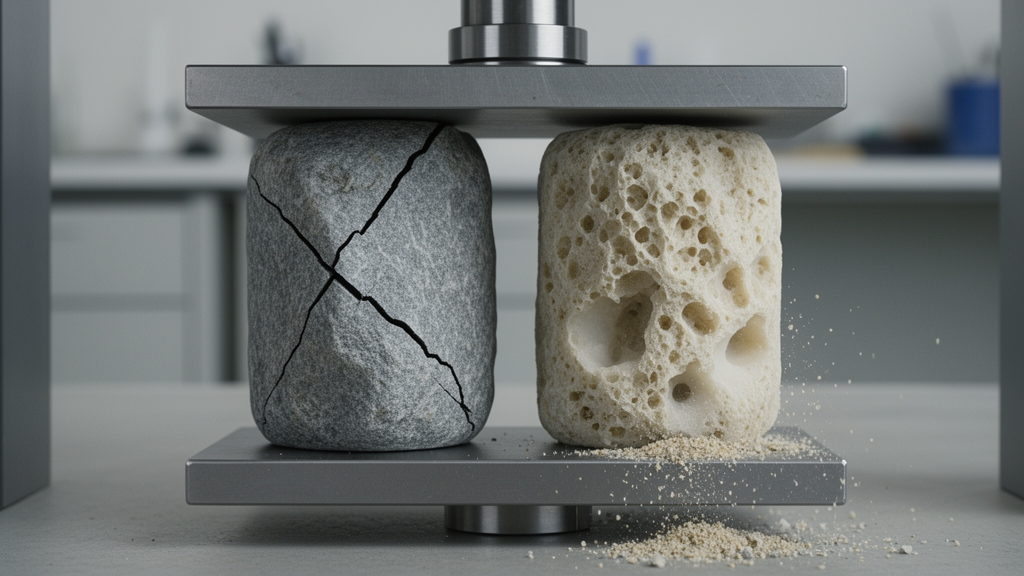
Increasing dissolution weakened rock-like specimens and shifted their failure under uniaxial compression from rapid coalescence of one dominant crack to progressive, mixed tensile-shear damage involving multiple defects. Experiments on specimens prepared at dissolution degrees of 0%, 5%, 10%, 15%, and 20% showed clear declines in four measured mechanical properties, alongside changes in acoustic emission and surface strain measured by digital image correlation.

The study used a mechanical-acoustic-optical system to combine mechanical loading with acoustic emission monitoring and digital image correlation. Mechanical measurements quantified compressive strength, elastic modulus, peak axial strain, and deformation modulus. Acoustic emission tracked activity associated with cracking during loading, while digital image correlation mapped the evolution of strain across the specimen surface. Together, the methods characterized the specimens’ overall mechanical response, fracture activity, and spatial strain patterns.

From the least to the most dissolved specimen, compressive strength decreased by 36.45%, elastic modulus by 27.01%, peak axial strain by 17.25%, and deformation modulus by 41.28%. The largest relative change was therefore in deformation modulus, while peak axial strain showed the smallest decrease. These measurements indicate that increasing dissolution affected both the load-bearing and deformational behavior of the rock-like material.

Acoustic emission also changed in timing and distribution. At low dissolution, activity was concentrated near peak strength and accompanied the rapid coalescence of a single controlling crack. At higher dissolution, acoustic activity began earlier and continued throughout loading, expanding the pre-peak damage interval. Digital image correlation showed a corresponding progression from small-scale microcracking to the propagation and coalescence of larger cracks. Instead of primarily axial tensile splitting, the more dissolved specimens developed multiple shear strain concentration zones and progressive mixed tensile-shear failure. The results provide experimental evidence about how dissolution-related defects can alter rock-like material under controlled uniaxial compression, with direct relevance to stability assessment and disaster mitigation in karst underground engineering.

Subject of Research: Effects of dissolution on the mechanical, acoustic, and optical failure behavior of rock-like specimens under uniaxial compression

Article Title: Mechanical-acoustic-optical response properties in uniaxial compression failure of rock masses with different dissolution degrees

Article References: Luo, W., Guo, J., Chen, F., Chen, T., & Wang, Y. (2026). Mechanical-acoustic-optical response properties in uniaxial compression failure of rock masses with different dissolution degrees. PLOS One, 21(10), e0360540. https://doi.org/10.1371/journal.pone.0360540

Image Credits: AI Generated

DOI: 10.1371/journal.pone.0360540

Keywords: rock dissolution, uniaxial compression, rock-like specimens, acoustic emission, digital image correlation, compressive strength, crack coalescence, mixed tensile-shear failure, progressive damage, karst engineering, Mechanical-acoustic-optical, response

Cite Scienmag News

Denise Maddox. (October 20, 2026). Dissolution Alters Failure in Rock-Like Specimens Under Uniaxial Compression. Scienmag. https://scienmag.com/dissolution-alters-failure-in-rock-like-specimens-under-uniaxial-compression/


Denise Maddox. "Dissolution Alters Failure in Rock-Like Specimens Under Uniaxial Compression." Scienmag, 20 October 2026, https://scienmag.com/dissolution-alters-failure-in-rock-like-specimens-under-uniaxial-compression/. Accessed 20 October 2026.

Denise Maddox. "Dissolution Alters Failure in Rock-Like Specimens Under Uniaxial Compression." Scienmag. October 20, 2026. https://scienmag.com/dissolution-alters-failure-in-rock-like-specimens-under-uniaxial-compression/

Tags: acoustic emissioncompressive strengthcrack coalescencedigital image correlationkarst engineeringMechanical-acoustic-opticalmixed tensile-shear failureprogressive damageresponserock dissolutionrock-like specimensuniaxial compression
Share26Tweet16
Previous Post

Survival remains limited in older transplant-ineligible mantle cell lymphoma

Next Post

Chile wetland study links birds with community memory of ecological change

Related Posts

Chile wetland study links birds with community memory of ecological change
Social Science

Chile wetland study links birds with community memory of ecological change

October 20, 2026
Survival remains limited in older transplant-ineligible mantle cell lymphoma
Cancer

Survival remains limited in older transplant-ineligible mantle cell lymphoma

October 20, 2026
Self-supervised deep learning enables reliable 20-fold accelerated fMRI mapping
Technology and Engineering

Self-supervised deep learning enables reliable 20-fold accelerated fMRI mapping

October 20, 2026
Betaine solvent extracts more than 99% of copper from waste circuit boards
Earth Science

Betaine solvent extracts more than 99% of copper from waste circuit boards

October 20, 2026
SWAP70 promotes liver cancer growth through CPT1A-dependent fatty acid oxidation
Biology

SWAP70 promotes liver cancer growth through CPT1A-dependent fatty acid oxidation

October 20, 2026
Machine learning links immune-cell measures to resected lung cancer prognosis
Cancer

Machine learning links immune-cell measures to resected lung cancer prognosis

October 20, 2026
Next Post
Chile wetland study links birds with community memory of ecological change

Chile wetland study links birds with community memory of ecological change

  • Mothers who receive childcare support from maternal grandparents show more optimized

    Mothers who receive childcare support from maternal grandparents show more parental warmth, finds NTU Singapore study

    27656 shares
    Share 11059 Tweet 6912
  • University of Seville Breaks 120-Year-Old Mystery, Revises a Key Einstein Concept

    1061 shares
    Share 424 Tweet 265
  • Bee body mass, pathogens and local climate influence heat tolerance

    682 shares
    Share 273 Tweet 171
  • Researchers record first-ever images and data of a shark experiencing a boat strike

    546 shares
    Share 218 Tweet 137
  • Groundbreaking Clinical Trial Reveals Lubiprostone Enhances Kidney Function

    531 shares
    Share 212 Tweet 133
Science

Embark on a thrilling journey of discovery with Scienmag.com—your ultimate source for cutting-edge breakthroughs. Immerse yourself in a world where curiosity knows no limits and tomorrow’s possibilities become today’s reality!

RECENT NEWS

  • Chile wetland study links birds with community memory of ecological change
  • Dissolution Alters Failure in Rock-Like Specimens Under Uniaxial Compression
  • Survival remains limited in older transplant-ineligible mantle cell lymphoma
  • Self-supervised deep learning enables reliable 20-fold accelerated fMRI mapping

Categories

  • Agriculture
  • Anthropology
  • Archaeology
  • Athmospheric
  • Biology
  • Biotechnology
  • Blog
  • Bussines
  • Cancer
  • Chemistry
  • Climate
  • Earth Science
  • Editorial Policy
  • Marine
  • Mathematics
  • Medicine
  • Pediatry
  • Policy
  • Psychology & Psychiatry
  • Science Education
  • Science News
  • Social Science
  • Space
  • Technology and Engineering

Subscribe to Blog via Email

Enter your email address to subscribe to this blog and receive notifications of new posts by email.

Join 5,149 other subscribers

© 2025 Scienmag - Science Magazine

Welcome Back!

Login to your account below

Forgotten Password?

Retrieve your password

Please enter your username or email address to reset your password.

Log In
No Result
View All Result
  • HOME
  • SCIENCE NEWS
  • CONTACT US

© 2025 Scienmag - Science Magazine

Discover more from Science

Subscribe now to keep reading and get access to the full archive.

Continue reading