


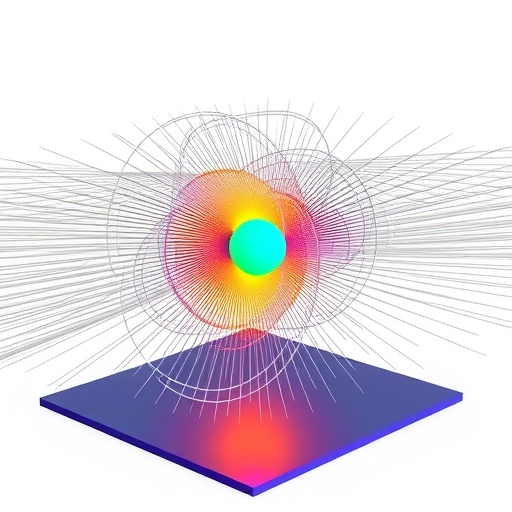
A groundbreaking advancement in the precise characterization of magnetic dipoles offers transformative potential across numerous scientific disciplines. Led by Dr. Zhaojin Rong from the Institute of Geology and Geophysics, Chinese Academy of Sciences, this novel method addresses longstanding challenges in magnetic field analysis and source localization. Magnetic fields pervade the universe, making understanding their sources crucial for unraveling phenomena from planetary magnetism to medical applications. At the heart of magnetic source approximation lies the magnetic dipole, a fundamental concept describing how magnetic sources can be modeled as dipoles under first-order approximation. This new technique refines the process of extracting critical dipole parameters—including position, orientation, and magnetic moment—with unprecedented accuracy.
Traditional approaches, predominantly based on spherical harmonic analysis (SHA), have been instrumental in deciphering geomagnetic fields for decades. SHA expresses the magnetic field as a series of associated Legendre functions, with the initial terms representing the central dipole component, usually assumed to sit at the coordinate origin. However, SHA’s conventional framework offers limited capacity to directly extract the true physical parameters of an eccentric or displaced dipole. Instead, it decomposes such dipoles into a central dipole combined with higher order multipoles, thereby obscuring intrinsic spatial and orientational information. This intrinsic limitation poses challenges for applications requiring precise dipole localization or magnetic moment quantification.
Efforts to directly fit magnetic field measurements to dipole models trace back to early geomagnetism research, including attempts to represent sources as single or multiple dipole and current loop configurations. Despite progress, these classic fitting strategies necessitate the simultaneous optimization of all dipole parameters, often leading to complex, multidimensional parameter spaces with multiple local minima. Guaranteeing a global optimal fit is computationally intensive and prone to uncertainties, thus impacting the reliability of the inferred dipole properties. The nonuniqueness problem—where different parameter sets provide comparable field fits—compounds this difficulty, stalling precise inversion of magnetic sources.
In direct response to these challenges, Dr. Rong’s team introduced an innovative inversion technique grounded in the geometric characteristics of dipolar fields. This method successively separates the multi-parameter inversion problem into hierarchical steps, effectively decoupling otherwise intertwined dipole parameters. By leveraging intrinsic dipole coordinate transformations and exploiting the corotating planetocentric reference frame, the algorithm navigates the parameter space more efficiently. Tests using both simulated datasets and empirical measurements underscore the reliability, convergence, and robustness of this approach, marking a significant methodological leap beyond past fitting paradigms.
One of the key breakthroughs is the technique’s ability to accurately retrieve the eccentric dipole source’s position and axial orientation, described through polar and azimuthal angles within planetocentric coordinates. This nuanced description contrasts sharply with prior assumptions of dipoles fixed at planetary centers, permitting refined insights into magnetic field anomalies and their spatial heterogeneity. Additionally, the method naturally aligns with the deployment of spacecraft trajectories, allowing magnetometer readings to be incorporated seamlessly into the inversion framework as the spacecraft traverses the magne tic environment. This synergy increases confidence in the resultant dipole model against real observational datasets.
Applications of this method extend beyond Earth’s magnetic field to extraterrestrial contexts, notably Mars. Mars’ magnetic remanent field—residual magnetization locked into crustal materials—presents complex local anomalies whose sources have long eluded definitive characterization. Employing Dr. Rong’s technique, researchers have demonstrated that many enigmatic Martian magnetic anomalies can be effectively modeled as dipolar fields originating at depths between 90 and 100 kilometers. This insight potentially reshapes our understanding of the planet’s crustal magnetism and sheds light on past planetary dynamo processes. Such advances illuminate both planetary evolution and the broader astrophysical magnetic environments.
Beyond planetary sciences, this dipolar inversion technique holds promise across a spectrum of magnetic studies. In magnetic prospecting, for instance, the ability to isolate precise dipole parameters could drastically improve localization of ore bodies or subsurface mineral deposits. Similarly, the method’s rigid mathematical foundation makes it adaptable to medical magnetism applications, such as biomagnetic field mapping in magnetocardiography and magnetoencephalography, where accurate source identification is critical. Palaeomagnetism and geomagnetism will also benefit from more fine-grained magnetic source modeling, enabling refined reconstructions of Earth’s magnetic history and dynamics.
Central to the success of this inversion is its intelligent exploitation of the dipolar field’s geometric invariants. Traditional non-linear fitting approaches struggle with parameter interdependencies, but this new method parses inversion into sequential geometrically motivated steps, ensuring each parameter is independently and exactly determined from magnetic field data. This approach mitigates the “curse of dimensionality” typically encountered in multiparameter optimizations, enhancing both computational efficiency and solution stability. Moreover, the dipole coordinate system’s alignment with planetary rotations guarantees physical consistency, further improving model interpretability.
The robustness of the methodology has been repeatedly validated through comprehensive tests on synthetic data with known parameters and real magnetic field measurements. These tests confirm the algorithm’s resilience to noise, measurement errors, and model approximations, which historically complicate magnetic field inversions. By providing a clear pathway to unequivocally parameterize eccentric dipoles, the technique promises to revolutionize magnetic source interpretation, directly impacting navigation, resource detection, space weather prediction, and fundamental geophysical research.
The implications for planetary magnetism research are particularly profound. Many planets, including Earth, Mars, and some moons, exhibit magnetic fields that are influenced by noncentral dipole sources. The capacity to precisely invert these complex configurations promises a deeper understanding of planetary interiors, thermal history, and dynamo mechanisms. As spacecraft missions increasingly acquire high-resolution magnetometer data, techniques like Dr. Rong’s will be essential for extracting maximal scientific value from these measurements.
In conclusion, the development of a precise and robust dipole fitting method marks a pivotal milestone in electromagnetic field analysis. By addressing the fundamental limitations of existing spherical harmonic and model fitting methods, Dr. Rong and colleagues have opened avenues for more accurate characterization of magnetic field sources. This breakthrough empowers researchers across geophysics, planetary science, medical diagnostics, and resource exploration to decode magnetic signals with enhanced clarity and confidence, transforming our capability to interpret the magnetic universe.
News Publication Date: 25-Jul-2025
Web References: http://dx.doi.org/10.26464/epp2025078
Keywords
Magnetic dipole; magnetic field inversion; eccentric dipole; spherical harmonic analysis; geomagnetism; planetary magnetism; magnetic source localization; Martian magnetic anomalies; dipole coordinate system; magnetic field fitting; geophysical inversion; spacecraft magnetic measurements
Cite Scienmag News
Bethany Barker. (August 12, 2025). Dipole Model Reveals Inversion Mechanism of Dipolar Magnetic Fields. Scienmag. https://scienmag.com/dipole-model-reveals-inversion-mechanism-of-dipolar-magnetic-fields/
Bethany Barker. "Dipole Model Reveals Inversion Mechanism of Dipolar Magnetic Fields." Scienmag, 12 August 2025, https://scienmag.com/dipole-model-reveals-inversion-mechanism-of-dipolar-magnetic-fields/. Accessed 3 September 2026.
Bethany Barker. "Dipole Model Reveals Inversion Mechanism of Dipolar Magnetic Fields." Scienmag. August 12, 2025. https://scienmag.com/dipole-model-reveals-inversion-mechanism-of-dipolar-magnetic-fields/


