


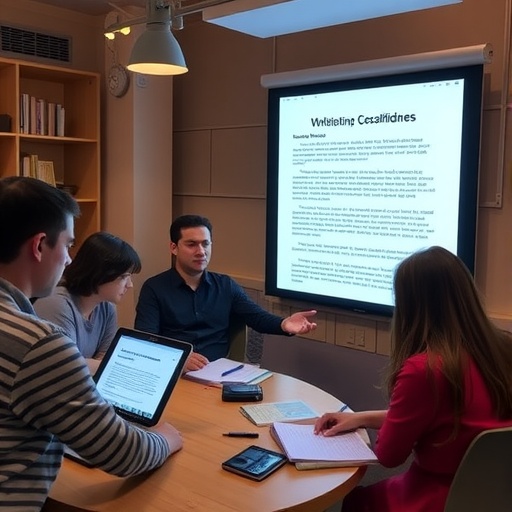
In the evolving landscape of education, the fusion between digital scaffolding and collaborative writing has sparked new conversations about how students engage in the iterative process of text revision. A recent case study investigates this relationship by analyzing how small subgroups of students revise written fables, contrasting traditional methods with those enhanced by digital platforms. The meticulous evaluation and rich qualitative insights reveal not just differences in the quantity of textual modifications, but deeper shifts in cognitive and metalinguistic engagement.
The study zeroes in on the fundamental rewriting operations that shape text improvement: addition, replacement, movement, and deletion. These categories, originally outlined by Fabre (1990), provide a rigorous framework to examine how students evolve their drafts. Additions and replacements, understood as explicit corrections, prompt a metalinguistic discourse—a conscious reflection on language and expression. In contrast, deletions and movements operate on a more paralinguistic level, tuning the semiotic rhythm and cohesion of the narrative.
The experimental group, which was instructed to publish their revised fables on the Moodle platform, demonstrated a heightened propensity to enrich their texts via additions. Their revised drafts contained significantly more lexical and descriptive expansions compared to the control group, who received no such digital scaffolding instructions. For instance, one subgroup’s initial depiction of a mysterious group of influencers—“full of pretensions” and promising “wealth, prosperity, and glory”—was elaborated in the second draft with layers of imagery such as “far away on the horizon” and “a shining future.” These nuanced augmentations manifested a sophisticated narrative depth and vividness that exceeded simple sentence polishing.
Besides thematic enrichment, the experimental group also infused their fables with more complex emotional and character dimensions. In the enhanced description of a crow character, the addition of “mischievous” alongside “curious” expanded the animal’s role from a passive observer to an active, cunning participant. Such lexical choices signify a higher level of critical engagement, signaling that students were not merely correcting errors but strategically crafting their story arcs.
On the flip side, deletions appeared more prevalently within the control group’s revisions, often cutting potentially redundant or poetic elements in an attempt to streamline their storytelling. Yet, a closer look at the experimental group’s approach to deletions reveals a more deliberate balancing act, where words or phrases were judiciously removed to improve sonority and maintain thematic focus. For example, eliminating “of courage” in a description of a gazelle not only avoided semantic redundancy but concentrated the reader’s attention on the core trait of ardour, intensifying the emotional charge of the narrative.
Movement operations, though less frequent across both groups, played a critical role in maintaining narrative coherence and pacing. Strategic repositioning of sentence fragments adjusted the rhythm and emphasis, thereby enhancing the overall readability and engagement of the fables. One illustrative example involved moving the phrase “Convened an assembly, endless action” to the front of a sentence describing a lion’s determination, creating an urgent and dynamic opening that captured reader interest instantly.
This multifaceted engagement with revisions indicates a transformation beyond traditional composition exercises. The experimental group’s iterative writing processes reflect a sophisticated internal dialogue with their texts, exemplifying an interactive and recursive understanding of writing—where drafts serve not as endpoints but as evolving documents open to continuous scrutiny and enhancement. Such findings align with contemporary theories of writing as recursive cognition, wherein authors constantly negotiate meaning, expression, and structure.
Digital scaffolding, manifested through the Moodle platform, appears to catalyze this shift by providing both motivation and a clear framework for reflective revision. By integrating digital publication as part of the assignment, the experimental group was incentivized to go beyond surface-level edits, engaging in deeper metalinguistic reflection. This suggests that educational technologies, when thoughtfully implemented, can amplify students’ awareness of writing as a process rather than a product.
However, the study authors caution that the sample size—limited to six subgroups—necessitates a careful qualitative interpretation of the data. While the observed trends in additions, deletions, and movements are enlightening, they do not claim broad generalizability. Instead, these results offer a compelling case study into the microdynamics of collaborative rewriting in digitally mediated contexts, highlighting the importance of instructional design in scaffolding writing development.
The implications of this research extend well beyond the classroom. Understanding how digital scaffolding shapes the revision process can inform pedagogical practices aimed at fostering critical thinking and metacognitive strategies in learners. This is crucial in an era where writing demands interactive, audience-aware, and multimodal competences. The blending of traditional rhetoric with modern digital tools heralds new possibilities for nurturing not only literacy but creativity and collaboration.
Moreover, the qualitative depth of the study underscores the value of examining writing evolution through a detailed lens—appreciating not only what changes are made but why. The distinction between explicit corrections (additions and replacements) and paralinguistic adjustments (deletions and movements) invites educators and researchers to consider the semiotic layers at play during revision, offering a nuanced taxonomy of rewriting operations.
Future investigations might expand this framework by incorporating larger cohorts and diverse writing genres, testing the scalability of digital scaffolding effects. Further exploration could also assess how different types of feedback—peer, instructor, or automated—interact with such scaffolding to enhance writing outcomes. Integrating longitudinal designs may unveil how sustained engagement with digital platforms transforms students’ writing trajectories over time.
In conclusion, the study beautifully illustrates how structured digital interventions can enrich collaborative writing by empowering students to reflect, revise, and refine their texts with greater intentionality. Moving beyond linear composition models, these findings champion writing as a dynamic, dialogic enterprise—one that thrives on iteration, creativity, and critical self-evaluation fostered through thoughtful instructional scaffolds and technological facilitation.
Cite Scienmag News
Courtney Benton. (October 20, 2025). Digital Scaffolding Transforms Collaborative Writing Practices. Scienmag. https://scienmag.com/digital-scaffolding-transforms-collaborative-writing-practices/
Courtney Benton. "Digital Scaffolding Transforms Collaborative Writing Practices." Scienmag, 20 October 2025, https://scienmag.com/digital-scaffolding-transforms-collaborative-writing-practices/. Accessed 5 September 2026.
Courtney Benton. "Digital Scaffolding Transforms Collaborative Writing Practices." Scienmag. October 20, 2025. https://scienmag.com/digital-scaffolding-transforms-collaborative-writing-practices/


