


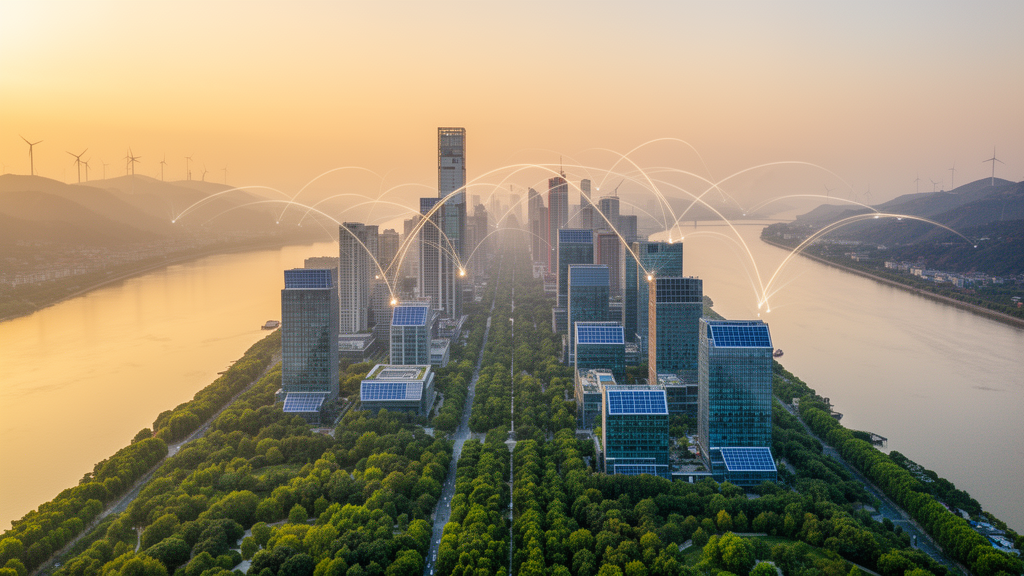
A study of 108 cities along the Yangtze River Economic Belt reports that deeper integration between the real economy and the digital economy is significantly associated with higher green economic efficiency, according to an analysis of panel data covering 2006 to 2022. The research, published as an open-access article in Discover Sustainability, was conducted by Jianyang Lei and Fangfang Wang.
The authors measured real-digital integration using a patent co-classification method and assessed green economic efficiency with a super-efficiency SBM model, applying both measures to city-level panel data across the seventeen-year period.
The results show that real-digital integration levels across the cities trended upward over the study period, but that regional disparities widened in a pattern the authors describe as a Matthew Effect, in which already more-integrated cities pull further ahead. Green economic efficiency followed a distinct spatial ordering, with upstream cities scoring higher than downstream cities, which in turn scored higher than those in the middle reaches of the belt.
Statistically, the study found real-digital integration to be significantly associated with higher green economic efficiency. The authors identify three channels through which this association operates: the development of green finance, greater green innovation capacity, and the application of artificial intelligence technologies.
The association was not uniform across the sample. It appeared stronger in upstream and downstream cities, stronger in cities that are not resource-based, stronger in the period after 2015, and stronger in service-oriented cities. These heterogeneity results suggest that the relationship between real-digital integration and green efficiency depends on local economic structure and stage of development.
The authors present the findings as policy references for governments, enterprises, and financial institutions seeking to advance green transformation through real-digital integration. The published version is an accepted manuscript shared early for faster access; it remains citable through its permanent DOI and is subject to further editing before the final Version of Record replaces it.
Subject of Research: The impact of real-digital integration on green economic efficiency in the Yangtze River Economic Belt
Article Title: The impact of real-digital integration on green economic efficiency in the Yangtze River Economic Belt
Article References: Lei, J., & Wang, F. (2026). The impact of real-digital integration on green economic efficiency in the Yangtze River Economic Belt. Discover Sustainability. https://doi.org/10.1007/s43621-026-05111-7
Image Credits: AI Generated
DOI: 10.1007/s43621-026-05111-7
Keywords: real-digital integration, green economic efficiency, Yangtze River Economic Belt, patent co-classification, super-efficiency SBM model, green finance, green innovation, artificial intelligence, regional disparities, Discover Sustainability, impact, real-digital
Cite Scienmag News
Violet Maxwell. (October 25, 2026). Digital integration linked to greener economies across Yangtze River cities. Scienmag. https://scienmag.com/digital-integration-linked-to-greener-economies-across-yangtze-river-cities/
Violet Maxwell. "Digital integration linked to greener economies across Yangtze River cities." Scienmag, 25 October 2026, https://scienmag.com/digital-integration-linked-to-greener-economies-across-yangtze-river-cities/. Accessed 25 October 2026.
Violet Maxwell. "Digital integration linked to greener economies across Yangtze River cities." Scienmag. October 25, 2026. https://scienmag.com/digital-integration-linked-to-greener-economies-across-yangtze-river-cities/


