


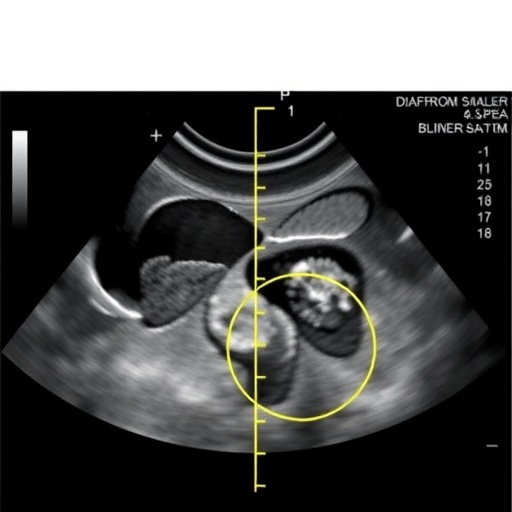
A newborn’s first breaths are among the most demanding moments in human life. Within seconds of delivery, fluid-filled fetal lungs must begin exchanging air, while the diaphragm—the broad, dome-shaped muscle beneath the lungs—must generate enough force to expand the chest. A new cross-sectional study published in the Journal of Perinatology examines how that transition may differ in babies who are small for their gestational age compared with newborns whose size is considered appropriate for the length of pregnancy. The research combines two bedside technologies, diaphragm ultrasound and lung ultrasound, to provide a non-invasive view of both breathing-muscle performance and the amount of air reaching the lungs shortly after birth.
The distinction is clinically important because small-for-gestational-age, or SGA, newborns are not simply smaller versions of average-sized babies. SGA is generally defined as a birth weight below the 10th percentile for gestational age and sex, although the biological causes can vary. Some infants are constitutionally small but healthy, while others have experienced fetal growth restriction caused by placental insufficiency, maternal disease, infection or other complications. These conditions can influence the development of the lungs, chest wall and respiratory muscles before birth. After delivery, SGA infants may face an increased risk of respiratory instability, low blood glucose, temperature problems and admission to neonatal intensive care, making early assessment of breathing particularly valuable.
The team led by I.K.S. de Macedo compared SGA newborns with appropriate-for-gestational-age, or AGA, infants, whose birth weights fall within the expected range for their gestational age. Rather than relying only on visible signs such as rapid breathing, grunting or chest retractions, the researchers used ultrasound to investigate the mechanics underlying those signs. Diaphragm ultrasound can be performed at the bedside without radiation. In an M-mode examination, the movement of the diaphragm during inspiration and expiration can be tracked as a wave, allowing clinicians to estimate diaphragmatic excursion—the distance the muscle travels with each breath. Other measurements can estimate diaphragm thickness and the degree to which it thickens during inspiration, an indicator of contractile activity.
The study also assessed lung aeration using lung ultrasound. When newborn lungs contain fluid or poorly aerated tissue, ultrasound waves produce characteristic vertical artifacts known as B-lines. As air progressively replaces fetal lung fluid, the ultrasound pattern changes, typically moving toward a more aerated appearance. Researchers can translate these patterns into a lung ultrasound score, providing an indirect estimate of aeration across different regions of the chest. This approach does not measure oxygen concentration in the blood or replace radiography when an image of the lung is required, but it can reveal regional changes rapidly and repeatedly while avoiding ionizing radiation.
By placing these two examinations together, the researchers explored a question that conventional newborn assessment cannot fully answer: whether differences in lung aeration in SGA infants are accompanied by differences in the action of the diaphragm. Breathing is a coordinated process. The diaphragm must contract downward, the rib cage must expand and the lungs must open against their own elastic resistance and any remaining fluid. If the lungs are less aerated, the respiratory muscles may have to work harder. Conversely, if the diaphragm is weak or its movement is restricted, effective lung aeration may be delayed. The study’s comparison indicates that growth status is associated with measurable differences in early respiratory physiology, linking the newborn’s prenatal growth pattern with the mechanics of the first breaths.
That connection could help explain why some apparently stable SGA infants later develop signs of respiratory difficulty. A standard clinical examination offers a snapshot, but ultrasound may identify subtler changes before oxygen levels fall or breathing becomes visibly labored. Measurements of diaphragm excursion and inspiratory thickening can help distinguish inadequate muscle performance from a primary problem in the lungs. Lung ultrasound can then show whether the air-filled regions of the lung are expanding evenly or whether fluid and reduced aeration persist in particular areas. Together, the techniques could give neonatal teams a more detailed physiological profile using equipment that is increasingly available in delivery rooms and intensive-care units.
The findings should not be interpreted as proof that being SGA directly causes abnormal diaphragm function or impaired lung aeration. The investigation was cross-sectional, meaning that the newborns were assessed at a particular point rather than followed over time. Such a design can reveal associations but cannot establish whether differences in ultrasound measurements lead to respiratory disease, result from it or reflect another factor shared by the infants. Gestational age, delivery mode, sex, prenatal growth restriction, maternal health, oxygen exposure and the timing of the ultrasound examination may all affect neonatal breathing. Larger longitudinal studies will be needed to determine whether early diaphragm and lung-ultrasound measurements predict the need for respiratory support or later complications.
Even with those limitations, the work highlights a growing shift in neonatal medicine toward functional imaging at the bedside. Ultrasound is portable, repeatable and free of ionizing radiation, allowing clinicians to observe the rapidly changing physiology of transition from fetal to newborn life. It can be performed while an infant remains in a warmer or on non-invasive respiratory support, and results can potentially be integrated with oxygen saturation, respiratory rate and blood-gas measurements. For SGA newborns, whose risks may be difficult to judge from size alone, this combination could eventually support more individualized decisions about monitoring, feeding, oxygen therapy and escalation of care.
The study by de Macedo and colleagues therefore offers more than a comparison between two categories of newborn weight. It presents the diaphragm and the lungs as connected parts of a single system whose performance can be visualized within minutes of birth. If future research confirms that specific ultrasound patterns reliably identify infants at risk, the technology could become an early-warning tool in neonatal units, particularly where access to advanced imaging is limited. The broader message is striking: a silent, radiation-free scan of a newborn’s chest may reveal how successfully the body is adapting to life outside the womb, long before respiratory failure becomes obvious.
Cite Scienmag News
Harold Sullivan. (August 21, 2026). Diaphragm Ultrasound Reveals Differences in Lung Aeration Between Smaller and Typical Newborns. Scienmag. https://scienmag.com/diaphragm-ultrasound-reveals-differences-in-lung-aeration-between-smaller-and-typical-newborns/
Harold Sullivan. "Diaphragm Ultrasound Reveals Differences in Lung Aeration Between Smaller and Typical Newborns." Scienmag, 21 August 2026, https://scienmag.com/diaphragm-ultrasound-reveals-differences-in-lung-aeration-between-smaller-and-typical-newborns/. Accessed 3 September 2026.
Harold Sullivan. "Diaphragm Ultrasound Reveals Differences in Lung Aeration Between Smaller and Typical Newborns." Scienmag. August 21, 2026. https://scienmag.com/diaphragm-ultrasound-reveals-differences-in-lung-aeration-between-smaller-and-typical-newborns/


