


As kimchi has been drawing attention as a global healthy food trend, cabbage is one of the representative vegetables used as a main ingredient for manufacturing kimchi overseas.

Credit: The World Institute of Kimchi
As kimchi has been drawing attention as a global healthy food trend, cabbage is one of the representative vegetables used as a main ingredient for manufacturing kimchi overseas.
The annual global production of cabbage and other Brassica crops is reported to be 72 million tons, and more than 30% of them are estimated to be discarded during the manufacturing and distribution processes, causing environmental pollution as well as considerable waste disposal costs in the industry.
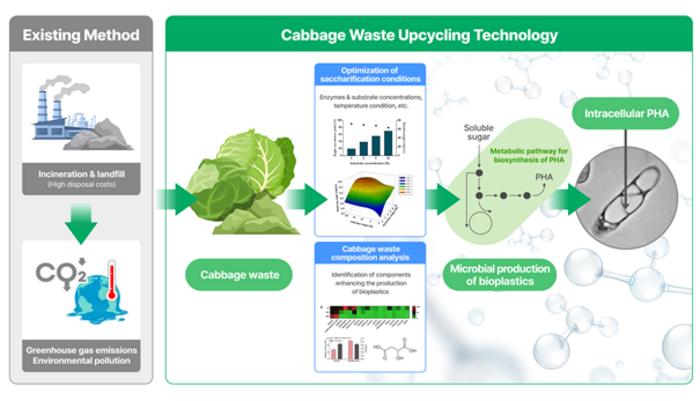
In connection with this problem, Hae Choon Chang, President of the World Institute of Kimchi (WiKim), a government-funded research institute under the Ministry of Science and ICT, announced on April 22 that the institute has developed a ‘bio-refactoring-based upcycling technology’ that can convert cabbage byproducts discarded as waste during the food manufacturing process into biodegradable plastics*.
※ Biodegradable plastics: Plastics that can be completely degraded by natural microbial activity under certain conditions
Bio-refactoring refers to a technology for redesigning microorganisms to give new functions other than their existing characteristics.
The research team led by Dr. Jung Eun Yang, a senior researcher of the Fermentation Regulation Technology Research Group at the WiKim, developed microbial strains for the production of biodegradable bioplastics by using bio-refactoring technology, and identified conditions for achieving a sugar conversion rate of up to 90.4% by optimizing the concentrations of enzymes and the substrate used in the saccharification process.
In particular, for the first time in the world, the research team found that malic acid, one of the bioactive materials in cabbage byproducts, can contribute to the productivity improvement of PHA* (Polyhydroxyalkanoate).
※ PHA (Polyhydroxyalkanoate): It is a bio-based biodegradable material obtained through microbial fermentation, and is characterized by biodegradability in natural environments.
The newly developed technology can be applied to various agricultural and food byproducts such as waste from cabbage and onions used for kimchi production, and is expected to reduce the waste disposal costs for byproducts from the kimchi manufacturing process, which are estimated to be 10 billion won per year.
“The results of this research are significant in terms of having secured an environmentally-friendly technology for converting agricultural and food waste into high value-added materials,” said Dr. Hae Woong Park, director of the Technology Innovation Research Division of the WiKim. He added, “We will continue to develop upcycling technology in the agricultural and food sectors so that the kimchi industry will contribute to the achievement of carbon neutrality.”
Meanwhile, the research team analyzed the components in cabbage byproducts, and systematically categorized various components helpful for microbial growth. Based on these research results, the team plans to develop the core technology to convert agricultural and food waste into various high-value-added materials.
This research has been published as the front cover article in the March 2024 issue of the ‘Journal of Agricultural and Food Chemistry (ACS Publications),’one of the top 10% international scholarly journals in the field of food science and technology.
※ Paper title: Valorization of Cabbage Waste as a Feedstock for Microbial Polyhydroxyalkanoate Production: Optimizing Hydrolysis Conditions and Polyhydroxyalkanoate Production
– Authors: (Corresponding author) Hae Woong Park, PhD (First author) Jung Eun Yang, PhD
Journal
Journal of Agricultural and Food Chemistry
Article Title
Valorization of Cabbage Waste as a Feedstock for Microbial Polyhydroxyalkanoate Production: Optimizing Hydrolysis Conditions and Polyhydroxyalkanoate Production
Article Publication Date
19-Feb-2024
Cite Scienmag News
Denise Maddox. (May 10, 2024). Development of technology for producing bioplastics from agricultural and food byproducts by the World Institute of Kimchi. Scienmag. https://scienmag.com/development-of-technology-for-producing-bioplastics-from-agricultural-and-food-byproducts-by-the-world-institute-of-kimchi/
Denise Maddox. "Development of technology for producing bioplastics from agricultural and food byproducts by the World Institute of Kimchi." Scienmag, 10 May 2024, https://scienmag.com/development-of-technology-for-producing-bioplastics-from-agricultural-and-food-byproducts-by-the-world-institute-of-kimchi/. Accessed 3 September 2026.
Denise Maddox. "Development of technology for producing bioplastics from agricultural and food byproducts by the World Institute of Kimchi." Scienmag. May 10, 2024. https://scienmag.com/development-of-technology-for-producing-bioplastics-from-agricultural-and-food-byproducts-by-the-world-institute-of-kimchi/

