


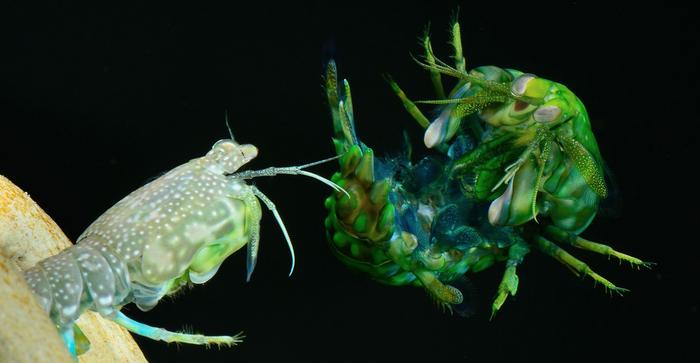
(Santa Barbara, Calif.) — Mantis shrimp are small creatures known for their superlatives. Their eyes have 12 to 16 different color receptors, versus our own three, and can detect the polarization of light. Their punches are famously fast, accelerating on par with a 22-caliber bullet. They use these strikes on prey, predators and competitors alike.

Credit: Patrick Green
(Santa Barbara, Calif.) — Mantis shrimp are small creatures known for their superlatives. Their eyes have 12 to 16 different color receptors, versus our own three, and can detect the polarization of light. Their punches are famously fast, accelerating on par with a 22-caliber bullet. They use these strikes on prey, predators and competitors alike.
Ecologist Patrick Green, at UC Santa Barbara, studied these creatures to understand how they defend themselves from the blows of their rivals. Although their shells provide significant protection, he found that their fighting stance absorbed an additional 20% of the shock. The results, published in the Journal of Experimental Biology, highlight how insights from behavior are critical in understanding animal morphology.
“In mantis shrimp competitors exchange bullet-like hits on each other’s armored tail plates, or telsons, during fights over shelters,” Green explained. Prior work found that their exoskeletons are resilient to strikes, absorbing some of the impact like a punching bag. But those studies looked at armor laying on a lab bench. “In natural fights, we see mantis shrimp coil their tails in front of their bodies like a shield. I wanted to know how this behavioral use of the tail changed how they receive impacts.”
Green introduced pairs of these territorial crustaceans and filmed their skirmishes. “They almost immediately started hitting each other,” he said. He captured footage of the clash at 30,000 to 40,000 frames per second, roughly 1,000-times faster than a conventional camera.
Analyzing the movement of their appendages before and after they made contact with each other enabled him to calculate how much energy they imparted to one another. This, along with the movement of their tails before and after impact, told him how much energy they dissipated from each strike.
After crunching the numbers, Green found that incorporating this telson coil behavior enables mantis shrimp to dissipate more energy than their armor can absorb based on its material properties alone, bumping the number from 69% of strike energy to around 90%. “It made logical sense to me that holding your armor off the ground should let you dissipate more energy,” he said. “Think about a boxer moving with a punch that they receive.”
Interestingly, he arrived at different results when he considered only the movement of the appendage versus both the appendage and tail movement together. This suggests there is a certain amount of nuance that still needs sorting out.
Indeed, Green plans to continue studying mantis shrimp armor and combat. There are over 400 species worldwide, with incredible variation in form between their tail plates. “Some look like bumped, ridged shields, others look like flat shovels,” he said. Species also vary in how much they fight, and Green suspects there may be a correlation between behavior and morphology.
Many animals deal with high-impact forces, from bighorn sheep to trap-jaw ants. “When we try to understand how animals contend with impacts, we should think about both the structures they use (like armor) and also how they use those structures,” Green said. “This study helps us connect behavior and morphology, so we can better understand how animals navigate their fights.”
Journal
Journal of Experimental Biology
Article Title
Recoil protects mantis shrimp from mighty blows
Article Publication Date
9-May-2024
Cite Scienmag News
Drew Townsend. (May 10, 2024). Rolling with the punches: How mantis shrimp defend against high-speed strikes. Scienmag. https://scienmag.com/rolling-with-the-punches-how-mantis-shrimp-defend-against-high-speed-strikes/
Drew Townsend. "Rolling with the punches: How mantis shrimp defend against high-speed strikes." Scienmag, 10 May 2024, https://scienmag.com/rolling-with-the-punches-how-mantis-shrimp-defend-against-high-speed-strikes/. Accessed 4 September 2026.
Drew Townsend. "Rolling with the punches: How mantis shrimp defend against high-speed strikes." Scienmag. May 10, 2024. https://scienmag.com/rolling-with-the-punches-how-mantis-shrimp-defend-against-high-speed-strikes/

