Deep beneath the blinding white crust of the sabkha salt flats near Al Mirfa in Abu Dhabi, some of the planet’s toughest microbes have been quietly enduring conditions that would kill most living things: punishing salinity, scarce water, searing radiation, and wild temperature swings. Now, researchers at United Arab Emirates University have harnessed that resilience in a way that could reshape how farmers protect crops from drought. In a study published in the Journal of Agriculture and Food Research, a team led by Qurban Ali and Sunil Mundra isolated five Bacillus strains from these hypersaline soils and showed that, when applied to tomato plants, they dramatically improve the crop’s ability to withstand moderate and severe water deficit. The findings arrive at a moment when drought already cuts global agricultural yields by more than 50 percent each year, making the search for sustainable, biology-based solutions increasingly urgent.
The five strains, designated S4, S5, S6, S9, and S10, were selected from a previously established collection of culturable bacteria sampled from Abu Dhabi’s salt flats. Whole-genome sequencing allowed the team to place each isolate on firm taxonomic ground: strains S4 and S5 belong to Bacillus paralicheniformis, S6 to Bacillus safensis, and S9 and S10 to Bacillus haynesii. Genome-wide average nucleotide identity values, ranging from 96.2 to 99.4 percent against their closest type strains, exceeded the standard threshold used to delineate bacterial species, and phylogenomic trees built from 119 conserved marker genes confirmed the assignments. The genomes themselves were high quality, with completeness values above 98.8 percent and contamination below 1.1 percent, giving the researchers a reliable blueprint of each strain’s functional potential.
That blueprint proved rich. Bioinformatic pipelines including Prokka, BlastKOALA, antiSMASH, and the plant growth-promotion predictor PGPT-Pred revealed thousands of genes tied to plant-beneficial traits: indole-3-acetic acid metabolism, nitrogen fixation, ACC deaminase activity, siderophore-mediated iron acquisition, biofilm formation, and exopolysaccharide production. The strains also carried predicted biosynthetic gene clusters for secondary metabolites such as fengycin, bacillibactin, lichenysin, bacilysin, and bacitracin, along with stress-response genes for drought, heat, cold, and heavy metal tolerance. Strain S9 stood out with the largest repertoire of functional protein clusters, harboring 5,064 clusters of orthologous groups, more than any of its four relatives.
Genomic potential, however, is only a prediction, so the team put the bacteria through a battery of laboratory stress tests. Cultures were grown in media adjusted with polyethylene glycol to mimic non-stress, moderate, and severe drought, corresponding to water potentials of 0.0, -0.2, and -1.0 megapascals. All five strains maintained growth, biofilm formation, and exopolysaccharide production under osmotic pressure, but their performance diverged sharply. Bacillus haynesii S10 was the clear laboratory champion, sustaining the highest optical density, the thickest biofilms, the most exopolysaccharide, the strongest IAA production at 95.75 micrograms per milliliter, the highest ACC deaminase activity, and the greatest siderophore output even at the harshest water potential. Strains S4 and S5 performed moderately, while S6 and S9 lagged in most in vitro assays.
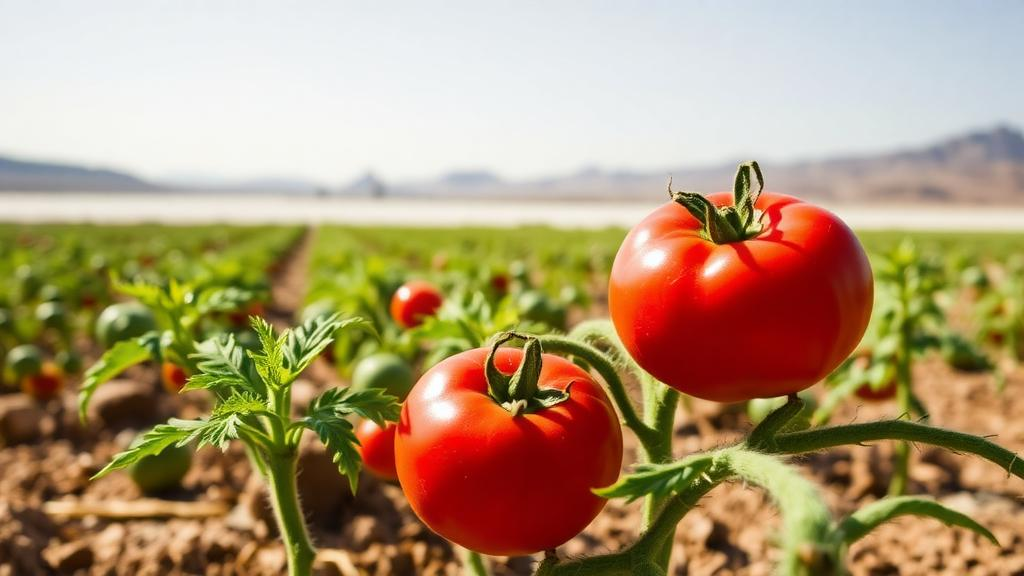
The real test came in the greenhouse, where tomato seedlings of the commercial cultivar SV4224TH were inoculated with each strain by root-zone drenching and then subjected to four weeks of well-watered, moderate drought, or severe drought conditions, with soil moisture held gravimetrically at 90, 50, or 30 percent relative water content. The results revealed a striking strain-by-train patchwork. Under severe drought, S10 increased shoot length by 69 percent and shoot dry weight by 52 percent relative to uninoculated drought-stressed plants, while boosting leaf number by 85 percent and node number by 121 percent. S9, despite its weaker laboratory showing, delivered the largest root length gain of 76 percent and doubled root dry weight under severe drought. Under moderate drought, the benefits split further: S10 drove shoot elongation, S6 promoted root elongation with a 49.6 percent increase, and S9 accumulated biomass, raising root dry weight by 71.8 percent.
Physiological measurements told a coherent story about why inoculated plants fared better. Using a leaf spectrometer, the researchers tracked a suite of vegetation and pigment indices, including SPAD, the Greenness Index, the photochemical reflectance index, the water band index, NDVI, and the Zarco-Tejada and Miller Index. Drought depressed all of them, but inoculation with S9 and S10 blunted the decline. S10 raised SPAD by 46.4 percent and PRI by 77.3 percent under moderate drought, and lifted the Greenness Index by 60.7 percent and the water band index by 71.8 percent under severe drought. Its NDVI response was even more dramatic, up 70 percent under moderate and 81 percent under severe drought. Crucially, these optical gains coincided with genuine water-status improvements: S10 maintained relative water content roughly 22 percent higher than drought controls and cut electrolyte leakage, a marker of membrane damage, by more than 70 percent under both drought levels.
The biochemical layer of the response was equally coordinated. Drought-stressed tomato plants inoculated with S10 showed elevated activities of the antioxidant enzymes superoxide dismutase, peroxidase, and ascorbate peroxidase, with increases of 16.5, 56.5, and 46.5 percent respectively under moderate drought, and 21.8, 19.8, and 25.4 percent under severe drought. Proline, an osmoprotectant that helps cells retain water and stabilize proteins, rose by 48.1 percent under moderate drought and 37.6 percent under severe drought with S10 treatment. S9 again followed closely behind. Together, the data point to a mechanism in which the bacteria help plants maintain redox balance, adjust osmotically, and preserve membrane integrity, rather than exerting a single isolated effect.
At the molecular level, the team used quantitative real-time PCR to track four drought-responsive genes that represent complementary arms of the tomato stress network. SlABF4 encodes an abscisic acid-responsive transcription factor central to stress signaling; ASR1 is a well-characterized component of osmotic and water-stress responses whose overexpression improves survival during water deficit; SlDEAD31, a DEAD-box RNA helicase, has been shown to reduce water loss and improve drought resistance when overexpressed; and SlMPK3 is a mitogen-activated protein kinase linked to drought tolerance. Inoculated plants, particularly those treated with S9 and S10, showed markedly stronger induction of all four genes under drought, with SlABF4 expression peaking in S10-treated plants under severe stress and SlMPK3 responding most strongly to the combination of S10 and severe drought. These transcriptional shifts lined up neatly with the physiological and biochemical data, suggesting the bacteria help activate the plant’s own stress-adaptation programs.
Perhaps the study’s most consequential lesson is what it says about how we screen for beneficial microbes. The two best performers in the greenhouse told opposite stories in the laboratory: S10 excelled in nearly every in vitro assay, while S9, mediocre on the lab bench, delivered some of the largest in-planta effects, including a 101 percent increase in root dry weight under severe drought. Species identity was no better a predictor, since the two B. haynesii strains diverged substantially despite overlapping genomic repertoires. The authors conclude that individual laboratory traits and genomic predictions alone cannot reliably forecast how a bacterium will perform inside a living plant, and that robust inoculant selection demands integrating bacterial phenotype, genomic potential, and plant-level response data.
The road from greenhouse to field remains long. The authors caution that their conclusions rest on controlled conditions and that field validation across heterogeneous soils and climates is essential before these strains can be deployed as commercial biofertilizers. Key open questions include how persistently S9 and S10 colonize the tomato rhizosphere, how stable they remain in formulated products, and whether their benefits extend across other tomato cultivars and crops. Still, the idea that microbes forged in one of Earth’s most hostile environments can teach a staple crop to endure its increasingly thirsty future is a compelling one, and it positions sabkha-derived Bacillus strains as promising candidates in the growing toolkit of climate-resilient agriculture.
Subject of Research: Plant growth-promoting Bacillus strains from hypersaline sabkha soils enhancing tomato drought tolerance
Article Title: Plant growth-promoting Bacillus strains enhance tomato drought tolerance through physiological, antioxidant, and stress-responsive gene expression
Article References: Ali, Q., Ali, M., Khan, T. A., Sadaiappan, B., & Mundra, S. (2026). Plant growth-promoting Bacillus strains enhance tomato drought tolerance through physiological, antioxidant, and stress-responsive gene expression. Journal of Agriculture and Food Research, Article 103341. https://doi.org/10.1016/j.jafr.2026.103341
Image Credits: AI Generated
DOI: 10.1016/j.jafr.2026.103341
Keywords: Bacillus, drought tolerance, tomato, plant growth-promoting bacteria, sabkha, genomics, antioxidant enzymes, gene expression, bioinoculants, sustainable agriculture, exopolysaccharides, water stress
Cite Scienmag News
Alan Morgan. (October 11, 2026). Desert Salt Flat Bacteria Help Tomatoes Survive Drought, Study Finds. Scienmag. https://scienmag.com/desert-salt-flat-bacteria-help-tomatoes-survive-drought-study-finds/
Alan Morgan. "Desert Salt Flat Bacteria Help Tomatoes Survive Drought, Study Finds." Scienmag, 11 October 2026, https://scienmag.com/desert-salt-flat-bacteria-help-tomatoes-survive-drought-study-finds/. Accessed 11 October 2026.
Alan Morgan. "Desert Salt Flat Bacteria Help Tomatoes Survive Drought, Study Finds." Scienmag. October 11, 2026. https://scienmag.com/desert-salt-flat-bacteria-help-tomatoes-survive-drought-study-finds/