


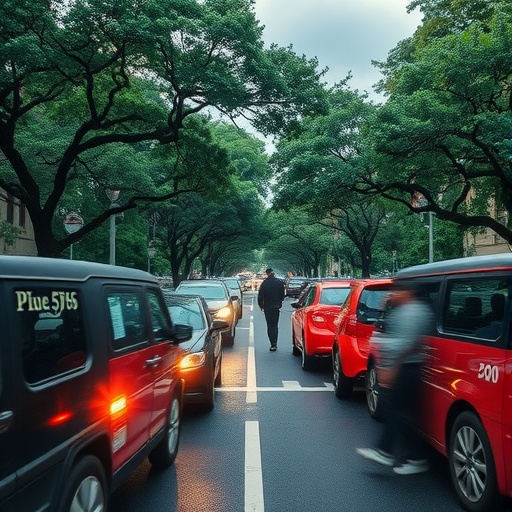
As urban areas around the world continue to expand, the role of vegetation in mitigating urban heat has received increasing attention from scientists, city planners, and policymakers alike. For decades, the prevailing wisdom held that planting more trees and establishing green spaces in cities invariably leads to a cooling effect, transforming concrete jungles into more comfortable environments. However, groundbreaking new research published in Nature Communications by Borah, Datta, Kumar, and colleagues challenges this long-standing assumption, revealing a startling paradox: in humid cities, dense tree canopies can actually reverse the cooling benefits of urban greening, potentially exacerbating heat stress instead of alleviating it.
This groundbreaking study emerges in response to a burgeoning global effort to combat urban heat islands, a phenomenon where metropolitan areas experience significantly higher temperatures than surrounding rural zones due to human activities and infrastructural materials. Efforts to green these spaces—via parks, street trees, and green roofs—have been underpinned by the understanding that vegetation cools surroundings mainly through shade provision and evapotranspiration, where water vapor released from plant leaves absorbs heat as it evaporates. Yet, Borah and colleagues’ meticulous analysis across several major humid cities reveals a more nuanced and complex interaction between vegetation density, humidity, airflow, and urban microclimates than previously appreciated.
At the core of the researchers’ findings lies the realization that dense tree canopies, while providing shade, can also create conditions that inhibit adequate air circulation. In humid urban environments, stagnant air beneath such canopies traps sensible and latent heat, preventing it from dissipating. Unlike drier cities where evaporative cooling dominates, high atmospheric moisture levels in humid cities reduce evaporation efficiency. This scenario transforms the canopy layers into heat reservoirs during the day, leading to elevated near-surface temperatures that contradict the anticipated cooling effects. The study painstakingly documented this phenomenon using a combination of satellite remote sensing, on-the-ground microclimate sensors, and advanced computational fluid dynamics modeling that simulates local airflow and heat exchange patterns.
Furthermore, the intricate feedback between dense foliage and urban humidity compounds the problem. Vegetation emits moisture as part of its physiological processes, increasing ambient humidity further. In already humid climates, this additional moisture can raise the heat index—a metric combining temperature and humidity that reflects human-perceived temperature—to levels more stressful than measured temperature alone. The consequence is a counterintuitive effect: neighborhoods rich in dense tree cover may experience a warmer and more oppressive microclimate during afternoons and evenings due to reduced evapotranspiration and impaired heat removal via ventilation.
Another critical insight centers on the species composition and structural characteristics of urban forests. The researchers emphasize that not all trees affect microclimates equally. Dense, broadleaf evergreen canopies, common in many tropical and subtropical cities, are especially potent at trapping heat and moisture beneath their crowns. Conversely, trees with more open canopies or seasonal leaf shedding can promote airflow and facilitate nighttime cooling. This suggests urban forestry strategies need to move beyond simplistic “more trees is better” paradigms toward a precise understanding of species traits, canopy architecture, and local climate interactions to optimize cooling benefits.
The implications of these findings ripple through urban planning, climate adaptation, and public health domains. As many rapidly growing tropical cities face escalating heatwaves amid climate change, misapplied greening initiatives could unintentionally worsen thermal discomfort and increase risks of heat-related illnesses. Policymakers must therefore recalibrate greening policies by integrating climate-specific vegetation management approaches, prioritizing tree species selection, spacing, and maintenance practices that enhance air movement and mitigate excessive humidity buildup. Enhanced urban design incorporating green corridors and ventilation corridors can synergize with vegetation to facilitate convective heat removal rather than entrapment.
In a broader scientific context, this study contributes to a growing recognition that urban ecosystems are extraordinarily complex and context-dependent. Urban microclimates result from multifaceted interactions among energy balances, vegetation physiology, aerosol dynamics, and built environment configurations. Attempts to engineer urban cooling must embrace this complexity with interdisciplinary research that combines climatology, ecology, architecture, and social sciences to yield robust solutions for sustainable, livable cities.
Technological advances were pivotal to this research. High-resolution satellite imaging combined with in situ sensors provided granular temperature and humidity profiles, while computational fluid dynamics models enabled simulation of airflow disruptions caused by tree canopies. This integrated methodological framework sets a new standard for deciphering urban greening effects under varying climatic regimes, allowing researchers to predict outcomes with much higher confidence than prior coarse-scale models.
The study also highlights knowledge gaps requiring urgent attention. For instance, time-of-day dynamics of canopy shading versus heat release remain poorly characterized, as do the impacts of nocturnal transpiration under humid conditions. Furthermore, socio-economic factors shape accessibility to urban green spaces and thus differential exposure to heat risks within populations. Future investigations merging spatial temperature mapping with public health data could inform equitable urban heat mitigation strategies.
Ultimately, this landmark research urges a reassessment of urban greening as a universal panacea for heat mitigation. Instead, nuanced, climate-tailored urban forestry practices must guide future developments, especially in moisture-rich tropical and subtropical cities. By appreciating that dense canopies can paradoxically invert cooling effects under humid conditions, cities have an opportunity to design greener, cooler, and healthier urban habitats, optimizing tree cover not merely for aesthetics but for functioning as true climate moderating assets.
This revelation arrives at a crucial juncture when urban heat extremes are escalating globally, and diverse cities seek sustainable pathways to climate resilience. Integrating the insights from Borah et al. into urban design policies can inspire innovative, multifaceted strategies that blend green infrastructure with engineering controls to overcome the limitations of dense canopy greening. As cities continue to redefine their relationship with nature, this research underscores nature’s dual power to heal or harm, contingent on thoughtful stewardship informed by science and context-awareness.
As conversations around sustainable urban futures intensify, this study reorients the framework for understanding vegetation’s climatic role from simplistic cooling myths toward sophisticated, evidence-based paradigms reflecting the realities of humid urban environments. This paradigm shift challenges all stakeholders—scientists, planners, residents—to collaboratively craft urban landscapes that harmonize ecological processes with human needs under rapidly changing global climates.
The research by Borah and colleagues invites an urgent call to action: to reevaluate and redesign urban greening interventions tailored to local climate contexts, balancing canopy density and species choice with microclimatic dynamics to achieve true thermal relief in the world’s hottest, most humid urban centers.
Cite Scienmag News
Violet Maxwell. (May 4, 2026). Dense Canopies Negate Cooling in Humid Cities. Scienmag. https://scienmag.com/dense-canopies-negate-cooling-in-humid-cities/
Violet Maxwell. "Dense Canopies Negate Cooling in Humid Cities." Scienmag, 4 May 2026, https://scienmag.com/dense-canopies-negate-cooling-in-humid-cities/. Accessed 4 September 2026.
Violet Maxwell. "Dense Canopies Negate Cooling in Humid Cities." Scienmag. May 4, 2026. https://scienmag.com/dense-canopies-negate-cooling-in-humid-cities/


