


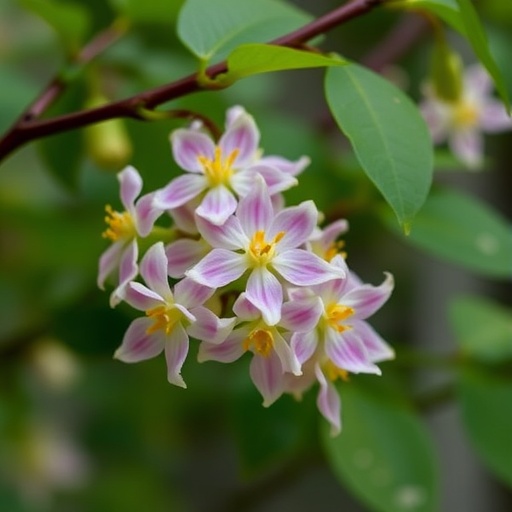
In an exciting development within the field of cancer research, a recent study has uncovered promising insights into the potential of Dendrobium officinale, a traditional herbal remedy, in combating colon adenocarcinoma. This research, conducted by a team of experts including Miao, Luo, and He, focuses on the compound’s mechanisms of action, particularly its interaction with the protein LGALS4, which plays a crucial role in cancer cell proliferation and migration.
Dendrobium officinale, a member of the orchid family, has been used in traditional Chinese medicine for centuries. However, this study takes a bold stride into modern science by exploring its potential pharmacological effects against colon cancer. The researchers meticulously analyzed how this herb influences the behavior of colon adenocarcinoma cells, aiming to provide a foundation for future therapeutic strategies.
One of the significant findings of this research is the ability of Dendrobium officinale to inhibit the proliferation of colon adenocarcinoma cells. This process is crucial, as uncontrolled cell growth is a hallmark of cancer. By identifying the pathways through which Dendrobium officinale exerts its effects, the authors hold the potential to uncover a new avenue for therapeutic interventions against this aggressive form of cancer.
Moreover, the study delves deep into the molecular interactions between Dendrobium officinale and LGALS4. This protein, which has been associated with cancer progression, serves as a key player in modulating the signaling pathways that control cell migration. The researchers illustrated how Dendrobium officinale downregulates LGALS4, which, in turn, hampers the migration abilities of cancer cells, an essential step in the metastatic process.
The importance of understanding the molecular underpinnings of colon cancer cannot be understated. With colorectal cancer being one of the most common and lethal types of cancer globally, innovative strategies to mitigate its effects are urgently needed. Dendrobium officinale could represent a new frontier in such strategies, combining traditional medicinal knowledge with modern scientific inquiry to tackle one of the most pressing health challenges of our time.
Furthermore, the research highlights the broader implications of integrating herbal medicine into cancer treatment protocols. The study’s findings suggest that compounds derived from Dendrobium officinale may be developed into new drugs or supplements aimed at supporting conventional cancer therapies. This holistic approach could enhance patient outcomes while exploring the synergy between natural compounds and existing pharmacological treatments.
Safety and efficacy are cornerstones of any clinical application, and this research addresses those aspects as well. The authors conducted an extensive review of the existing literature on Dendrobium officinale, weighing its traditional uses against modern scientific evidence. They report a relatively favorable safety profile, which is vital as researchers strive to minimize adverse effects in cancer treatment.
The study’s design includes rigorous experimental techniques, such as in-vitro assays and molecular analyses, to provide robust evidence supporting the role of Dendrobium officinale in cancer therapy. The meticulous nature of the research sets a new standard in the field, suggesting that further investigations could clarify the herb’s potential and mechanisms at play.
As the research community begins to accept and validate complementary medicine concepts, the path for Dendrobium officinale becomes increasingly promising. This study serves as a crucial stepping stone, paving the way for clinical trials to examine the full therapeutic potential of this traditional herb in the context of colon cancer and possibly other malignancies.
It’s also remarkable how this study aligns with emerging trends in personalized medicine. By tailoring treatments to individual patient needs and genetic backgrounds, researchers can harness the power of natural compounds like Dendrobium officinale in a targeted manner. This individualized approach could redefine conventional cancer care.
Moreover, the study could lead to a renaissance in the adoption of herbal remedies within modern healthcare systems. Hospitals and clinics might soon see the integration of such complementary therapies, potentially leading to enhanced patient engagement and adherence to treatment regimens.
In conclusion, the research led by Miao et al. introduces a pioneering analysis of Dendrobium officinale’s effects on colon adenocarcinoma, with findings that could inspire further exploration into herbal medicines as viable cancer treatment options. The pathways unveiled by this investigation are not merely academic; they hold the promise of translating into real-world therapies that could change lives and improve outcomes for those battling cancer.
The outcome of this study not only ushers in a new era of research surrounding Dendrobium officinale but also exemplifies the need for a bridge between traditional medicine and modern scientific inquiry. The future may hold a more integrated approach to health where the wisdom of ancient healing practices finds its place within the scientific framework, leading to breakthroughs that enhance the quality of life for many.
This compelling narrative about Dendrobium officinale serves as a reminder that the quest for effective cancer treatments is ongoing, fostering hope and driving innovation as researchers continue to delve into nature’s bounty for answers.
Miao, J., Luo, B., He, X. et al. Dendrobium officinale Kimura et Migo regulates the proliferation and migration of colon adenocarcinoma via LGALS4.
Mol Divers (2025). https://doi.org/10.1007/s11030-025-11335-y
Cite Scienmag News
Nathaniel Bowman. (September 5, 2025). Dendrobium officinale Modulates Colon Cancer Growth and Migration. Scienmag. https://scienmag.com/dendrobium-officinale-modulates-colon-cancer-growth-and-migration/
Nathaniel Bowman. "Dendrobium officinale Modulates Colon Cancer Growth and Migration." Scienmag, 5 September 2025, https://scienmag.com/dendrobium-officinale-modulates-colon-cancer-growth-and-migration/. Accessed 3 September 2026.
Nathaniel Bowman. "Dendrobium officinale Modulates Colon Cancer Growth and Migration." Scienmag. September 5, 2025. https://scienmag.com/dendrobium-officinale-modulates-colon-cancer-growth-and-migration/


