


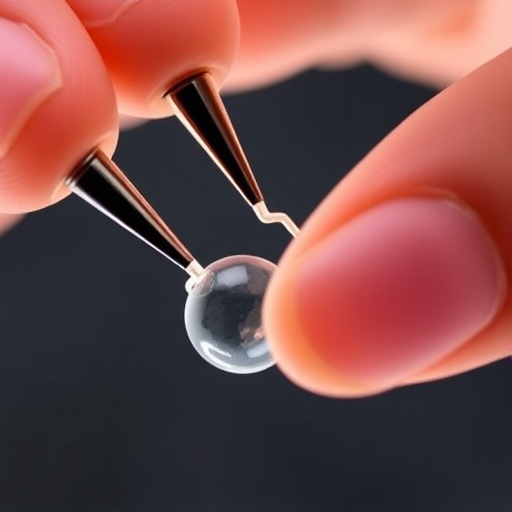
In the rapidly evolving field of tissue engineering, precision and delicacy are paramount. The construction of complex human tissues from cellular building blocks depends heavily on manipulating delicate cell structures known as spheroids. These spherical clusters of cells mimic the intricate cell-to-cell and cell-to-matrix interactions found in real tissues, enabling advanced modeling of biological systems. However, their fragility often presents a significant challenge: conventional methods of handling these spheroids, such as mechanical suction, can impart damaging forces that compromise their viability and structural integrity.
Breaking new ground, a team of researchers at Purdue University has engineered a groundbreaking miniature robotic system designed to address this challenge. Published in APL Bioengineering, the research describes a mobile microgripper (MMG) — an innovative force-sensing microrobot that can gently and precisely manipulate individual spheroids. This microrobot brings a level of finesse previously unattainable with traditional manual or automated tools, allowing bioengineers to assemble spheroids into functional, multi-cellular constructs with unprecedented care.
The core of the MMG design resembles the gripping mechanism of a claw toy, featuring two miniature arms connected through a hinge that facilitates controlled movement. This architecture enables the microgripper to exert just the right amount of pressure without crushing these delicate cell clusters. Unlike typical gripping systems, which rely on direct contact or suction, this device is actuated via magnetic fields— a choice rooted in biocompatibility and precision. Magnetic actuation ensures gentle locomotion and jaw control, avoiding the collateral damage that harsher mechanical or pneumatic methods might induce.
Magnetic fields are harnessed both to move the microgripper across the culture substrate and to modulate the opening and closing of its jaws. This dual functionality was a significant engineering feat, requiring a nuanced understanding of electromagnetics combined with microscale mechanical design. By fine-tuning magnetic intensities and spatial gradients, the device can be directed remotely with high precision, effectively navigating complex environments while maintaining stable control over gripping force.
An integral feature of the MMG is its force-sensing capability. Embedded sensors allow continuous real-time monitoring of the gripping force. This feedback loop ensures that the device’s applied pressure remains within physiologically safe margins, preventing deformation or damage to the spheroids. Adjustments in grip strength can be made instantaneously, tailored to the specific mechanical properties of different spheroid types or sizes. This dynamic responsiveness marks a considerable advance over traditional, static force application methods.
Initial in-vitro testing has demonstrated the MMG’s remarkable ability to safely manipulate individual spheroids, assembling them into organized cellular sheets. The formation of these sheets is crucial for replicating real tissue architectures, as natural tissues often consist of multiple, interacting cellular populations organized in specific spatial arrangements. The ability to precisely position spheroids without injury opens numerous possibilities for building complex tissue models and, ultimately, engineered organs.
This approach also facilitates the integration of heterogeneous cell types within a single construct. By assembling distinct spheroids—each potentially representing varying cell lineages or differentiation states—the MMG allows researchers to mimic the cellular diversity inherent in many biological tissues. Such composite tissue models can lead to better in vitro platforms for drug testing, disease modeling, and regenerative therapies.
Looking forward, the Purdue research team envisions expanding the MMG system beyond manual operation toward fully automated spheroid assembly. Automation would enhance reproducibility, throughput, and scalability— essential features for clinical translation and industrial applications. Networks of microgrippers could collaborate to build increasingly complex three-dimensional tissue architectures, navigating a future where miniature robots serve as indispensable architects of living matter.
Beyond tissue engineering, this magnetic microrobot technology sets the stage for new frontiers in microscale manipulation. Potential adaptations could include applications in single-cell analysis, targeted drug delivery, or minimally invasive surgeries at cellular resolutions. The convergence of robotics, materials science, and cell biology embodied by the MMG underscores the transformative potential of microrobotic technologies within biomedicine.
Despite these promising advances, challenges remain to be resolved—such as enhancing the robustness of the microgrippers for prolonged operation, ensuring compatibility with a broader range of cell types, and integrating advanced imaging and control systems for more autonomous functioning. However, the fundamental demonstration of gentle, force-sensitive manipulation via magnetically controlled microgrippers represents a milestone, charting a course toward more precise and versatile tools for biofabrication.
In sum, the development of the force-sensing mobile microgripper by Purdue University researchers marks a pivotal achievement in the delicate art of tissue assembly. By marrying microscale robotics with sensitive feedback mechanisms and magnetic actuation, they have unlocked new capabilities for constructing viable, complex tissue constructs. As research progresses, such microrobotic systems will likely become cornerstone technologies for regenerative medicine, transforming how scientists and clinicians build and repair living tissues.
News Publication Date: April 28, 2026.
Web References: https://doi.org/10.1063/5.0304932
Keywords
Microrobots, Robotics, Physics, Tissue Engineering, Bioassembly, Magnetic Actuation, Force Sensing, Cell Spheroids, Microgrippers, Regenerative Medicine, Cellular Constructs, Microrobotic Control
Cite Scienmag News
Denise Maddox. (April 28, 2026). Delicate Touch: Mobile Microgrippers Gently Capture Cells with Precision. Scienmag. https://scienmag.com/delicate-touch-mobile-microgrippers-gently-capture-cells-with-precision/
Denise Maddox. "Delicate Touch: Mobile Microgrippers Gently Capture Cells with Precision." Scienmag, 28 April 2026, https://scienmag.com/delicate-touch-mobile-microgrippers-gently-capture-cells-with-precision/. Accessed 4 September 2026.
Denise Maddox. "Delicate Touch: Mobile Microgrippers Gently Capture Cells with Precision." Scienmag. April 28, 2026. https://scienmag.com/delicate-touch-mobile-microgrippers-gently-capture-cells-with-precision/


