


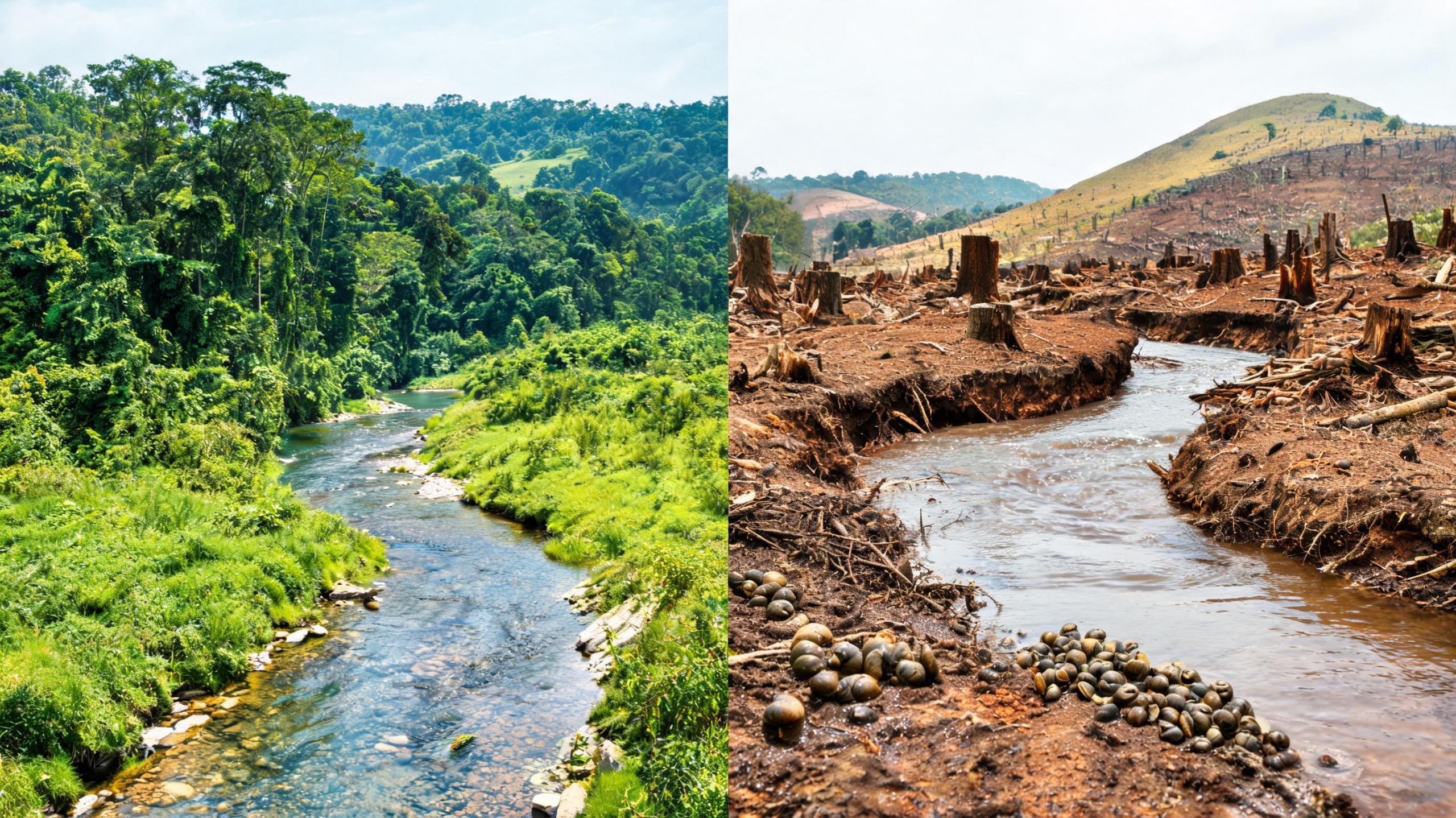
Forest loss in western Uganda has been linked to the emergence of new freshwater hotspots for schistosomiasis, a parasitic disease that can cause chronic illness in people and animals. The finding comes from an 18-month investigation around Bugoma Forest in Kikuube District, where researchers combined repeated surveys of disease-carrying snails, molecular testing of parasites, screening of nearby children and satellite analysis of landscape change. The study suggests that transmission is no longer confined to the familiar shoreline communities of Lake Albert. Instead, it may be expanding into upland areas roughly 15 kilometres away as forest clearance creates warmer, more open wetlands and streams suitable for intermediate host snails. The results offer a detailed example of how land-use change can reshape the geography of an infectious disease. They also show why monitoring the environment, rather than relying only on clinical case data, may provide an early warning of transmission before infections become widely recognized. In this setting, the warning came from snails shedding Schistosoma cercariae, the free-swimming parasite larvae that infect people or other hosts after leaving their aquatic intermediaries.
Schistosomiasis is caused by trematode worms in the genus Schistosoma. The parasites require freshwater snails to complete part of their life cycle. Infected humans or animals release parasite eggs into water, where the eggs hatch and infect compatible snails. The parasites multiply inside the molluscs and eventually emerge as cercariae, which can penetrate human skin during contact with contaminated water. Schistosoma mansoni is associated primarily with intestinal disease, while S. haematobium causes urogenital schistosomiasis. Other species, including S. bovis and S. rodhaini, generally circulate among livestock and wildlife. The distinction matters because cercariae from different species can look alike under a microscope, while their public-health implications differ. In the Ugandan study, researchers therefore used molecular methods to identify parasite DNA rather than relying solely on appearance. Their approach connected ecological observations with human health and animal infection, providing a One Health view of a disease system shaped by people, wildlife, livestock, snails and changing water bodies.
From June 2023 through October 2024, the team visited nine sites every two months, collecting snails during standardized 30-minute sampling periods. Two collectors used long-handled scoops with a 2-millimetre mesh, recording the location and examining the animals in a field laboratory. They identified 2,524 Biomphalaria snails at seven sites and 422 Bulinus forskalii snails at one site. The distribution was strongly associated with the history of forest clearance. Three sites cleared earlier contained 74 percent of all Biomphalaria collected, while more recently encroached sites contained the remaining 26 percent. The abundance of these snails was significantly higher in older cleared areas, with a statistical value of p = 0.002. No snails were found at a forest-edge site that retained tree cover. Across the monitoring period, 0.4 percent of Biomphalaria and 1.9 percent of Bulinus shed schistosome cercariae. The highest monthly shedding rates occurred in December 2023, reaching 3.1 percent among Biomphalaria and 3.7 percent among Bulinus.
The researchers also detected a physical transformation in the water environments where the snails lived. Average water temperature across the monitoring sites was 23.5 degrees Celsius, with a mean conductivity of 235.0 microsiemens and a mean pH of 6.9. Water at sites cleared more than a decade earlier averaged 24.4 degrees Celsius, compared with 22.8 degrees Celsius at recently cleared sites. That difference was statistically significant, with p = 0.0001 and a 95 percent confidence interval of 0.811 to 2.34 degrees. The contrast is consistent with the loss of the forest canopy’s cooling and shading effects. As trees are removed, sunlight reaches shallow water directly, while agricultural activity, settlement and altered drainage can create or enlarge swamps, marshes and pools. These habitats may provide food, shelter and stable conditions for snails that were previously limited by cooler, shaded environments. The study does not claim that deforestation alone caused every infection, but its findings show a close geographic and environmental association between forest conversion, snail colonization and parasite transmission.
Molecular testing revealed an unexpectedly complex parasite community. DNA from cercariae shed by two Biomphalaria pfeifferi snails at one site identified S. rodhaini, a species associated with rodents. Tissue from two other infected snails at the same site identified Biomphalaria sudanica carrying S. mansoni, the human parasite responsible for intestinal schistosomiasis. No coinfections were detected in the examined Biomphalaria snails. At another site, genetic analysis of a cercaria-shedding B. forskalii identified S. bovis, a parasite typically associated with cattle. The analyses used different molecular tools, including polymerase chain reaction, DNA sequencing and high-resolution melting assays. For S. rodhaini, researchers compared partial sequences from mitochondrial cox1, nuclear internal transcribed spacer DNA and 18S ribosomal DNA. These tests are important because species that appear similar during microscopic inspection may follow different transmission routes and pose different risks to humans, livestock or wildlife.
The environmental signal was accompanied by evidence of human infection. In August 2024, health workers and community teams screened school-aged children living within 200 metres of sites where infected snails had been found. Near the site containing S. mansoni-positive snails, 41 children provided stool samples for examination using the Kato-Katz method, which detects and estimates parasite eggs in feces. Twenty-three children tested positive, producing a prevalence of 56.1 percent. Infection intensity ranged from 12 to 900 eggs per gram, with an overall mean of 109 eggs per gram. The children were between six and 14 years old. By contrast, urine screening of 41 children near the site where Bulinus snails carried S. bovis found no evidence of urogenital schistosomiasis. The absence of S. haematobium infection in that small group does not eliminate future risk, particularly if infected people move into the area and introduce parasite eggs into water where compatible snails are present. The study team treated children found to have S. mansoni with praziquantel through local health services.
Satellite imagery helped place these findings in a longer environmental timeline. Comparing land-cover data from 2000 and 2021, the researchers found that central Bugoma Forest had declined by 18.0 percent, while surrounding shrubland had fallen by 57.0 percent. Cropland and grassland expanded as forest was converted for subsistence and commercial agriculture. Field observations recorded settlement growth, sugarcane cultivation, cattle grazing, charcoal production and the cutting of poles for housing. The Kyangwali refugee settlement, which began in a cleared portion of forest in 1967, expanded after 2012 as displaced populations arrived from the Democratic Republic of the Congo and South Sudan. Internal migration and agricultural encroachment also contributed to land conversion. The researchers describe these changes as plausible drivers of new aquatic habitats and increased contact between people, animals and contaminated water. Their satellite analysis used the Global Land Cover 2000 dataset and the ESA WorldCover 2021 product, with the higher-resolution imagery resampled to a common one-kilometre scale before comparison.
The study’s central message is that schistosomiasis surveillance must track ecological change as well as human illness. Detecting infected snails can identify a transmission focus while it is still geographically limited, allowing health teams to investigate nearby communities and consider treatment or other interventions. The authors recommend finer-scale monitoring by Uganda’s Ministry of Health and stronger attention from the National Forestry Authority, particularly as forest loss continues and population movement connects previously separated disease systems. They also emphasize the limits of the evidence. Children were screened only around two villages, and molecular identification was performed on a small number of infected snails, meaning additional parasite species or transmission sites may have been missed. The researchers did not demonstrate every step of transmission from the detected snails to the surrounding population. Even so, the combination of infected intermediate hosts, high local prevalence of intestinal schistosomiasis and substantial landscape change presents a compelling public-health warning. In Bugoma, the disappearance of forest cover is not only altering biodiversity and water temperature; it may also be redrawing the map of a neglected tropical disease.
The study’s repeated sampling is important because both snail abundance and cercarial shedding can vary over time. A single visit might miss infected snails or mistake a temporary absence for a stable pattern. By returning every other month for 18 months, the investigators could compare sites across changing environmental conditions and identify a December 2023 peak in shedding. This does not establish a fixed seasonal cycle, but it demonstrates why surveillance based on occasional collection may underestimate transmission potential.
The findings also distinguish ecological suitability from confirmed human transmission. More Biomphalaria snails were found where forest clearance was greater, and some carried S. mansoni, but snail abundance alone is not a measure of disease risk. Transmission additionally depends on contamination of water with parasite eggs, compatibility between parasite and snail, survival of the parasite in the environment and frequency of human or animal contact with water. The detection of S. bovis and S. rodhaini therefore broadens the surveillance question: the same modified wetlands may support parasite cycles involving people, livestock or wildlife, even when a particular human infection is not detected.
The child survey provides a strong signal but remains a preliminary snapshot. It involved school-aged children living near selected sites and used a limited sample, so the reported prevalence should not be treated as a district-wide estimate. It does, however, justify extending screening and snail investigations beyond the sampled villages, especially along connections among farms, settlements, streams and permanent swamps. Molecular testing of cercariae is likewise valuable for targeting follow-up, because morphology cannot reliably separate several schistosome species. Together, these approaches can help health authorities identify which water bodies require urgent attention and whether control efforts should address human infection, animal reservoirs, environmental exposure or several of these pathways at once.
Subject of Research: Deforestation-driven expansion of schistosomiasis transmission in Western Uganda
Article Title: Longitudinal malacological monitoring, with a parasitological survey, reveals new schistosomiasis transmission foci in deforested sites in Western Uganda
Article References: Oguttu, D. W., Nkolokosa, C., Kiberu, D., Odongo, M., Besigye, F., Juhasz, A., Barungi, W., Huyse, T., Kabatereine, N. B., Tolo, C. U., Elliott, A. M., Webster, B. L., & Stothard, J. R. (2026). Longitudinal malacological monitoring, with a parasitological survey, reveals new schistosomiasis transmission foci in deforested sites in Western Uganda. BMC Environmental Science, 3(1), Article 21. https://doi.org/10.1186/s44329-026-00061-x
Image Credits: AI Generated
DOI: 10.1186/s44329-026-00061-x
Keywords: schistosomiasis, deforestation, Bugoma Forest, Uganda, Biomphalaria, Bulinus, snail surveillance, One Health, land-use change, Longitudinal, malacological, monitoring
Cite Scienmag News
Kristina Jarvis. (August 29, 2026). Deforestation Opens New Schistosomiasis Hotspots in Western Uganda. Scienmag. https://scienmag.com/deforestation-opens-new-schistosomiasis-hotspots-in-western-uganda/
Kristina Jarvis. "Deforestation Opens New Schistosomiasis Hotspots in Western Uganda." Scienmag, 29 August 2026, https://scienmag.com/deforestation-opens-new-schistosomiasis-hotspots-in-western-uganda/. Accessed 7 October 2026.
Kristina Jarvis. "Deforestation Opens New Schistosomiasis Hotspots in Western Uganda." Scienmag. August 29, 2026. https://scienmag.com/deforestation-opens-new-schistosomiasis-hotspots-in-western-uganda/


