


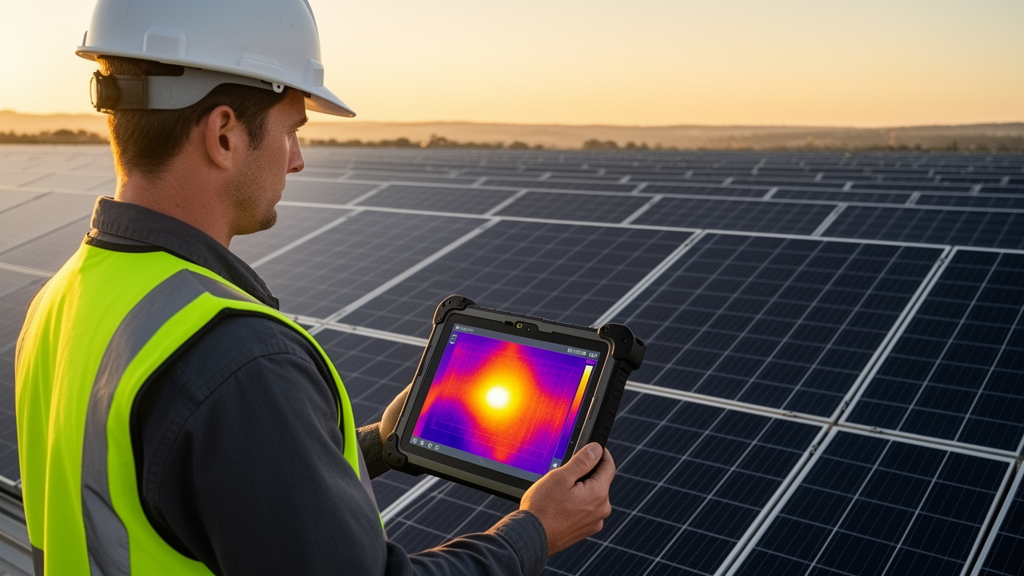
Solar photovoltaics has become the fastest-growing source of renewable electricity, and the International Energy Agency expects it to supply roughly a fifth of all generated power worldwide by 2030. Yet the same modules that promise 25 to 30 years of service must survive in open outdoor conditions, exposed to dust accumulation, bird droppings, thermal swings, wind-induced mechanical stress, snow and ice, and photochemical degradation. Field studies across different climatic zones show that dust alone causes energy losses of 5 to 30 percent, while bird droppings and snow accumulation can push losses to 45 percent. When these faults go unnoticed, they quietly erode economic returns and raise the levelized cost of energy for entire solar plants.
Researchers Ramji Tiwari and S. Saravanan, publishing in Results in Engineering, have now built a unified deep learning framework that does something previous systems could not: it classifies six distinct types of photovoltaic surface faults and simultaneously predicts how much power each fault is costing, using a single fine-tuned neural network backbone. The work is explicitly aimed at edge deployment, meaning the trained model is compact enough to run on modest hardware such as a GTX 1060 graphics card, performing inference on 224 by 224 pixel RGB images at roughly 45 frames per second. That speed makes near-real-time monitoring feasible for drones, fixed cameras, and robotic inspection platforms.
The framework’s dataset is one of its most important contributions. Prior studies typically relied on fewer than 5,000 images from a single repository, covering only two to four fault categories, which limited generalization to real-world conditions. Tiwari and Saravanan instead aggregated 12,463 photovoltaic surface images from four public repositories, harmonized their inconsistent labels into a unified six-class taxonomy, and removed near-duplicates using perceptual hashing with a Hamming distance threshold of 10. The six classes are Bird-drop, Clean, Dust, Electrical-Damage, Physical-Damage, and Snow-Covered. The final distribution is imbalanced, with Clean panels accounting for 38.7 percent of images while Snow-Covered and Electrical-Damage represent only 4.9 and 6.3 percent respectively, reflecting the natural rarity of severe faults. Stratified sampling preserved class proportions across the 80:10:10 train-validation-test split, and online augmentation with random rotation, translation, flipping, and scaling boosted minority-class representation during training without introducing artificial samples.
Beyond the image dataset, the authors collected 110 experimental power-loss measurements using a 500 W monocrystalline module at an outdoor test facility. They deposited realistic dust simulants, including cement dust, fine road dust, and soil dust with a median particle size of about 35 micrometers, at seven progressive levels from 5 to 35 grams per square meter. Each level remained on the module for at least 48 hours, with measurements of irradiance, open-circuit voltage, short-circuit current, maximum power point voltage and current, output power, and temperature taken every 15 minutes. Power loss was computed relative to a temperature-corrected clean baseline, yielding a continuous regression target that avoids the boundary artifacts of discretized severity classes.
The classification backbone was built on two state-of-the-art convolutional architectures, ResNet50 and DenseNet201, both initialized with pretrained ImageNet weights and fine-tuned across all layers using the Adam optimizer with an initial learning rate of 1e-4. ResNet50 uses shortcut connections that add the input feature map to the learned residual mapping, mitigating performance degradation in deep networks. DenseNet201 goes further, concatenating feature maps from all preceding layers in each dense block, which enables explicit feature reuse and gives parameter efficiency: approximately 20 million parameters versus ResNet50’s 25.6 million despite greater depth. The power-loss regressor is a ridge regression trained on feature vectors extracted from the second-to-last fully connected layer of the trained classifiers, coupling fault classification and energy-loss prediction through a shared learned representation rather than treating them as separate systems.
The results show DenseNet201 clearly outperforming ResNet50. Test accuracy rose from 85.61 to 87.80 percent, macro F1-score improved from 0.88 to 0.93, Cohen’s Kappa increased from 0.832 to 0.876, and macro-average AUC climbed from 0.945 to 0.975. The largest class-specific gain came in the Bird-drop category, where recall jumped 17 percentage points from 0.65 to 0.82, a benefit the authors attribute to DenseNet201’s dense connectivity preserving multi-scale texture information needed to distinguish scattered bird droppings from irregular dust accumulation. McNemar’s test confirmed the difference was statistically significant, with a chi-squared statistic of 7.6 and a p-value of 0.006. Grad-CAM explainability visualizations showed that DenseNet201 consistently concentrated activation on physically meaningful fault regions, such as localized deposits for Bird-drop, crack edges for Physical-Damage, and discolored cell regions for Electrical-Damage, rather than spurious image features.
The power-loss estimation module achieved an in-sample R-squared of 0.978 with DenseNet201 features, explaining 97.8 percent of observed power-loss variance, with RMSE of 3.3 percent and MAE of 2.5 percent. The authors are transparent that these figures reflect fitting on the 110-sample dataset rather than generalization, and they report a supplementary leave-one-out cross-validated tabular-feature model with R-squared of 0.927, RMSE of 1.79 percentage points, and MAE of 1.47 percentage points as the primary cross-validated evidence of predictability. The practical economic value is substantial: an MAE of 2.5 percent corresponds to roughly 12.5 W of estimation error for a 500 W module, or about 25 kW for a 1 MW plant, translating to approximately USD 7,000 per year at an electricity price of USD 0.08 per kWh with 3,500 hours of annual peak sun.
An ablation study quantified the contribution of each framework component. Replacing pretrained ImageNet weights with random initialization reduced validation accuracy by 12.10 percentage points, confirming that low-level features learned from ImageNet remain highly valuable for photovoltaic fault classification. Freezing the backbone and training only the classification head cost 5.17 percentage points, showing that domain-specific adaptation of convolutional features is essential. Removing preprocessing normalization and data augmentation cost 3.86 and 3.41 percentage points respectively, while batch size variations had only minor influence below 1 percentage point.
The framework maps each continuous power-loss estimate onto a five-level severity scale, from Negligible (0 to 5 percent) through Minor, Moderate, Severe, and Critical (above 35 percent), each with a recommended maintenance response ranging from routine monitoring to emergency intervention. This severity grading transforms automatic image processing beyond mere fault identification into actionable asset management, allowing operators to prioritize cleaning and repairs by their actual effect on energy yield rather than by visual appearance alone.
The authors acknowledge several limitations. The power-loss experiment used a single monocrystalline module under arid-region dust conditions, so generalizability to other module technologies, geographic locations, and bifacial designs remains unproven. The clean-reference power was estimated from a single calibration reading via linear irradiance and temperature correction rather than measured by a continuously monitored parallel reference module, introducing model-based uncertainty into every regression metric. Applied dust level and module temperature were correlated in the dataset, confounding any independent temperature effect. The framework relies on visible-spectrum imagery only, excluding thermal infrared, electroluminescence, and SCADA electrical monitoring that could reveal subsurface damage. Future work directions include Vision Transformers and ConvNeXts for larger datasets, YOLOv11-based fault localization, multimodal data fusion, Digital Twin maintenance planning, SHAP explainability, federated learning across installations, and INT8 quantization or knowledge distillation for further edge compression.
Subject of Research: Deep transfer learning-based fault classification and power loss prediction for solar PV modules: toward edge deployment
Article Title: Deep transfer learning-based fault classification and power loss prediction for solar PV modules: toward edge deployment
Article References: Tiwari, R., & Saravanan, S. (2026). Deep transfer learning-based fault classification and power loss prediction for solar PV modules: toward edge deployment. Results in Engineering, 32, Article 113560. https://doi.org/10.1016/j.rineng.2026.113560
Image Credits: AI Generated
DOI: 10.1016/j.rineng.2026.113560
Keywords: Deep, transfer, learning-based, fault, classification, power, loss, prediction, solar, modules, toward, edge
Cite Scienmag News
Ophelia Keating. (October 17, 2026). Deep transfer learning brings solar fault diagnosis and power loss prediction to the edge. Scienmag. https://scienmag.com/deep-transfer-learning-brings-solar-fault-diagnosis-and-power-loss-prediction-to-the-edge/
Ophelia Keating. "Deep transfer learning brings solar fault diagnosis and power loss prediction to the edge." Scienmag, 17 October 2026, https://scienmag.com/deep-transfer-learning-brings-solar-fault-diagnosis-and-power-loss-prediction-to-the-edge/. Accessed 17 October 2026.
Ophelia Keating. "Deep transfer learning brings solar fault diagnosis and power loss prediction to the edge." Scienmag. October 17, 2026. https://scienmag.com/deep-transfer-learning-brings-solar-fault-diagnosis-and-power-loss-prediction-to-the-edge/


