


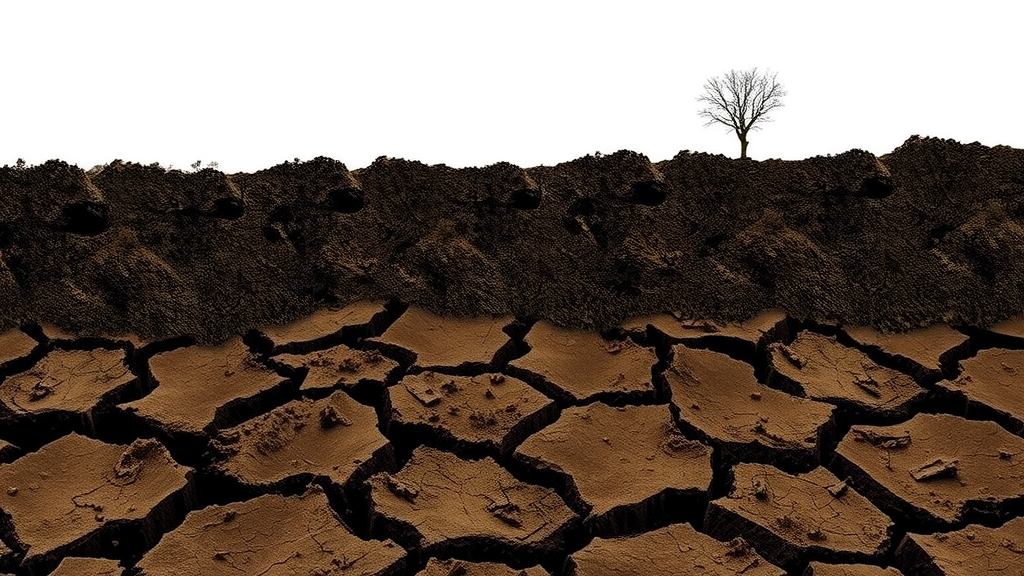
When drought strikes, the first casualty is rarely the water closest to the surface. According to new research published in Nature Geoscience, the most consequential losses occur far deeper in the soil column, where moisture stored across multiple layers sustains vegetation through dry spells and buffers ecosystems against climatic extremes. The study, led by an international team of geoscientists and hydrologists, demonstrates that drought impacts on ecosystems worldwide cannot be understood by monitoring surface conditions alone. Instead, the depletion of moisture in deeper soil horizons, which replenishes slowly and resists recovery, amplifies vegetation stress and can push forests, grasslands, and croplands toward tipping points that surface-level metrics dramatically underestimate.
Soil moisture is not a single reservoir but a layered system. Water held in the top centimeters of soil responds almost immediately to rainfall and evaporation, fluctuating with weather patterns on timescales of hours to days. Deeper layers, by contrast, exchange water with the surface through slow percolation and with plants through root uptake, operating on timescales of weeks, months, and in some environments even years. This multilayer structure means that drought is a cumulative phenomenon. A single hot, dry summer may barely register in deep soil, but consecutive dry seasons can progressively drain these reserves, leaving ecosystems without the subsurface lifeline they rely upon when precipitation fails.
The researchers assembled global observational datasets and model-based reconstructions of soil moisture at multiple depths, combined with satellite-derived vegetation activity metrics and terrestrial ecosystem observations. By partitioning soil moisture into surface and deeper components, they were able to isolate the contribution of each layer to vegetation health during drought episodes. Their analysis revealed a consistent pattern across biomes: the loss of moisture in deeper soil layers correlates more strongly with vegetation decline, reduced carbon uptake, and long-term ecosystem stress than the loss of moisture at the surface. Surface drought, while visible and dramatic, is often transient; deep drought, the study shows, is what determines whether an ecosystem recovers or deteriorates.
This distinction has profound implications for how drought severity is measured and communicated. Many widely used drought indicators are either atmospheric, tracking precipitation deficits and evaporative demand, or near-surface, relying on shallow soil measurements and satellite retrievals that only penetrate the top few centimeters. Such indicators may signal the onset of drought but can miss its accumulation in the subsurface. The new findings suggest that ecosystems may already be suffering severe, lasting damage during periods when surface indicators suggest conditions are moderate or even improving. In effect, the subsurface acts as a hidden ledger, recording the true balance of water supply and demand over seasons and years.
The mechanisms linking deep soil moisture depletion to ecosystem harm are rooted in plant physiology. Many dominant vegetation types, from temperate forests to tropical savannas, depend on deep root systems to access water stored well below the surface during dry periods. When these deeper reserves are exhausted, plants face hydraulic stress that cascades through their tissues: reduced stomatal conductance limits photosynthesis, carbon uptake declines, and prolonged stress increases vulnerability to pests, pathogens, and mortality. Because deep soil moisture returns slowly, a single severe depletion event can impair ecosystem function for years, even after rainfall returns to normal levels.
The global scale of the analysis allowed the team to identify regions where multilayer depletion is particularly consequential. Water-limited environments such as Mediterranean ecosystems, temperate grasslands, and boreal forests emerged as areas where deep-layer dynamics strongly modulate vegetation responses to drought. In these regions, the study found that droughts accompanied by deep soil moisture depletion produced markedly larger and more persistent impacts on vegetation greenness and productivity than droughts of comparable surface severity but with intact subsurface reserves. The results underscore that two droughts with identical atmospheric signatures can produce very different ecological outcomes depending on the state of the soil profile beneath them.
Climate change adds a worrying dimension to these findings. Warmer temperatures increase evaporative demand, drawing moisture from the soil surface and, through sustained stress, from deeper layers as well. At the same time, shifts in precipitation patterns, including longer dry spells and more intense but less frequent rainfall events, can reduce the recharge of deep soil moisture, since heavy rains often run off rather than percolating gradually through the profile. The combination of rising demand and diminished recharge creates conditions in which deep droughts become more frequent and more severe, compounding the stress on ecosystems already near their physiological limits. The study’s authors caution that this trajectory could accelerate ecosystem degradation in vulnerable regions in the coming decades.
The findings also carry significant implications for carbon cycle science and climate modeling. Vegetation that is drought-stressed absorbs less carbon dioxide, weakening the terrestrial carbon sink that currently offsets a substantial fraction of human emissions. If Earth system models underestimate the role of deep soil moisture depletion, they may overstate the resilience of the land carbon sink and understate future atmospheric carbon dioxide growth. Incorporating multilayer soil moisture dynamics into models is therefore not a technical refinement but a necessity for accurate projections of both ecosystem futures and the global climate system itself. The researchers emphasize that observational networks capable of monitoring moisture at depth, including in situ sensors and gravimetric satellite missions, deserve expanded investment.
For land managers and policymakers, the message is equally clear. Drought early warning systems built on surface indicators alone may provide a false sense of security. Monitoring programs that track deeper soil moisture, and restoration strategies that protect the soil processes enabling deep recharge, could substantially improve resilience planning for agriculture, forestry, and conservation. As the study demonstrates, the most dangerous droughts are not always the most visible ones. Beneath a deceptively normal-looking surface, the slow draining of deep soil moisture may already be writing the next chapter of global ecosystem stress, one that will only become apparent when the damage has accumulated beyond recovery.
Subject of Research: Multilayer soil moisture depletion and its intensifying effects of drought on global ecosystems
Article Title: Multilayer soil moisture depletion intensifies drought impacts on global ecosystems
Article References: Gu, X., Wang, R., Chen, D., Miao, C., Luo, S., Guan, Y., Wang, S., Li, L., Gu, T., Luo, C., Li, J., Huang, S., Li, X., Wu, J., Zhang, X., & Wang, L. (2026). Multilayer soil moisture depletion intensifies drought impacts on global ecosystems. Nature Geoscience. https://doi.org/10.1038/s41561-026-02083-1
Image Credits: AI Generated
DOI: 10.1038/s41561-026-02083-1
Keywords: soil moisture, drought, ecosystems, deep soil layers, vegetation stress, Nature Geoscience, hydrology, climate change, carbon cycle, land degradation, drought indicators, Earth system models
Cite Scienmag News
Violet Maxwell. (September 23, 2026). Deep Soil Moisture Loss Intensifies Drought Impacts on Global Ecosystems. Scienmag. https://scienmag.com/deep-soil-moisture-loss-intensifies-drought-impacts-on-global-ecosystems/
Violet Maxwell. "Deep Soil Moisture Loss Intensifies Drought Impacts on Global Ecosystems." Scienmag, 23 September 2026, https://scienmag.com/deep-soil-moisture-loss-intensifies-drought-impacts-on-global-ecosystems/. Accessed 4 October 2026.
Violet Maxwell. "Deep Soil Moisture Loss Intensifies Drought Impacts on Global Ecosystems." Scienmag. September 23, 2026. https://scienmag.com/deep-soil-moisture-loss-intensifies-drought-impacts-on-global-ecosystems/


