


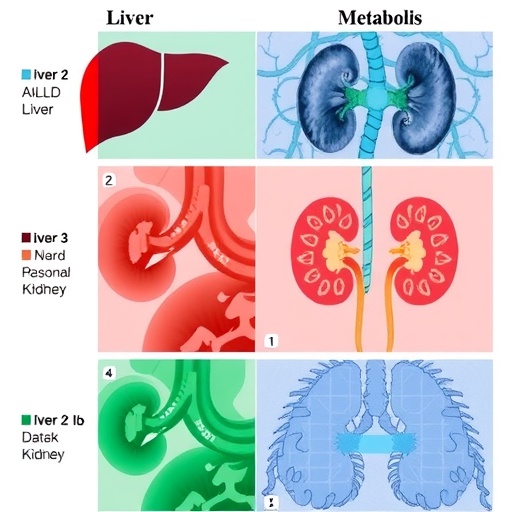
A pioneering study spearheaded by Professor Yan Bi and colleagues from Nanjing Drum Tower Hospital and Nanjing University has unveiled a transformative algorithm for the classification of metabolic-associated steatotic liver disease (MASLD). Published in the Chinese Medical Journal, this groundbreaking research introduces a data-driven multi-task deep learning LASSO model that distinguishes MASLD into four precise subtypes, providing a nuanced framework to predict both hepatic and extrahepatic disease trajectories. This approach marks a decisive leap toward precision medicine, promising enhanced clinical stratification and individualized management tailored to the complex pathophysiology of MASLD.
MASLD is recognized as a heterogeneous syndrome affecting over 30% of the global population, traditionally understood and staged through histological indices progressing from simple steatosis to metabolic dysfunction-associated steatohepatitis (MASH), fibrosis, and cirrhosis. However, the systemic nature of MASLD implicates a pronounced burden of extrahepatic complications, including cardiovascular diseases (CVD), type 2 diabetes mellitus (T2DM), and chronic kidney disease (CKD). Such clinical complexity poses a significant challenge for clinicians, who lack robust stratification tools that integrate multisystem risks. Addressing this gap, the study’s innovative classification system targets both hepatic and multisystem comorbidities, redefining MASLD management paradigms.
The study cohort comprised 1,111 biopsy-confirmed MASLD patients whose clinical data were subjected to an advanced multi-task deep LASSO algorithm aimed at feature selection. This model identified six pivotal clinical parameters: age, body mass index (BMI), glycated hemoglobin (HbA1c), triglyceride-glucose index (TyG), total cholesterol to high-density lipoprotein ratio (TC/HDL), and gamma-glutamyl transferase to platelet ratio (GGT/PLT). These biomarkers synergistically elucidate metabolic, inflammatory, and hepatic injury dimensions, serving as a foundation for cluster analysis that reliably segregated MASLD into four biologically and clinically distinct subtypes.
External validation of the clustering schema was rigorously performed in two large independent cohorts: a health check cohort comprising 6,172 adults with a MASLD prevalence of 43.9%, monitored over a 27.6-month average follow-up, and the extensive NHANES-III cohort with 7,406 participants, carrying a 37.3% MASLD prevalence and a remarkably prolonged follow-up of over two decades. The persistence of the four-cluster configuration across these divergent datasets underscores the reproducibility and generalizability of the classification model, bolstering its clinical utility.
The first cluster, comprising 41% of the studied MASLD population, was characterized by low cardiovascular risk. Individuals in this subgroup exhibited the highest proportions of subcutaneous body fat while maintaining relatively low visceral adiposity, underscoring a phenotype susceptible primarily to localized hepatic changes without significant systemic vascular risk. This delineation is crucial for avoiding overtreatment and focusing therapeutic efforts on mitigating hepatic steatosis progression.
In stark contrast, the second cluster, representing 26% of the cohort, was distinguished by a high fibrosis risk profile. This subgroup manifested marked dyslipidemia with disrupted lipid homeostasis and pronounced liver injury markers. Patients clustered here demand intensive fibrosis surveillance and potentially early antifibrotic interventions, given their predisposition to severe hepatic remodeling that drives chronic liver disease advancement.
The third cluster, making up 19% of individuals, stood out through elevated cardiovascular and renal risk burdens. This subgroup’s phenotypic signature included reduced skeletal muscle mass alongside systemic inflammatory markers, accentuating the role of sarcopenia and inflammation in orchestrating multisystem organ dysfunction. Therapeutic emphasis on modulating systemic inflammation and enhancing cardiorenal protective strategies is imperative for this cluster.
The fourth and most critically burdened cluster, encompassing 14% of the study population, harbored markedly severe insulin resistance and dysglycemia—over 98% had established diabetes mellitus. This subgroup’s defining features included substantial liver damage, elevated visceral fat, and a notably high prevalence (>70%) of risk alleles in PNPLA3, a gene implicated in lipotoxicity and fibrosis. The intersection of profound metabolic derangements and genetic susceptibility in this cluster predicates an aggressive disease phenotype with compounded risks spanning cardiovascular, hepatic, and renal systems.
Genotypic analyses revealed compelling associations between single nucleotide polymorphisms (SNPs) and disease phenotype, particularly emphasizing the PNPLA3 rs738409 variant. Carriers of this polymorphism demonstrated a dramatically heightened risk of significant fibrosis, with a 3.2-fold increase in individuals heterozygous for the G allele and a 2.7-fold increase among homozygotes. The enrichment of deleterious alleles in both Cluster 4 and Cluster 2 further reflects the genetic underpinnings shaping MASLD heterogeneity and progression pathways.
Professor Yan Bi highlighted the clinical implications of these findings, emphasizing that the algorithmic stratification empowers precision hepatology by enabling targeted, subgroup-specific interventions. For example, Cluster 2 individuals warrant prioritized fibrosis assessment protocols, while aggressive cardiorenal protective strategies should be emphasized for those in Clusters 3 and 4. Such tailored approaches promise to optimize treatment efficacy, reduce healthcare burden, and improve long-term outcomes.
The study’s innovative integration of deep learning techniques with comprehensive clinical and genetic data constitutes a paradigm shift. It transcends conventional MASLD classification based on histopathology alone, situating MASLD within a broader cardiovascular–liver–kidney–metabolic nexus. The algorithm’s capacity to synthesize multidimensional data suggests a scalable model for other complex metabolic diseases marked by systemic interplay.
From a methodological perspective, the application of a multi-task deep LASSO algorithm underscores an evolution in biomedical data analysis, facilitating simultaneous selection of salient features across heterogeneous datasets while controlling for multicollinearity and enhancing predictive power. This approach is particularly suited for complex disorders like MASLD where multifactorial influences and nonlinear interactions govern disease expression.
The robustness of the classification was ensured through replication across ethnically and clinically diverse populations, a critical step toward universal applicability. Furthermore, leveraging readily available clinical parameters for subtype assignment facilitates straightforward clinical translation, obviating the need for invasive biopsies or costly molecular assays.
Looking forward, this stratification framework opens avenues for prospective trials testing individualized therapeutic regimens and closer monitoring aligned with cluster-specific risk profiles. Additionally, incorporating emerging biomarkers and longitudinal omics data could refine these subtyping algorithms, propelling personalized medicine into routine hepatology practice.
In conclusion, this landmark research articulates a sophisticated yet clinically actionable MASLD classification system grounded in machine learning and integrated clinical-genetic analyses. The algorithm heralds a new era in chronic liver disease management, emphasizing the interwoven nature of hepatic and systemic metabolic dysregulation and underpinning the critical need for precision-guided interventions in combating this globally pervasive health threat.
News Publication Date: 28-Jan-2026
Web References:
https://journals.lww.com/cmj/fulltext/9900/data_driven_classification_of_metabolic_associated.1919.aspx
References:
DOI: 10.1097/CM9.0000000000003984
Cite Scienmag News
Blake Davidson. (March 26, 2026). Deep Learning Reveals Four Distinct MASLD Subtypes for Tailored Cardiovascular, Liver, Kidney, and Metabolic Care. Scienmag. https://scienmag.com/deep-learning-reveals-four-distinct-masld-subtypes-for-tailored-cardiovascular-liver-kidney-and-metabolic-care/
Blake Davidson. "Deep Learning Reveals Four Distinct MASLD Subtypes for Tailored Cardiovascular, Liver, Kidney, and Metabolic Care." Scienmag, 26 March 2026, https://scienmag.com/deep-learning-reveals-four-distinct-masld-subtypes-for-tailored-cardiovascular-liver-kidney-and-metabolic-care/. Accessed 3 September 2026.
Blake Davidson. "Deep Learning Reveals Four Distinct MASLD Subtypes for Tailored Cardiovascular, Liver, Kidney, and Metabolic Care." Scienmag. March 26, 2026. https://scienmag.com/deep-learning-reveals-four-distinct-masld-subtypes-for-tailored-cardiovascular-liver-kidney-and-metabolic-care/


