


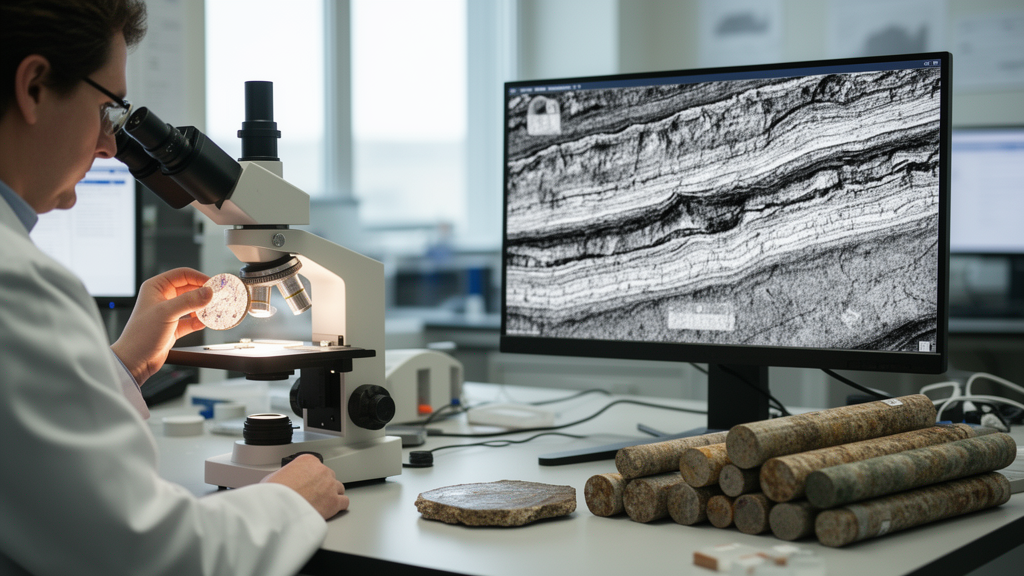
Researchers have put seventeen of the most widely used deep learning architectures through a single, tightly controlled test to answer a deceptively simple question: which convolutional neural network reads a rock scan best? The new benchmark, published in Earth Science Informatics, trained each model to classify high-resolution grayscale slices from micro-computed tomography (µCT) images of sandstone, limestone, and shale, and found that densely connected networks such as DenseNet169, DenseNet201, and DenseNet121 delivered the most stable and accurate results, with mean accuracy values close to or above 0.99 across validation folds. The motivation stems from a long-standing problem in reservoir characterization.
Sandstones, carbonates, and shales host the bulk of the world's oil and gas resources, and increasingly serve as targets for carbon dioxide and hydrogen storage as well as geothermal energy development. Properties such as porosity, permeability, and capillary pressure depend directly on lithology, yet the traditional tools used to pin that down—polarized-light petrography, X-ray diffraction, scanning electron microscopy, and mercury intrusion porosimetry—are slow, sometimes destructive, dependent on scarce expert personnel, and open to subjective interpretation. Micro-CT offers a way out: it images rock interiors non-destructively at micrometer resolution in three dimensions, and when paired with machine learning it promises faster, cheaper, and more objective analysis of the pore–matrix textures that define a reservoir rock.
What makes the new study unusual is its discipline. Rather than expanding the number of rock classes or chasing ever-larger datasets, the team built a controlled benchmarking framework in which every variable except the network architecture was held constant. The dataset comprised 52,706 two-dimensional grayscale µCT slices drawn from 35 physical specimens: 11 sandstone samples, 16 limestone samples, and 8 shale plugs extracted from a single core.
The sandstone images came from a public Digital Rocks Portal project scanned at 2.25 micrometers per voxel on a Bruker Skyscan 1272 system; the limestone images came from a second public collection of 16 Brazilian pre-salt carbonates scanned at 6 to 8 micrometers; and the shale images were acquired in-house from bituminous shales of the Aptian Ipubi Formation in the Araripe Basin of northeastern Brazil, using a Nikon XTH 225 ST scanner at 2.50 micrometers per voxel. Every image followed the same preprocessing pipeline. Slices were converted to 8-bit grayscale, cropped to 1000 by 1000 pixels, and then resized to 224 by 224 pixels using an area-like BOX resampling filter—a deliberate choice to avoid the aliasing artifacts that nearest-neighbor downsampling can introduce when shrinking detailed microstructural images.
Pixel intensities were normalized to the range of zero to one, and no architecture-specific preprocessing was applied. Each of the seventeen pretrained networks, ranging from ResNet and VGG families to DenseNet, Inception, MobileNet, NASNet, and Xception, had its original classification layers removed and replaced with an identical custom head: a global average pooling layer, a dense layer of 1024 neurons with ReLU activation, and a final three-neuron softmax layer naming the rock class. Perhaps the most consequential design decision was the validation scheme.
Because the dataset consists of thousands of adjacent slices cut from a small number of physical samples, a naive random split would let near-identical images appear in both training and test sets, inflating apparent accuracy through what the authors call slice-level pseudoreplication. To counter this, the team used specimen-level grouped three-fold cross-validation: all slices from a given sandstone sample, limestone sample, or shale plug were confined to a single partition in each fold. The convolutional backbones were kept frozen throughout, with only the new classification heads trained, so that differences among models would reflect their behavior as fixed ImageNet-pretrained feature extractors rather than the vagaries of architecture-specific fine-tuning schedules.
Training ran for 20 epochs per fold with a batch size of 16, categorical cross-entropy loss, and the Adam optimizer, augmented by random rotations, flips, shifts, shearing, and zooming of the training images. The results were striking in their stratification. DenseNet169 achieved the best overall performance, followed closely by DenseNet201 and DenseNet121, and a broad group including InceptionV3, InceptionResNetV2, Xception, NASNetMobile, NASNetLarge, and several MobileNet variants also reached mean accuracies near or above 0.99 with low fold-to-fold variability.
At the other end, seven models fell below that threshold, with the ResNet family showing the most pronounced degradation: ResNet101 recorded the lowest mean accuracy at 0.8937 plus or minus 0.0445, a weighted F1-score of 0.8896, and a mean per-class accuracy of 0.8695. VGG16 and VGG19 were similarly less stable. Notably, training time did not explain the ranking—most models required roughly 1.6 to 1.9 hours per fold on a single NVIDIA GeForce RTX 3060, and DenseNet169 combined top performance with one of the shortest training times, while ResNet101 delivered the weakest results at comparable computational cost.
Class-wise analysis sharpened the picture. Shale was the most consistently recognized category across nearly all architectures, though the authors caution that all shale images came from eight plugs of a single core, which limits the geological variability the models had to handle. The real fault line ran between limestone and sandstone.
In the less stable networks, confusion matrices showed limestone slices being predicted as sandstone and, in the case of VGG19, a substantial fraction of sandstone images drifting into the limestone column. The researchers attribute this to genuinely overlapping grayscale textures: both lithologies can display heterogeneous pore–matrix arrangements, irregular pore spaces, and locally granular patterns in two-dimensional cross-sections, making the boundary genuinely ambiguous at the slice level rather than a simple model failure. Gradient-weighted Class Activation Mapping, or Grad-CAM, added a visual dimension to the diagnosis.
Comparing DenseNet121, InceptionV3, and ResNet101 on representative test images, the heatmaps showed that all three models based their predictions on spatially distributed textural regions rather than single object-like features, consistent with the texture-dominated nature of µCT rock imagery. In one telling case, a limestone image correctly classified with maximum confidence by DenseNet121 and InceptionV3 was misclassified as sandstone by ResNet101, whose activation map concentrated on localized regions resembling sandstone-like granular textures. The authors emphasize that Grad-CAM does not identify pores, grains, or minerals directly; it only visualizes which image regions drove each prediction, but the pattern supports the idea that sandstone–limestone confusion arises from local microtextural overlap rather than random error.
The benchmark also situates itself within a growing literature. Previous studies have reported accuracies above 90 percent for CNN classification of petrographic thin sections, up to 92 percent for carbonate core images with Inception-v3, and strong permeability prediction from micro-CT scans, while a 2024 workflow combining µCT imaging of 130 core plugs with ResNet-50 transfer learning reached similar conclusions about the difficulty of sandstone textures. The new results converge with those findings on several fronts: the recurring effectiveness of InceptionV3, the role of intra-class variability in misclassification, and the overfitting risk in small datasets noted by earlier carbonate classification studies.
The authors are careful about the limits of their claims. The dataset covers only three end-member lithologies without mixed or transitional rocks such as shaly sandstones or siliciclastic-bearing limestones; the shale class derives from a single core; the class distribution is imbalanced, with limestone accounting for 48 percent of images and sandstone only 21 percent; and the closed-set design never tested the models against unknown lithologies, reconstruction artifacts, or out-of-distribution inputs. Because backbones were frozen, the ranking applies specifically to that transfer-learning setting and may change under full fine-tuning.
Two-dimensional slices also discard information on pore connectivity and spatial continuity that matters for permeability prediction and fracture characterization. Future work, the team suggests, could extend the framework to additional lithologies, segmentation-based feature-aware classification, and 2.5D or fully three-dimensional learning strategies that exploit volumetric connectivity—steps toward integrating deep learning more fully into digital rock analysis and reservoir characterization workflows.
Subject of Research: Benchmarking deep convolutional neural network architectures for classifying sandstone, limestone, and shale from micro-CT rock images
Article Title: Benchmarking deep CNN architectures for micro-CT rock image classification
Article References: Pérez, D. M., Rodríguez, A. G., Proenza, Y. G., Duarte, D. A., da Silva, M. A. B., de la Noval, F. L. M., Barbosa, J. A., Martyushev, D. A., & Antonino, A. C. D. (2026). Benchmarking deep CNN architectures for micro-CT rock image classification. Earth Science Informatics, 19(12), Article 229. https://doi.org/10.1007/s12145-026-02285-6
Image Credits: AI Generated
DOI: 10.1007/s12145-026-02285-6
Keywords: micro-CT, convolutional neural networks, rock classification, DenseNet, transfer learning, digital rock physics, reservoir characterization, sandstone, limestone, shale, cross-validation, Grad-CAM
Cite Scienmag News
Violet Maxwell. (October 27, 2026). Deep Learning Benchmark Reveals Which Neural Networks Read Rock Scans Best. Scienmag. https://scienmag.com/deep-learning-benchmark-reveals-which-neural-networks-read-rock-scans-best/
Violet Maxwell. "Deep Learning Benchmark Reveals Which Neural Networks Read Rock Scans Best." Scienmag, 27 October 2026, https://scienmag.com/deep-learning-benchmark-reveals-which-neural-networks-read-rock-scans-best/. Accessed 27 October 2026.
Violet Maxwell. "Deep Learning Benchmark Reveals Which Neural Networks Read Rock Scans Best." Scienmag. October 27, 2026. https://scienmag.com/deep-learning-benchmark-reveals-which-neural-networks-read-rock-scans-best/


