


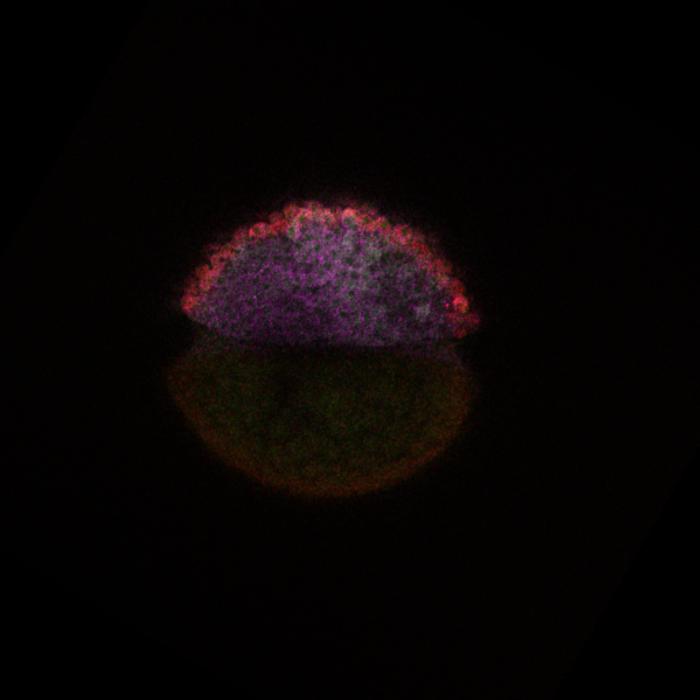
A new study at Hebrew University reveals insights into mRNA regulation during embryonic development. The study combines single-cell RNA-Seq and metabolic labeling in zebrafish embryos, distinguishing between newly-transcribed and pre-existing mRNA. This approach quantifies mRNA transcription and degradation rates within individual cell types, uncovering varied regulatory rates across genes and cell-type-specific differences in degradation. Understanding mRNA regulation during embryonic development helps decipher how genes are turned on and off in specific cells at precise times, informing our understanding of development, cell fate decisions, and potential applications in medicine and biology.

Credit: Dr Jeffrey Farrell, NIH
A new study at Hebrew University reveals insights into mRNA regulation during embryonic development. The study combines single-cell RNA-Seq and metabolic labeling in zebrafish embryos, distinguishing between newly-transcribed and pre-existing mRNA. This approach quantifies mRNA transcription and degradation rates within individual cell types, uncovering varied regulatory rates across genes and cell-type-specific differences in degradation. Understanding mRNA regulation during embryonic development helps decipher how genes are turned on and off in specific cells at precise times, informing our understanding of development, cell fate decisions, and potential applications in medicine and biology.
A new study led by PhD Student Lior Fishman and team under the guidance of researcher Dr. Michal Rabani from The Alexander Silberman Institute of Life Science at Hebrew University, and in collaboration with researchers from the National Institutes of Health in the USA, sheds light on the intricate process of mRNA regulation during embryonic development, providing novel insights into how pluripotent cells adopt specialized identities through gene expression.
Embryonic development involves pluripotent cells assuming specialized identities by adopting particular gene expression profiles. However, understanding the relative contributions of mRNA transcription and degradation to shaping these profiles has been challenging, particularly within embryos with diverse cellular identities.
In the study, researchers used a technique called single-cell RNA sequencing along with metabolic labelling to track how genes are turned on and off over time in zebrafish embryos. They could tell apart the mRNA that was made new (from the embryo itself) and the mRNA that was already there (from the mother). Using mathematical models, they measured how fast genes were turned on and off in different types of cells as they developed.
The results of the study reveal highly varied regulatory rates across thousands of genes. The researchers observed coordinated transcription and destruction rates for many transcripts and linked differences in degradation to specific sequence elements. Importantly, they identified cell-type-specific differences in degradation, including selective retention of maternal transcripts within primordial germ cells and enveloping layer cells, two of the earliest specified cell types.
Dr. Michal Rabani, senior author of the study, commented, “Our study provides a quantitative approach to studying mRNA regulation during a dynamic spatio-temporal response. This work opens up new avenues for understanding the molecular mechanisms underlying cell fate determination during embryonic development.”
The findings of this study contribute to a deeper understanding of mRNA regulation and its role in shaping cellular identities during embryonic development. The research team hopes that their work will pave the way for future studies aimed at unraveling the complexities of gene expression regulation in various biological contexts.
Journal
Nature Communications
Method of Research
Data/statistical analysis
Subject of Research
Animals
Article Title
Cell-type-specific mRNA transcription and degradation kinetics in zebrafish embryogenesis from metabolically labeled single-cell RNA-seq
Article Publication Date
10-Apr-2024
Cite Scienmag News
Drew Townsend. (May 7, 2024). Decoding development: mRNA’s role in embryo formation. Scienmag. https://scienmag.com/decoding-development-mrnas-role-in-embryo-formation/
Drew Townsend. "Decoding development: mRNA’s role in embryo formation." Scienmag, 7 May 2024, https://scienmag.com/decoding-development-mrnas-role-in-embryo-formation/. Accessed 3 September 2026.
Drew Townsend. "Decoding development: mRNA’s role in embryo formation." Scienmag. May 7, 2024. https://scienmag.com/decoding-development-mrnas-role-in-embryo-formation/

